


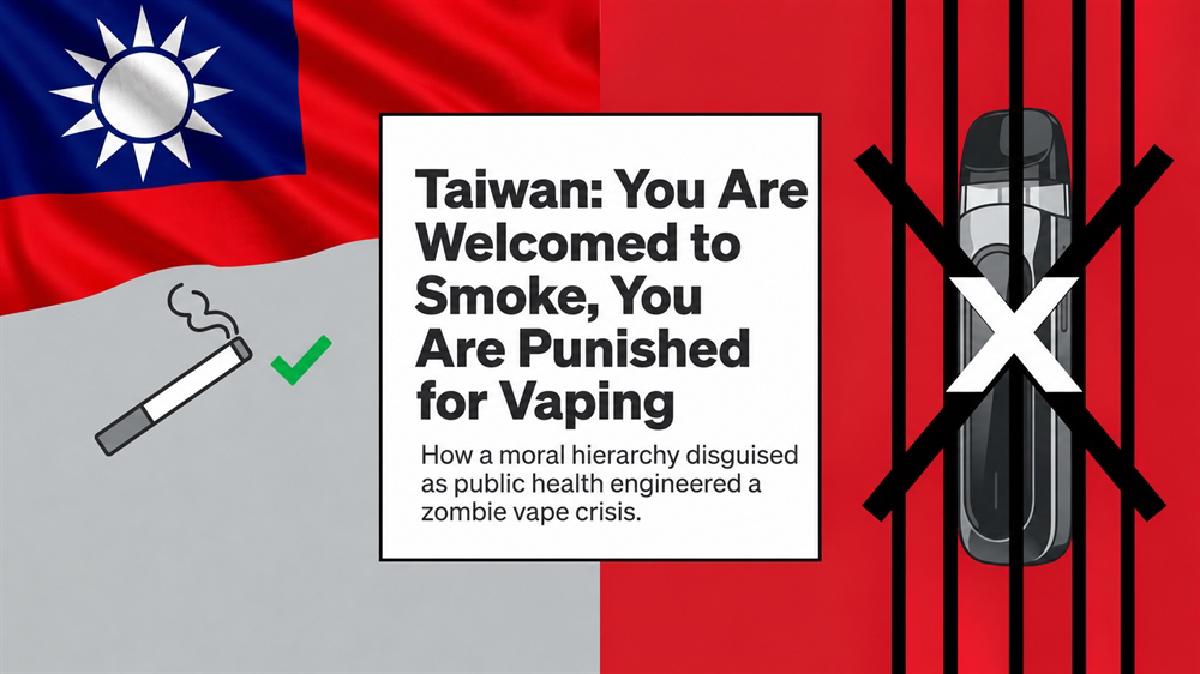

Taiwan: You Are Welcomed to Smoke, You Are Punished for Vaping#
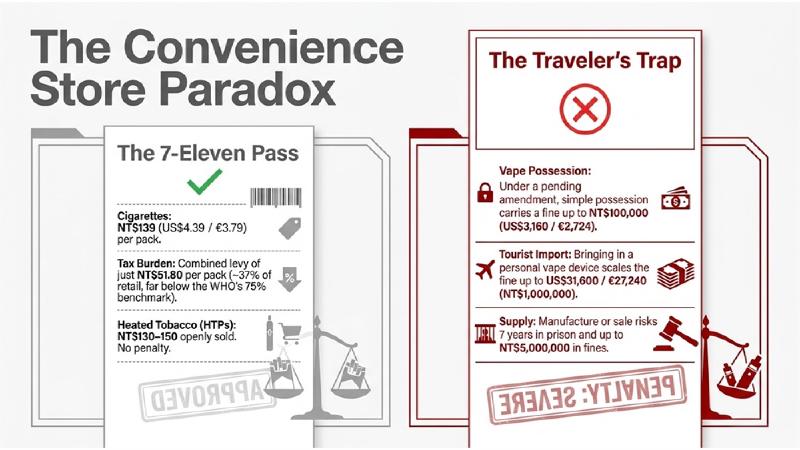
Bottom line: Walk into any 7-Eleven in Taipei and you can buy a pack of cigarettes, the deadliest nicotine product, for about US$4.40 (€3.79), no questions asked beyond your age. They are consumed by ~13% of the population. Walk out with a vape in your pocket, and you are now a criminal. Under an amendment currently moving through Taiwan’s Legislative Yuan, simply possessing an e-cigarette will carry a fine of up to NT$100,000 — roughly US$3,160 / €2,724 — plus confiscation. Import a handful of devices as a traveler, and the fine climbs to US$31,600 / €27,240. Manufacture or sell one, and you’re looking at seven years in prison. This is not harm reduction policy. It is harm-maximization policy, it is a moral hierarchy dressed up as public health policy. It punishes smokers who switched, and sends a clear message: the deadliest nicotine product is the only permitted one. And it is about to make Taiwan’s drug problem worse, not better.
Is Taiwan Welcoming Smoking?#
It looks like they are doing exactly that. A pack of cigarettes costs about NT$139 (US$4.39 / €3.79) in Taipei. Strip out the tobacco tax and health surcharge — NT$1,590 and NT$1,000 per 1,000 cigarettes respectively — and the combined levy comes to just NT$51.80 per pack, or roughly 37% of retail price. The World Health Organization’s own benchmark for effective tobacco tax policy is 75% of retail price. Taiwan isn’t close. Anti-smoking advocates at the John Tung Foundation have been begging the government for years to triple the price to NT$400 (US$12.64 / €10.90) by 2035, and have been largely ignored.
Heated tobacco is sold openly at 7-Eleven and Family Mart for the same NT$130–150 as a pack of cigarettes — gets a pass, presumably because it still contains tobacco. But vaping is treated as more dangerous than the cigarette sitting next to it on the shelf. A product containing no tobacco and producing no smoke, no tar, and none of the combustion byproducts responsible for the overwhelming majority of smoking-related death and disease, is considered the pulic health threat. Possess one and the fine alone, before you even get to the manufacturing and import penalties which run as high as NT$5,000,000 (roughly US$156,500 / €134,900), is worth 700 packs of cigarettes.
If you built a regulatory system from scratch with the explicit goal of keeping people smoking, this is roughly what it would look like.
“Zombie vapes”: exactly what you get when you ban the less harmful product#
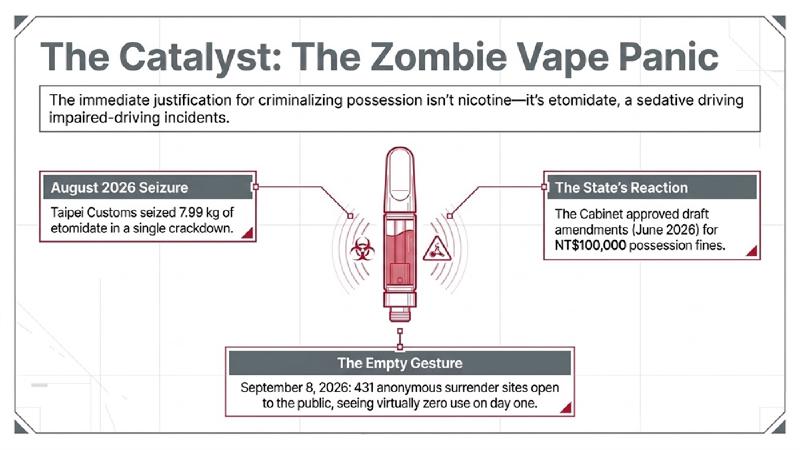
The immediate justification for criminalizing vape possession isn’t nicotine at all. It’s etomidate, a sedative that has been showing up in illicit vape cartridges and driving impaired-driving incidents across the country. Taipei Customs seized nearly 8 kilograms of the drug in a single crackdown in August 2026. The government’s response has been to treat this as a reason to escalate the ban.
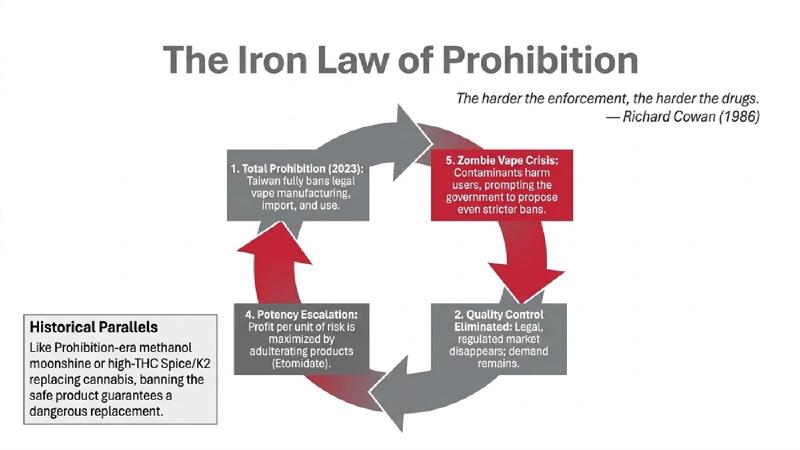
It is, in fact, the opposite. A recently published academic analysis in Harm Reduction Journal revisits a concept coined by drug-policy writer Richard Cowan back in 1986: the Iron Law of Prohibition:
“The harder the enforcement, the harder the drugs.”
When you ban a low-risk product outright, you don’t eliminate demand for it; you hand the entire supply chain to criminal networks who have every incentive to make their product more potent, more compact, and easier to smuggle, because that maximizes profit per unit of enforcement risk. The paper’s example is Prohibition-era America, where banning beer and wine didn’t stop drinking — it replaced low-proof, bulky alcohol with high-proof spirits and methanol-laced moonshine that blinded and killed people. The same mechanism has already played out with cannabis: decades of prohibition didn’t eliminate use, it pushed the market from imported low-THC hashish toward domestically grown, high-potency “skunk,” and later toward synthetic cannabinoids like Spice and K2 that are far more dangerous than the plant they were designed to replace.
Taiwan’s vaping market has been fully illegal since 2023 — manufacture, import, sale, and use all banned outright, with no legal, regulated, quality-controlled alternative for anyone who wants a lower-risk nicotine product than a cigarette. That’s not an accident of the etomidate crisis; it’s the precondition for it. When there is no legal vape market, there is no quality control, no ingredient verification, no accountable manufacturer, and no barrier stopping a cartridge from being spiked with whatever a criminal supplier wants to put in it. Taiwan didn’t get a “zombie vape” problem despite banning vaping. It got one because it banned vaping. Now the government’s proposed fix for a black market it created is more prohibition — new fines, new criminal penalties, a nationwide device-surrender campaign — which, if the Iron Law holds, will simply push the same dynamic further underground rather than reverse it.
None of this is a defense of etomidate-laced cartridges. It’s an observation that you don’t fix an adulterated black market by making the legal alternative more dangerous to possess than the adulteration itself.
Taiwan’s risk-inverted nicotine hierarchy#
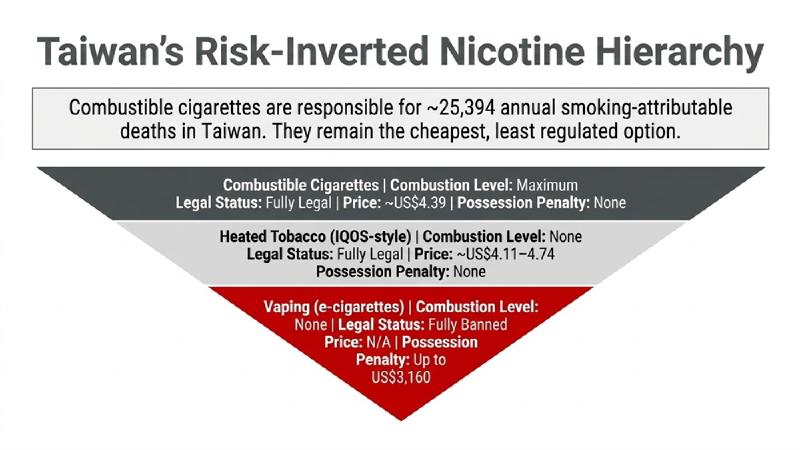
Line the three product categories up by legal status and price, and Taiwan’s regulatory logic looks inverted relative to relative product risk as commonly assessed in tobacco harm reduction research:
| Product | Legal status | Price (pack/device) | Penalty for simple possession |
|---|---|---|---|
| Combustible cigarettes | Fully legal | ~US$4.39 / €3.79 | None |
| Heated tobacco (IQOS-style) | Fully legal | ~US$4.11–4.74 / €3.54–4.09 | None |
| Vaping (e-cigarettes) | Fully banned | N/A (no legal market) | Up to US$3,160 / €2,724 |
The product responsible for the overwhelming share of Taiwan’s roughly 25,000 annual smoking-attributable deaths (GSTHR) remains the cheapest and least regulated option on this table, while the product with the harshest possession penalty is the one that produces no combustion at all. Does this ordering reflect\ the current evidence base on relative risk? Not at all.
Why this is not public health — it is anti-harm reduction#
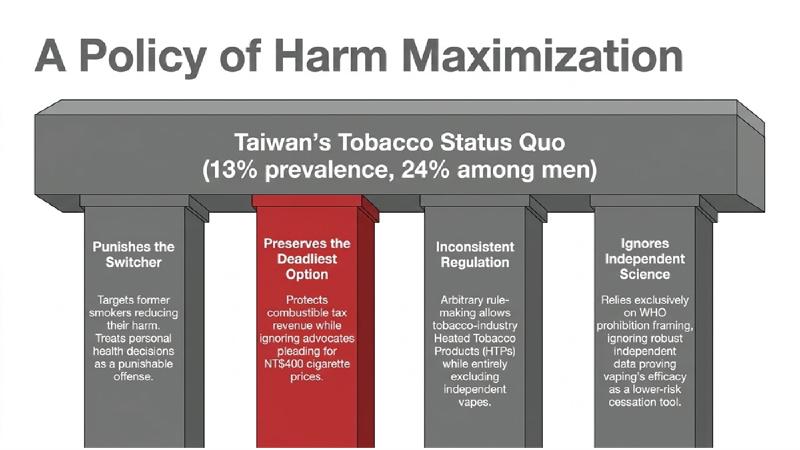
Taiwan’s smoking prevalence is ~13% nationally, nearly 24% among men. With millions of smokers, a rational harm-reduction strategy would expand lower-risk alternatives. Taiwan does the opposite:
- Punishes users of the lower-risk product. Possession fines mean the user, often a former smoker who switched, is the target. Not the supplier. The state treats the decision to reduce harm as a punishable offense.
- Preserves the deadliest option. Cigarettes remain legal, available at every convenience store, generating tax revenue that funds health agencies. The message is unambiguous: tobacco is welcome; harm reduction is not.
- Inconsistent regulation of lower-risk products. HTPs — permitted. Vapes — banned. Both are lower-risk than combustible tobacco. The distinction is not risk-based; it reflects regulatory capture (tobacco/HTP industry permitted; independent vape industry excluded) and pharmaceutical-industry control over nicotine delivery, as THR advocates in Taiwan have publicly stated.
Who actually pays for this?#
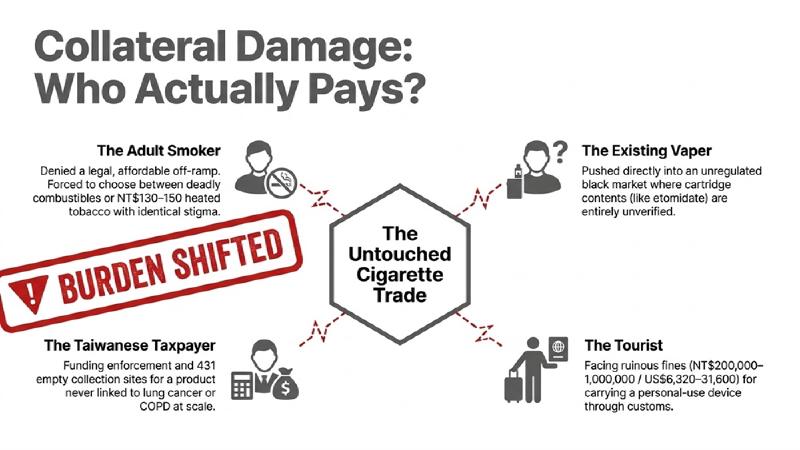
- Adult smokers who are deprived of a legal lower-risk off-ramp because the cheaper, well-documented cessation tool, vaping, is a felony to possess.
- Existing vapers, some of whom will simply keep using devices now sourced from an unregulated market where nobody is checking what’s actually in the cartridge or where it came from.
- Taiwanese taxpayers, who are funding 431 collection sites, an enforcement apparatus, and a Legislative Yuan review process to police a product that, unlike cigarettes, was never associated with lung cancer, COPD, or cardiovascular disease at anything close to the same scale.
- Travelers and tourists, who can now be fined the equivalent of a used car for carrying personal vape devices through customs.
Meanwhile the surrender boxes that opened on September 8, 2026 reportedly saw barely any use on their first day — which should surprise no one. People do not voluntarily walk into a government building to confess to owning something the government has just decided to fine them tens of thousands of dollars for possessing.
What a serious policy would look like?#
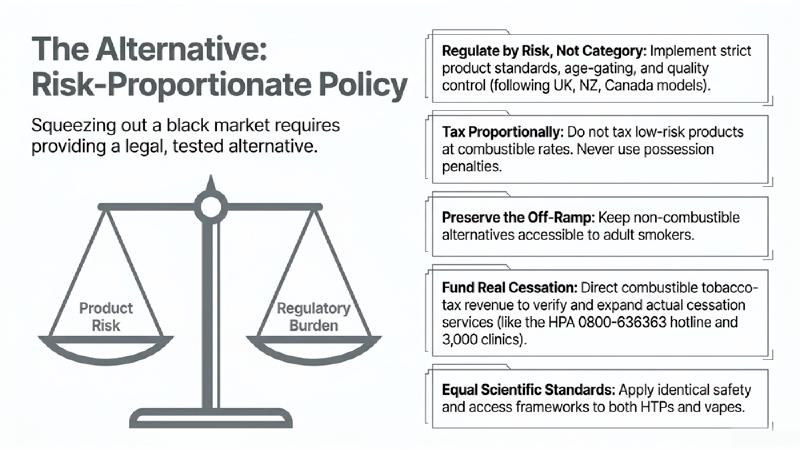
Nobody is arguing Taiwan should ignore etomidate-laced cartridges, or that vaping is risk-free. The argument is that the tool being used, blanket prohibition of the entire product category backed by fines and criminalization for possession that dwarf anything applied to cigarettes, is the one tool with a century-long track record of making exactly this kind of problem worse. A risk-proportionate approach would look almost the opposite of what Taiwan is doing:
- Regulate vapes by risk, not ban them by category. Require product standards, age-gating, and quality control (as the UK, New Zealand and Canada have done).
- Tax lower-risk products proportionally to risk, not at the same rate as combustibles, and certainly not with possession penalties.
- Preserve access for adult smokers who have switched. Not force them back to cigarettes or underground markets.
- Direct tobacco-tax revenue toward verified cessation services.
- Apply the same scientific standard to HTPs and vapes. Both are lower-risk than combustible; neither should be banned while cigarettes are sold.
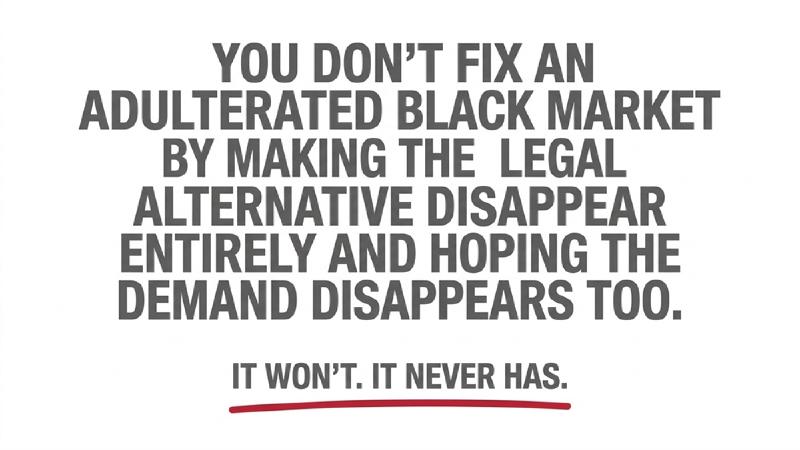
That’s how you squeeze out an adulterated black market — by giving people a legal, tested alternative to buy instead, not by making the legal alternative disappear entirely and hoping the demand for it disappears too.
It won’t. It never has.
FAQ#
Is it illegal to vape in Taiwan as a tourist? Yes. The ban applies to use and possession regardless of nationality, and travelers carrying vape devices into Taiwan face fines of NT$200,000–1,000,000 (US$6,320–31,600 / €5,448–27,240) once the pending amendment takes effect, even for small personal quantities.
How much is a pack of cigarettes in Taiwan in dollars? About US$4.39 (€3.79) in Taipei, based on an average price of NT$139 per pack of 20.
Can you buy heated tobacco in Taiwan? Yes. Heated tobacco products are legal and sold at major convenience store chains like 7-Eleven and Family Mart for roughly US$4.11–4.74 (€3.54–4.09) per pack, unlike vaping devices, which are banned outright.
What is a “zombie vape,” and is banning vapes the fix? It’s a vape cartridge adulterated with etomidate, a sedative linked to impaired-driving incidents in Taiwan. The evidence from a century of drug prohibition — alcohol in the 1920s, cannabis for decades after — suggests banning the underlying product category makes contamination and potency escalation more likely, not less, because it hands the entire supply chain to unregulated suppliers.
Has Taiwan’s vape possession fine become law yet? Not as of this writing. The Cabinet approved the draft amendment on June 25, 2026, and it remains under review in the Legislative Yuan. The 431 surrender sites opened September 8, 2026, ahead of the law’s expected passage.
Sources#
- Focus Taiwan — “Taiwan to set up 431 vape surrender sites from Sept. 8”
- Focus Taiwan — “Cabinet seeks tougher penalties on e-cigarettes to curb etomidate use”
- Taiwan News — “Taiwan Cabinet backs NT$100,000 fine for vape possession”
- SEATCA — “Taiwan Cabinet backs NT$100,000 fine for vape possession”
- Taipei Times — “HPA to set up anonymous e-cigarette disposal spots”
- Taipei Times — “E-cigarette disposal boxes see little use on first day”
- Taipei Times — “Health ministry plans confiscation, fines for e-cigarette possession”
- Taipei Times — “Taipei Customs seizes 7.99kg of etomidate in vape crackdown”
- Taipei Times — “Group pushes more tobacco tax”
- Tobacco Reporter — “Taiwan Plans Confiscation and Fines for E-Cigarette Possession”
- Tobacco Insider — “Tobacco Regulation: Asia”
- Tobacco Control Laws — Taiwan (China) Legal Summary
- Global State of Tobacco Harm Reduction — Taiwan country profile
- Global State of Tobacco Harm Reduction — Taiwan cigarettes profile
- Global State of Tobacco Harm Reduction — Taiwan e-cigarettes profile
- Taichung Customs — Declaration of Tobacco Products and Alcohols (official tax schedule)
- Expatistan — Cigarette prices in Taipei
- RELX Vape — “Taiwan E-Cigarette Ban 2026: Guide for Residents and Travelers”
- Trading Economics — Taiwan Dollar exchange rate
- European Central Bank — Euro/USD reference rate