


On 6 October 2026, health ministers from the Netherlands, Belgium, Finland, France, Hungary, Latvia, Slovenia, and Spain sent a joint letter to Commissioner Olivér Várhelyi. They framed it as a wish list for revising the Tobacco Products Directive (TPD) and the Tobacco Advertising Directive (TAD), claiming it paves the way for a smoke-free generation by 2040. In reality, it is the exact opposite. If adopted as written, this letter would fail to deliver a smoke-free Europe. Instead, it would shield cigarettes from competition, hand a ready-made market to criminals, and leave millions of smokers with a single legal nicotine product: the one that kills them. Everyone who cares about public health, whether they are authors of that letter or this post, shares the same ultimate goal: cutting smoking-related death and disease. The disagreement lies solely in the means. The letter’s proposed measures have already been tried, in whole or in part, in other countries. They failed, and the evidence is in plain sight.
What the letter actually asks for#
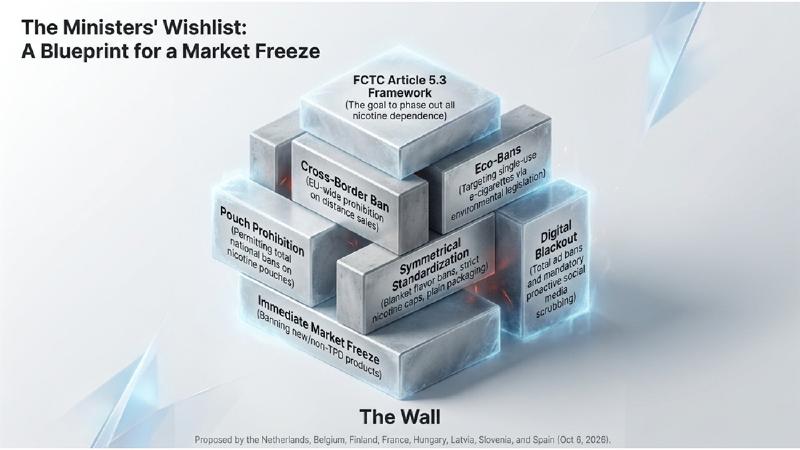
This letter urges the Commission to take seven concrete steps.
1. It demands an immediate market freeze: every non-TPD-regulated nicotine product and every device delivering it must be banned as a consumer good. This extends even to items with no nicotine that simply mimic their regulated counterparts.
2. It calls for strict caps on nicotine levels, a blanket ban on flavors, and the standardization of all products and devices, enforced through plain packaging rules.
3. It asks that Member States be permitted to implement total national bans on nicotine pouches alongside stringent restrictions on other tobacco-free nicotine products.
4. It demands that advertising bans should expand to cover every product, device, and channel, compelling social media platforms to proactively delete such content and stop it from being uploaded at all.
5. It seeks an EU-wide prohibition on cross-border distance sales.
6. It requests the ability for national bans grounded in environmental concerns, specifically targeting single-use e-cigarettes.
7. It asks these actions should all be framed within Article 5.3 of the WHO FCTC, adhering to both its letter and spirit, with the ultimate goal of phasing out nicotine dependence across the Union.
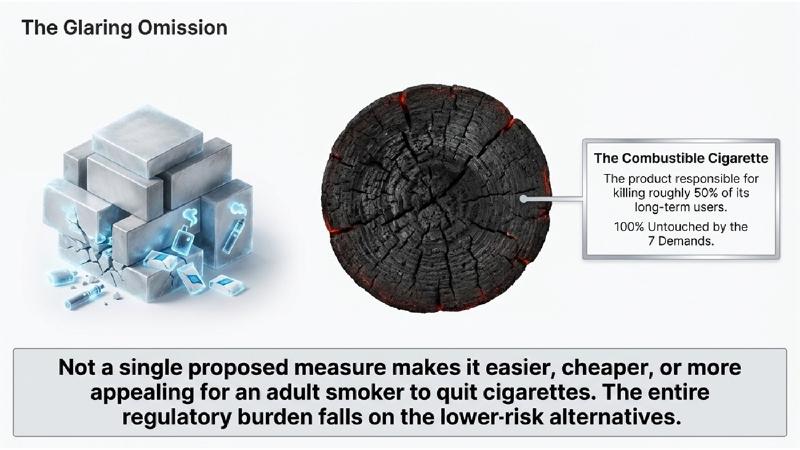
Yet there is one crucial demand missing from this letter: a single measure that would make it easier, cheaper, or more appealing for an adult smoker to quit cigarettes. Every proposal focuses on restricting the lower-risk alternatives. Nothing addresses the cigarette itself, the product responsible for killing roughly half of its long-term users.
1. The “market freeze” freezes the cigarette in place#
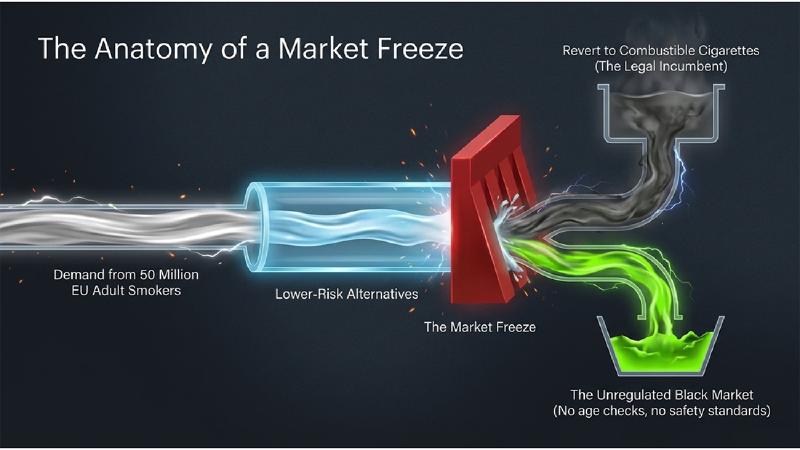
The letter wants to ensure that no new product containing nicotine, or a nicotine-like substance, or resembling such a product, can ever enter the EU market. It frames this as ending the industry’s ability to “get young people addicted”.
Consider what a freeze does in practice. It does not remove nicotine from the market. It removes competition for the most dangerous way of consuming it. Combustible cigarettes are the incumbent. They are on every high street, and they are legal. A freeze guarantees that whatever innovation is coming, including products that could be far safer than smoking, is barred from the legal market before anyone has examined its risk profile.
That is not a precautionary principle. A precautionary principle weighs risk against risk. This one weighs a hypothetical risk from products that do not yet exist against a certain, enormous, ongoing risk from the product that does. The letter’s own logic would have banned the nicotine patch, nicotine gum and the first generation of e-cigarettes had it been applied to them.
There is also a basic proportionality problem. Banning products “that contain neither nicotine nor nicotine-like substance but resemble products that do” criminalizes things that cannot, by definition, deliver nicotine at all. It is regulation by appearance.
2. Flavors, nicotine caps, plain packs and standardized devices: making the safer choice the worse choice#
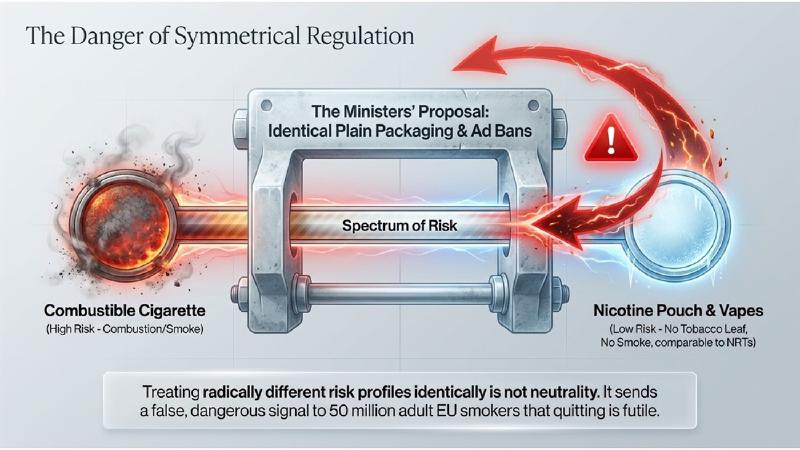
The letter proposes a sweeping ban on flavors, strict nicotine ceilings for all items, plain packaging, and standardized devices. It demands that every product be regulated “to the same extent” to stop switching between categories. Take that final phrase seriously. The stated aim is to block smokers from moving between product types. Yet, moving from cigarettes to lower-risk options is precisely what saves lives. Regulating a cigarette and a pouch equally ignores the reality that their risks are vastly different. Treating radically different risk profiles identically isn’t neutrality; it’s a signal to smokers that switching is futile.
Flavors aren’t a youth gimmick; they are the mechanism for adult switching. Adult smokers who transition to vaping overwhelmingly choose non-tobacco flavors, and many credit these flavors with helping them leave cigarettes behind—a tobacco-flavored vape often tastes too much like the habit they’re trying to escape. A broad flavor ban removes the very feature that makes alternatives work for adults while doing little to stop determined teenagers, who will simply find flavored products on the illicit market.
Nicotine caps undermine safer products. A smoker accustomed to 20 cigarettes a day won’t be satisfied by a product that fails to deliver nicotine at a comparable level. Under-dosing doesn’t help people quit; it drives them to keep smoking in parallel, revert to old habits, or seek out products elsewhere that actually work.
Plain packaging and standardized devices for harm-reduction products erase the single thing that lets an adult smoker distinguish a legal, tested product from an unregulated one: the brand, the labeling, and the information. In a market where the black market is already the primary competitor, removing legitimate differentiation is a gift to illicit sellers.
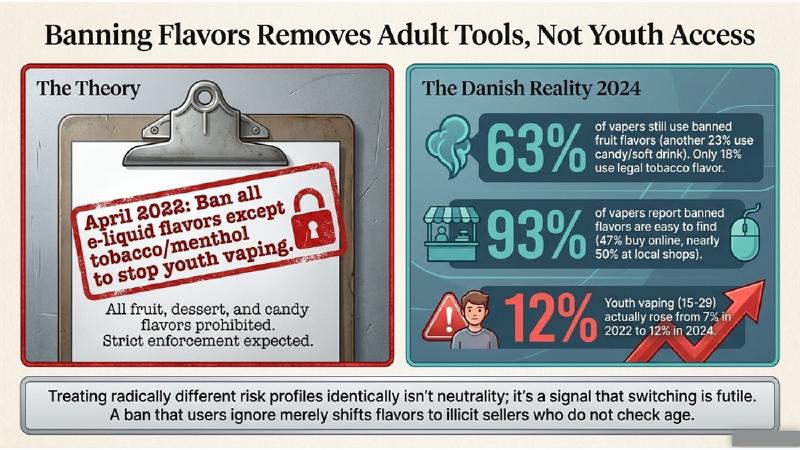
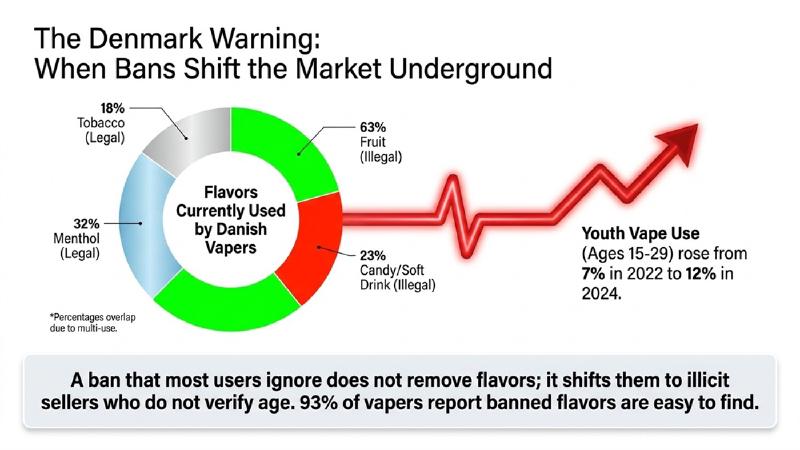
Denmark offers a live case study. In April 2022, it banned every e-liquid flavor except tobacco and menthol and added a tax on nicotine e-liquids. The Danish Health Authority’s 2024 survey of smoking habits, covering more than 10,600 people aged 15 to 79, reveals what followed. Of the fruit flavors now illegal, 63% of vapers used them, while another 23% used candy or soft-drink flavors. Only 32% used menthol and 18% used tobacco flavor. An earlier Ipsos poll commissioned by the Tholos Foundation found that 93% of Danish vapers said banned flavors were easy to find, with nearly half buying them at local shops and 47% online. Only 16% of vapers supported the ban, and 81% stated flavors were important to their decision to vape.
A ban that most users ignore does not remove flavors from the market; it shifts them to sellers who check nobody’s age. Meanwhile, vape use among 15 to 29-year-olds in Denmark rose from 7% in 2022 to 12% in 2024. The same survey shows smoking down two points while vaping rose by two, and 52% of daily vapers say they vape to smoke less. These are the adults for whom these products work, yet they are the people the ban hurts most. Denmark’s response was to tighten further: new rules from July 2025 cap pouch nicotine content, ban flavors in pouches, and restrict labeling, all while cigarettes remain on every shelf.
3. Nicotine pouches: banning the Swedish solution#
The pouch section of the letter stands out as its most revealing—and troubling—part. It displays a startling lack of empathy for smokers and a noticeable absence of common sense. It points out that oral tobacco, or snus, has been banned across the EU since 1992, “with the exception of Sweden,” and urges strengthening that ban while allowing total national prohibitions on pouches. A decision that should be considered a public health scandal, about a product for which there is overwhelming scientific evidence regarding its dramatically lower risk profile compared to smoking.
It labels pouches “highly harmful and addictive,” dismisses claims about cessation as “unfounded,” and insists they “circumvent” the existing snus restrictions.
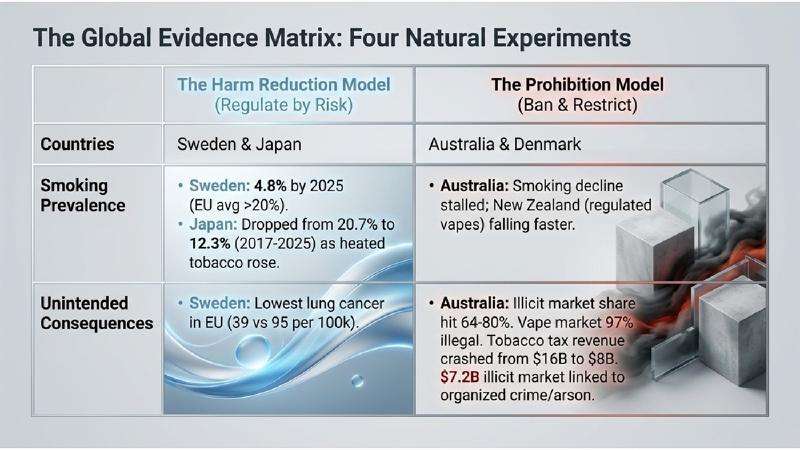
The single EU member state permitted to retain snus has accomplished what the other twenty-six countries have not. Among Swedish adults, daily smoking dropped from over 30% in the early 1980s to 16% in 2003, and further down to 4.8% by 2025, whereas more than 20% of EU adults still smoke daily. Lung cancer incidence in Swedish men hovers around 39 per 100,000, compared to an EU average of roughly 95. One estimate suggests snus has saved approximately 3,000 lives annually in Sweden by displacing cigarettes. Sweden has effectively met its 2040 target, and it did so using the very product the letter seeks to ban more strictly.
A tobacco-free pouch, if anything, takes a step further away from the risks associated with snus: it contains no tobacco leaf, no combustion, and no smoke. In reality, it represents the safest alternative to smoking nicotine products, offering a profile comparable to nicotine replacement therapies (NRTs). The letter provides no comparative risk assessment to back its assertion that these products are “highly harmful.” Instead, it offers an arbitrary conclusion and demands powers commensurate with that claim.
There is also a glaring inconsistency at play. If the goal is a smoke-free generation, the pouch isn’t the rival worth beating; the cigarette is. Banning pouches in a country where cigarettes remain available simply shifts displaced demand to one destination: the cigarette itself, or the illicit market for whatever substitutes take its place.
4. Advertising bans and the social media mandate#
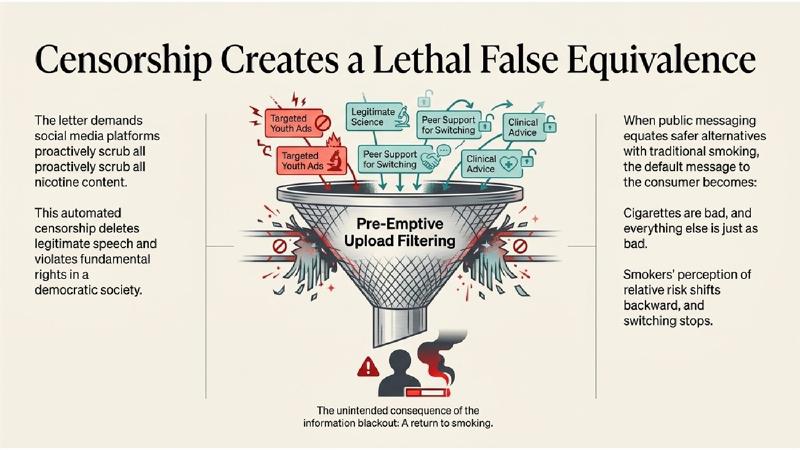
This letter is calling for a total advertising ban on every product and device, across every channel, no matter who posts it. It also demands that platforms be legally forced to proactively scrub this content and stop uploads before they happen.
Two major issues stand out immediately.
First, the ban swallows information about smokers entirely. By imposing a blanket prohibition on communication regarding lower-risk products while simultaneously maintaining the official stance that they are “highly harmful,” the message becomes: cigarettes are bad, and everything else is just as bad.
This distortion isn’t theoretical; it’s documented. Where public messaging equates vaping or pouches with traditional smoking, smokers’ perception of relative risk shifts in the wrong direction, and far fewer of them switch. In Australia, a researcher warns that failing to correct the misperception that vapes are as harmful as cigarettes effectively locks smokers into the most lethal form of nicotine use.
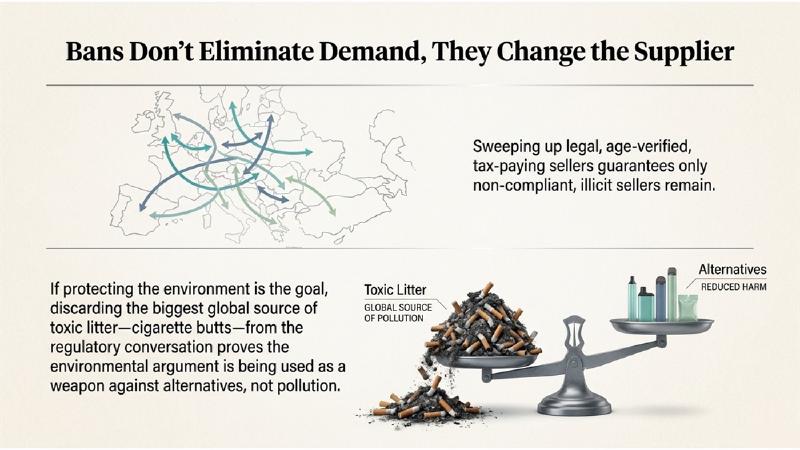
Second, the requirement for pre-emptive upload filtering raises serious fundamental-rights concerns. Asking platforms to prevent content from being uploaded under a category as broad as “nicotine-containing products and accessories” cannot work without automated filtering, which will inevitably delete legitimate speech. This includes harm-reduction education, peer support, scientific discussion, news reports, and consumer reviews that aren’t advertising. Α regime that stops people from discussing safer alternatives to smoking cannot be defended in a democratic society. I have personal experience for such a level of censorship. I have a social media channel presenting scientific information on tobacco harm reduction for smokers (in Greek). My videos have been repeatedly flagged as misinformation or commercial content, while not a single brand has ever been mentioned or shown in any of my videos.
5. Cross-border distance sales: a ban that creates its own black market#
The letter proposes banning cross-border distance sales across the EU. While targeting remote sellers who skip age checks and ignore national rules makes sense and warrants support, a blanket ban rests on a false premise: that consumers will simply stop buying once the legal path closes. They won’t. Instead, they’ll switch to whoever refuses to obey the ban.
This is the exact dynamic that has driven things wrong in Australia. The facts below draw from Australia’s federal opposition Taskforce report and a peer-reviewed study in Addiction (Borland et al., April 2026). They describe a policy that tried to control the nicotine market by driving legal products out of reach through high prices or unavailability:
* The illicit share of nicotine consumption rose from under 10% in 2016 to more than 64% by 2025, with some Taskforce co-chairs citing figures as high as 80%.
* Tobacco excise revenue slumped from roughly AUD $16 billion at its 2019–2020 peak to about AUD $8 billion by 2024–2025, with forecasts pointing to a further drop to AUD $2 billion by 2029–2030.
* Since legal vapes are locked into a medical-only framework, the vape market is reportedly around 97% illegal.
* The illicit nicotine market is estimated at approximately AUD $7.2 billion—bigger than the combined markets for cocaine, heroin, MDMA, and cannabis—and is linked in official reports to arson, extortion, and violence, including over 270 arson attacks on retailers since 2023.
The EU isn’t separated by an ocean, as is the case with Australia. It functions as a single market without internal border checks, leaving long external land frontiers to police. If an island with its own dedicated border force cannot prevent a “prohibition-by-price” strategy from blooming into a criminal enterprise, a union of 27 states certainly cannot. Enforcement against non-compliant cross-border sellers needs strengthening. A prohibition that sweeps up legal, age-verified, tax-paying sellers simply guarantees that the only ones remaining are the ones doing neither.
6. Environment and the single-use vape: the right target, the wrong tool#
The letter’s environmental section urges national bans on nicotine products to reduce their ecological footprint, with particular emphasis on tightening rules around single-use e-cigarettes.
While the environmental argument against disposable vapes is valid—and shared by many harm-reduction advocates—the proposed solution needs nuance. These devices pack in batteries and plastics that shouldn’t end up in a landfill after just a few days of use. A more rational approach focuses on extended producer responsibility, take-back programs, mandates for rechargeable options, and battery standards that cover all electronic goods, not just vapes. These steps tackle pollution head-on without pulling the product from the market or driving consumers toward unregulated, untraceable devices that are inherently worse for the planet. Yet, the same letter highlights the environmental toll of tobacco yet fails to mention its biggest source: combustible cigarettes. Their discarded butts remain among the most prevalent forms of litter globally. If protecting the environment is the goal, then cigarettes are, once again, the elephant in the room.
7. What the world has already taught us#
The letter treats the revision of the TPD as a blank sheet. It is not. Four natural experiments are available, and they all point the same way.
Sweden: access to lower-risk products works. Strong preventive measures (taxes, advertising bans, cessation support) combined with continued access to snus produced the lowest smoking rate in Europe, and some of the lowest lung-cancer rates. The Swedish model is not mysterious: make the smoke unattractive, and leave a better door open for people who will not or cannot quit nicotine.
Japan: smokers switch when the product works for them. In a nationally representative government survey of 16,499 people across five waves between 2017 and 2025, cigarette smoking fell from 20.7% to 12.3% while heated tobacco use rose from 5.3% to 11.7%. Retail data show cigarette sales falling about five times faster after heated tobacco products launched nationally. That is a country of 125 million people restructuring how it consumes nicotine without a prohibition, a flavor ban or a tax shock. (It is worth noting that Japan banned nicotine e-cigarettes in 2016, and the transformation would have been even more impressive without that ban).
Australia: prohibition by price and by regulation hands the market to criminals. Heavy excise, a medical-only model for vapes and an enforcement-first approach produced the outcomes listed above: a black market of 60 to 80% of the nicotine market by some accounts, collapsing revenue and a rise in organized-crime violence. Its New Zealand neighbor, which treats vapes as adult consumer products under health-focused supervision, has seen a smaller illicit market and a faster fall in adult smoking.
Denmark: restrict the safer products and the illegal market fills the gap. Flavor bans, taxes and caps were layered on vapes and then pouches, in the name of protecting young people. Three years after the 2022 flavor ban, the national survey found banned fruit flavors dominating use (63% of vapers), youth vape use up from 7% to 12%, and nearly every vaper in a 2023 poll reporting that banned flavors were easy to find. The ban did not stop young people reaching flavored products. It stopped adult smokers from legally buying the flavors that help them switch, while cigarettes stayed on sale.
Put these together and the letter’s agenda looks less like a plan and more like a collection of the measures that failed.
8. The ethical problem#
Behind the technical arguments lies a moral one, and it needs to be said plainly. There are roughly 50 million adult smokers in the EU. Many have tried to quit, often multiple times. Some will eventually succeed with medication and counselling. Others will not, and for them the realistic choice remains between continuing to smoke and switching to something that doesn’t burn tobacco. The letter’s approach strips that choice away, or makes it more expensive and less appealing, while simultaneously telling those smokers that the alternatives are “highly harmful” based on nothing more than an assertion.
This is a policy that prioritizes the “symbolic purity” of a nicotine-free end state over the actual health of people smoking today. When a regulation predictably leaves living people with a more lethal product than they might otherwise have used, it is not neutral. It is a deliberate decision, and the people who bear its cost have no seat at the table.
The letter claims the Commission should adhere to Article 5.3 of the FCTC “in letter and in spirit.” That is a sound principle regarding shielding policy from industry interference. But in practice, it has been stretched into a rule that excludes consumers, clinicians, and independent researchers from the conversation as well. We should also remember that the FCTC itself defines tobacco control as including harm-reduction strategies alongside supply and demand measures. Harm reduction is not a loophole in the convention; it is part of it.
Finally, the stated end goal in the letter’s final paragraph is “phasing out nicotine dependence” across the Union. Nicotine is indeed addictive. But the diseases that fill oncology wards and cardiac units come from smoke, not from nicotine. A policy whose horizon is the elimination of nicotine, rather than the elimination of smoking, will keep choosing worse outcomes for real people in exchange for a cleaner statistic.
9. The youth concern is real, and the answer is not prohibition#
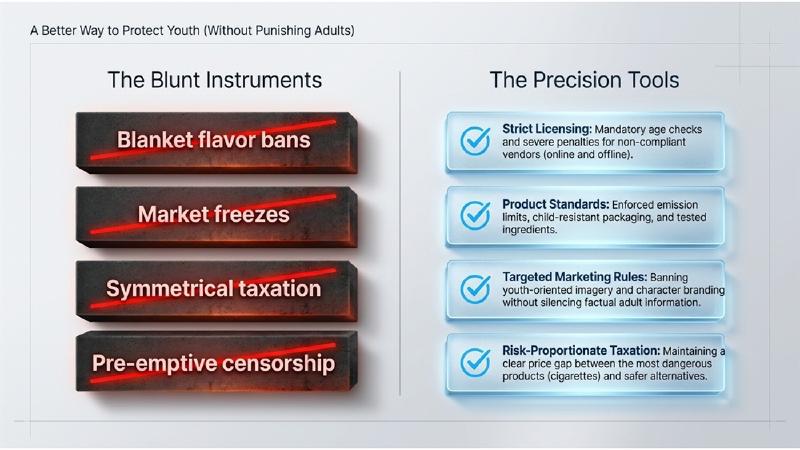
Nicotine use among teenagers is a genuine issue, and any serious proposal needs to tackle it head-on. However, there are ways to target youth without taking away options for adult smokers:
* Enforce strict minimum-age laws with real consequences for retailers who sell to minors, including online sellers.
* Require licensing and mandatory age checks for every vendor, while actively punishing those who ignore the rules.
* Restrict marketing aimed at minors and youth-oriented imagery or character branding, without banning factual information for adults.
* Enforce product standards like tested ingredients, child-resistant packaging, accurate labeling, and emissions limits—all of which only a legal market can reliably enforce.
* Provide clear public education that distinguishes the risks of smoking from those of lower-risk alternatives, advising non-smokers, especially youth, against using any of them.
* Set pricing that maintains a gap between the most dangerous product (cigarettes) and the least, instead of narrowing it with uniform taxation.
These are the tools of a regulated market. The tools proposed in the letter belong to an attempt at prohibition. Prohibitions do not eliminate demand; they merely change who supplies it.
What a credible TPD revision would look like#
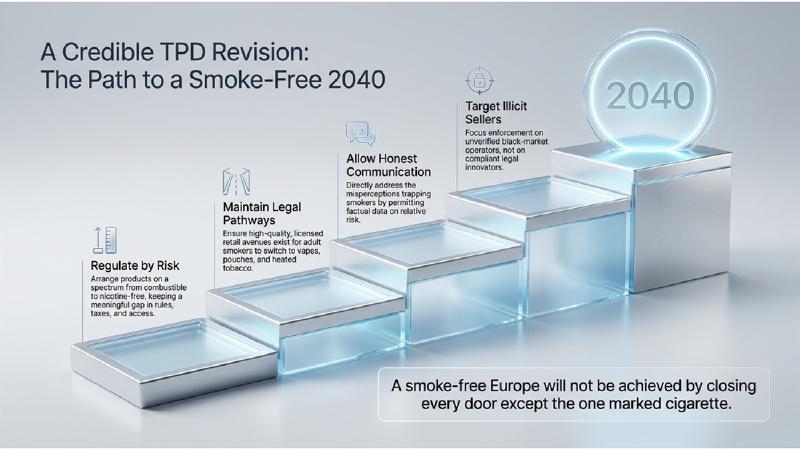
To hit the Commission’s goal of a smoke-free generation by 2040, this revision needs to take a clear stand.
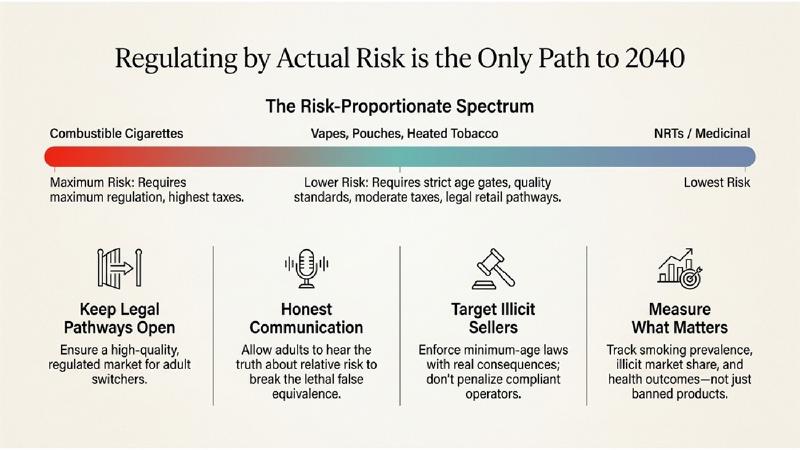
It must regulate by risk: arrange products on a spectrum from combustible cigarettes at the top down to nicotine-free and medicinal items at the bottom, then set rules, taxes, and communication limits that keep a meaningful gap between them.
It should maintain a legal, high-quality pathway for adult smokers to switch, covering vapes, pouches, and heated tobacco while ensuring safety standards, age verification, and licensed retail are in place.
It should allow for honest communication about relative risk to smokers, directly addressing the misperceptions that trap them in the habit.
Enforcement must target illicit and non-compliant sellers, never penalizing compliant, legal operators.
It should focus on measuring what matters: smoking prevalence, illicit market share, youth use and exposure—instead of just counting banned products.
It should conduct wide-ranging consultations that bring in clinicians, independent scientists, retailers, and current smokers or those who have already switched.
Conclusion#
The letter is the work of governments that care about public health. That is exactly why its conclusions matter so much. A set of measures that sounds strong, banning, freezing, capping and standardizing, can cause serious harm if it leaves smokers with fewer ways to stop, and gives organized crime a bigger market.
Sweden shows what happens when smokers have a better option. Japan shows that they take it when it is there. Australia shows what happens when the option is taken away. Denmark shows that adding restrictions on the safer products does not make the cigarette go away.
A smoke-free Europe by 2040 is achievable. It will not be achieved by closing every door except the one marked “cigarette”.
Sources and further reading:
Borland R, Martin J, Jegasothy E, Youdan B, Hall W. Has Australia lost control of its tobacco and nicotine markets? Addiction, 21 April 2026; Coalition Taskforce Into Illegal Tobacco, The Illicit Tobacco Crisis in Australia, 10 June 2026; Mizuno S et al., Nationwide trends in cigarette, heated tobacco product, e-cigarette and multiple-product use in Japan 2017 to 2025, Psychiatry and Clinical Neurosciences Reports 2026;5:e70409; Global State of Tobacco Harm Reduction 2026; Ramström (2024) on snus and mortality in Sweden; analyses by K. Farsalinos on Australia, Sweden and Japan (farsalinos.github.io); Danish Health Authority, Danes’ smoking habits in 2024 (as reported by Snusforumet and Vejpkollen); Ipsos poll for the Tholos Foundation, Danish Voters React Harshly to Vape Restrictions (August 2023); Danish Safety Technology Authority on the July 2025 nicotine rules; the joint letter to Commissioner Várhelyi, ref. 4421352-1100363-VGP, 6 October 2026.