


A 91-page situation report from Knowledge•Action•Change was recently released, the Global State of Tobacco Harm Reduction (GSTHR) 2026, covering tobacco harm reduction (THR) developments from January 2025 into early 2026. This report represents a single synthesis of data on smoking prevalence, safer nicotine product use, regulation, pricing, science and policy across more than 200 countries, and is released approximately every 2 years.
The Core Findings#
Five findings define this edition:
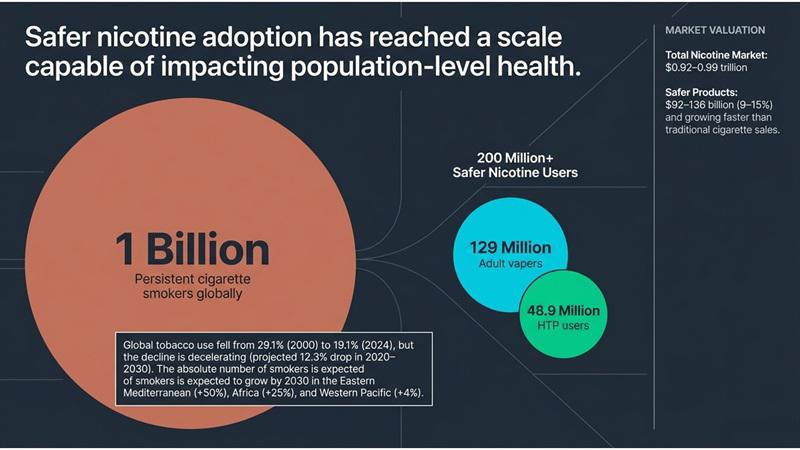
First, an estimated 129 million adults now vape plus 49 million use heated tobacco - over 200 million safer nicotine users overall, roughly a fifth to a quarter of the world’s smokers.
Second, in Sweden, Norway, Iceland, New Zealand and the UK, less harmful product use has overtaken smoking entirely - the ‘scissor’ pattern.
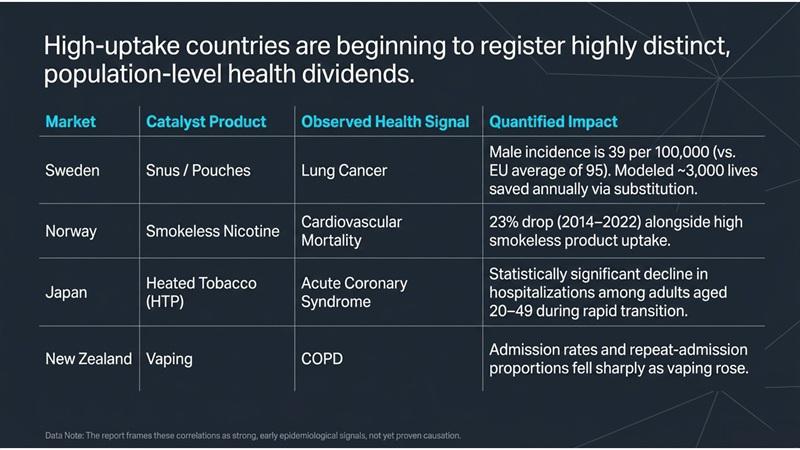
Third, the report suggests that early population health signals are appearing in high-uptake countries.
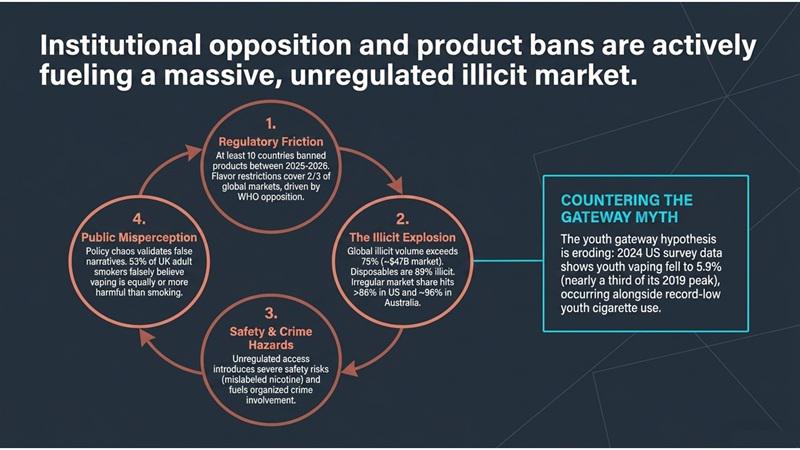
Fourth, regulation is moving backwards: at least ten countries banned products between 2025 and March 2026, flavor restrictions now cover two-thirds of markets, and illicit markets have exploded wherever prohibition took hold.
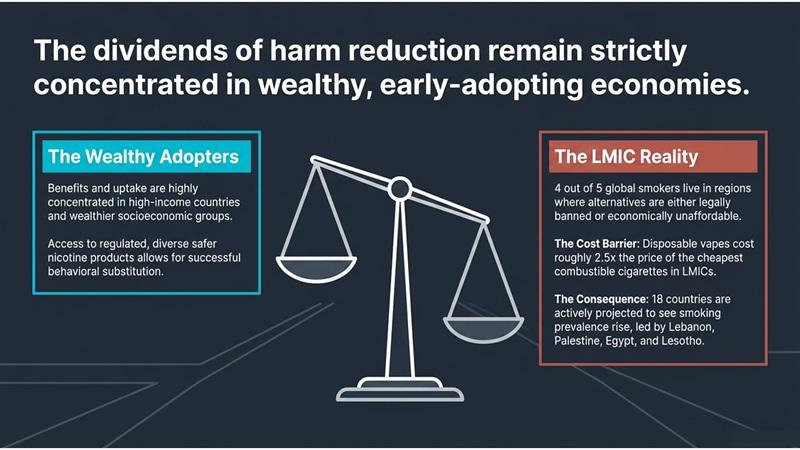
Fifth, the benefits remain concentrated in rich countries while four in five smokers live where alternatives are banned or unaffordable.
Smoking Trends: Progress Slowing and Uneven#
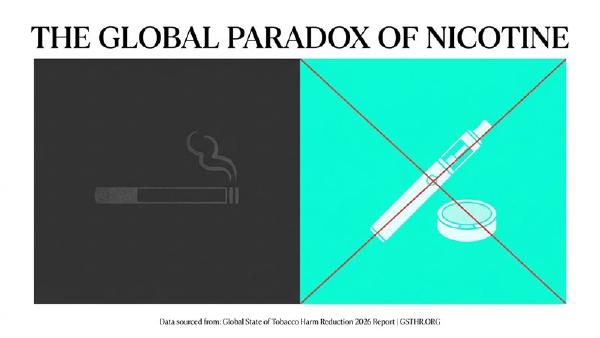
About one billion people still smoke worldwide, and cigarettes generate nearly a trillion dollars a year for major tobacco companies. Global tobacco use fell from 29.1% (2000) to 19.1% (2024) and cigarette smoking specifically from 22.4% to 14.9%, but the pace of decline has decelerated each decade — from a 17.9% relative drop in 2000–2010 to a projected 12.3% drop in 2020–2030. Worse, 18 countries (led by Lebanon, Palestine, Egypt, and Lesotho) are projected to see smoking prevalence rise, and the absolute number of smokers is expected to grow in the Eastern Mediterranean (+50%), Africa (+25%), and Western Pacific (+4%) by 2030 versus 2000. Notably, every country identified as a THR leader — Norway, Iceland, the UK, New Zealand, Sweden, Canada — ranks among the world’s top performers on smoking reduction, a correlation conventional tobacco control alone doesn’t explain.
How Many People Use Safer Nicotine Products#
Using a new three-stage modeling framework, GSTHR revised its global vaping estimate upward to roughly 129 million adult vapers in 2025 (up from 68 million in 2020), plus an estimated 48.9 million heated tobacco product (HTP) users in 2024 (up from near zero in 2014). Combined, these are roughly equivalent to one-fifth to one-quarter of the global cigarette-smoking population — a scale the authors argue is now large enough to matter at the population level.
Market Developments#
The overall tobacco/nicotine market is valued at about $0.92–0.99 trillion in 2025, still dominated by cigarettes, but safer nicotine products (HTP, vapes, pouches, snus) now represent $92–136 billion (9–15% of the total) and are growing faster than cigarette sales. Asia-Pacific leads in HTP, North America in vaping and pouches.
Early Population-Level Health Signals#
Sweden — the most mature THR market — shows male lung cancer incidence at 39 per 100,000 versus an EU average of 95, and one modeling study estimates roughly 3,000 lives saved annually via snus substitution (with a broader estimate suggesting matching Sweden’s smoking rate EU-wide could avert ~210,000 male deaths a year). However, other Swedish data show lung cancer hasn’t fallen as steeply as cigarette sales would predict, illustrating a multi-decade lag between substitution and measurable cancer outcomes. Norway saw a 23% drop in cardiovascular mortality (2014–2022) alongside high uptake of smokeless nicotine. Japan’s rapid HTP transition coincided with a statistically significant decline in acute coronary syndrome hospitalizations among adults aged 20–49. New Zealand saw COPD admission rates and repeat-admission proportions fall as vaping rose and smoking fell sharply. The report is careful to frame all of this as suggestive, not proven, causation.
Modeled Public Health Impact#
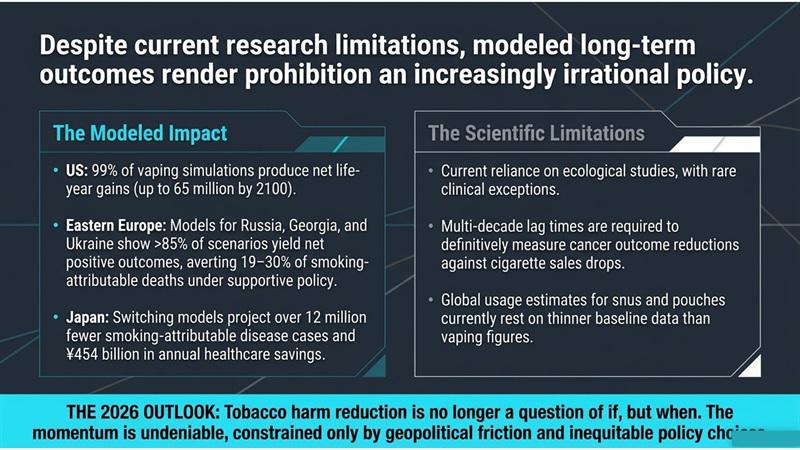
US-focused simulations found 99% of modeled vaping scenarios produced net life-year gains (143,000 to 65 million by 2100). Extended models for Russia, Georgia, and Ukraine found over 85% of scenarios yielded net positive outcomes, with vaping projected to avert 5–8% of smoking-attributable deaths under status-quo policy, or 19–30% under supportive THR policy. In Japan, one model projected switching could produce over 12 million fewer smoking-attributable disease cases and roughly ¥454 billion in annual healthcare savings.
Illicit Markets#
Global illicit vaping volume is estimated to exceed 75% of total volume (~$47 billion market), with disposables particularly affected (89% illicit). In the US, unauthorized products reportedly made up over 86% of tracked retail vape sales; in Australia, ~96% of the vape market allegedly sits outside regulation; in the EU, roughly 48% of vaping product supply is “irregular.” The report links prohibition-driven illicit markets to safety risks (mislabeled nicotine content, prohibited compounds) and, in places like Mexico and Australia, to organized crime involvement.
Inequality and Institutional Opposition#
THR uptake remains concentrated in wealthier countries and socioeconomic groups; disposable vapes cost roughly 2.5x the cheapest cigarettes in low- and middle-income countries, making switching financially irrational for many who smoke. The report is also critical of the WHO’s continued opposition to harm reduction within the Framework Convention on Tobacco Control, arguing this stance conflicts with the treaty’s own commitment to science-based measures, and highlights a widening public misperception problem — in the UK, 53% of adults who smoke and 63% of young people now believe vaping is as harmful as or more harmful than smoking, despite contrary scientific evidence. Youth-vaping “gateway” concerns are also addressed: the report cites evidence (including a 2024 US survey showing youth vaping down to 5.9%, near a third of its 2019 peak, alongside record-low youth cigarette use) that undercuts the gateway hypothesis.
Bottom Line#
The report concludes by stating: tobacco harm reduction is not a question of if, but when. Its thesis is that tobacco harm reduction’s momentum is real but constrained, and highly dependent on policy choices that currently vary enormously by country and income level.
Limitations#
As with every report, there are some limitations that need to be addressed. Population-level health signals remain exactly that - signals, not causal proof, as the authors themselves stress. The evidence is mostly coming from ecological studies, with few exceptions (such as the South Korean study on smoking patients undergoing coronary intervention, where the effects of e-cigarettes vs. quitting without any alternatives vs. continuous smoking were examined). But, in my opinion, the evidence on the impact of snus on Sweden’s smoking rates is remarkably consistent. Estimates for snus and pouch users globally rest on thinner data than vaping figures. These caveats do not undermine the report’s direction of travel; they mark where research should focus next. As a map of where the global debate stands in 2026 - evidence, markets, politics and all - this is the document to read, argue with, and act upon.
Source: Global State of Tobacco Harm Reduction 2026 Report | GSTHR.ORG