
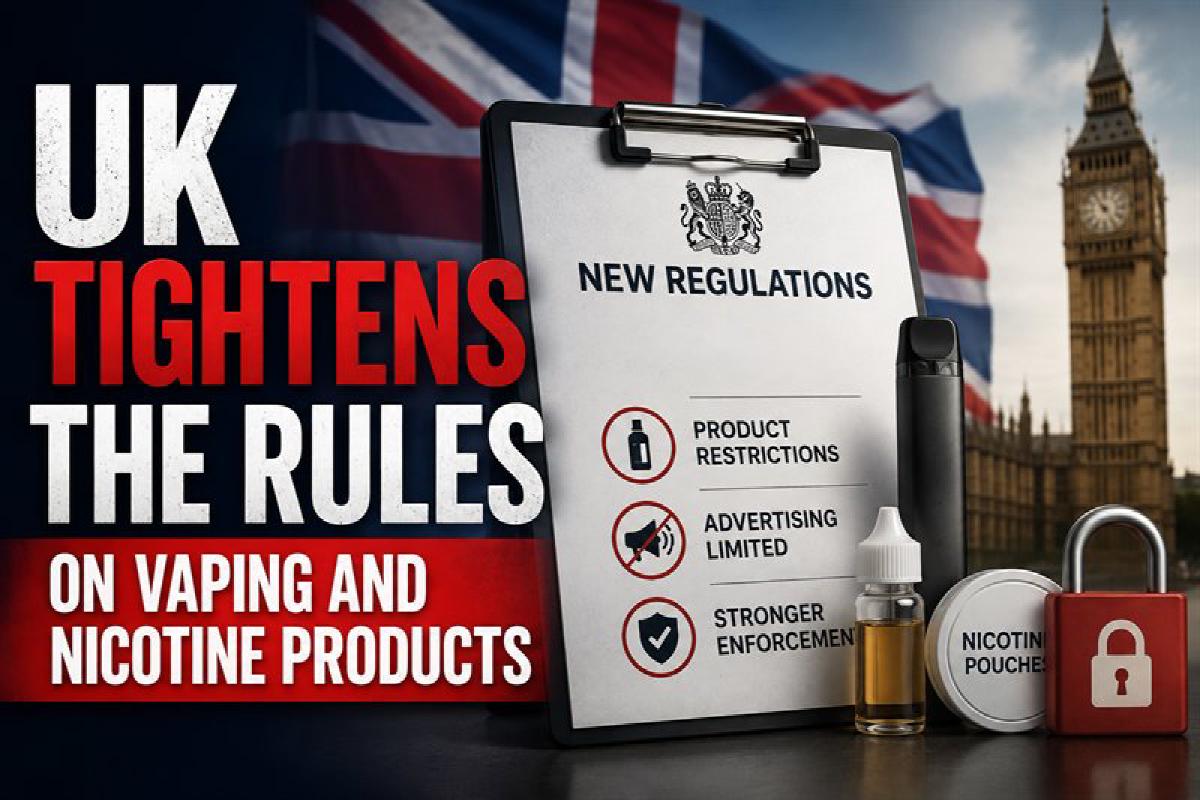

The UK government has published new guidance setting out a significant overhaul of the rules governing the sale of vaping and nicotine products across England, Wales, Scotland and Northern Ireland. The changes, issued by the Department of Health and Social Care, take effect on 29 October 2026 and mark one of the most sweeping updates to nicotine retail law in the UK to date.
A single, UK-wide age of sale#
The headline change is a unified minimum age of sale of 18 for all vaping and nicotine products, closing gaps that previously existed between nations and product types. In England, Wales and Northern Ireland, age restrictions had only applied to nicotine-containing vapes; from October, they will extend to non-nicotine vapes as well. Scotland already restricted both nicotine and non-nicotine vapes, but will now also bring nicotine products more broadly into scope — including nicotine pouches, nicotine strips and nicotine pearls, along with synthetic nicotine.
Retailers, including online sellers, will be legally required to be satisfied a customer is 18 or over before completing a sale, and customers should expect to be asked for ID. It will also become a criminal offence for anyone aged 18 or over to buy — or attempt to buy — these products on behalf of someone underage, a practice known as proxy purchasing.
New penalties for underage sales and proxy purchasing#
Retailers who sell to underage customers, or adults who proxy-purchase on behalf of a minor, could face a fixed penalty notice of £200 (£250 in Northern Ireland, pending Assembly approval), or a larger fine on summary conviction — up to £2,500 in England, Wales and Scotland, and up to £5,000 in Northern Ireland. Enforcement authorities, including local trading standards offices, will decide whether to issue a fixed penalty or pursue prosecution.
Free samples and deep discounts banned#
From the same date, it will be illegal to give away vaping or nicotine products — or coupons redeemable for them — to the public where the purpose or effect is to promote the product. This closes off free-sample giveaways and promotional freebies, whether in-store, online or through third parties. A related ban targets “substantial discounts,” such as selling e-liquid or devices for a nominal sum like 10p, which the government says is designed to stop businesses using steep discounting as a workaround to the free distribution ban. Ordinary clearance sales of unsold stock and standard bulk or trade discounts are unaffected. Notably, NHS-commissioned or council-funded stop smoking services will still be able to provide free vapes or coupons to service users as a quitting aid, provided this is done under a formal arrangement with a public authority.
Breaching the free distribution or discounting rules can also result in a £200–£250 fixed penalty notice, or prosecution carrying penalties as severe as an unlimited fine and up to two years’ imprisonment on conviction on indictment.
Repeat offenders face sales bans#
Retailers who rack up at least three relevant offences within a set period — two years in England, Wales and Scotland, five years in Northern Ireland — can be hit with a restricted sale order or restricted premises order, banning them from selling these products for periods ranging from 28 days up to three years, depending on the nation.
What doesn’t change#
The new age-of-sale rules apply only to retail transactions; wholesale and business-to-business sales remain unaffected, meaning, for example, that a 17-year-old could still work in a shop and purchase vaping stock from a wholesaler for resale, or buy products for legitimate scientific research. There are also no new minimum-age requirements for who can work in a shop selling these products in England, Wales or Northern Ireland, though Scotland requires written authorisation for under-18 staff to make sales.
Together, the changes build on the broader Tobacco and Vapes Act 2026 and reflect a continued government push to curb youth access and marketing of vaping and nicotine products while preserving their role as a smoking-cessation tool through regulated NHS and council services.
Source: UK Department of Health and Social Care, “Selling vaping and nicotine products,” GOV.UK, published 11 August 2026 — https://www.gov.uk/guidance/selling-vaping-and-nicotine-products