


“When Best Practice Falls Short.” Australia has long been praised as a world leader in tobacco regulation, shaping global standards via plain packaging and strong public‑health initiatives. Yet this image hides a serious strategic misstep. By rigidly following WHO‑endorsed “best practice” measures—namely heavy excise taxes and a medical‑only framework for nicotine vapes—Australia has unintentionally sparked a sovereignty crisis. The government has effectively abandoned its duty to oversee the market, handing control over to criminal networks.
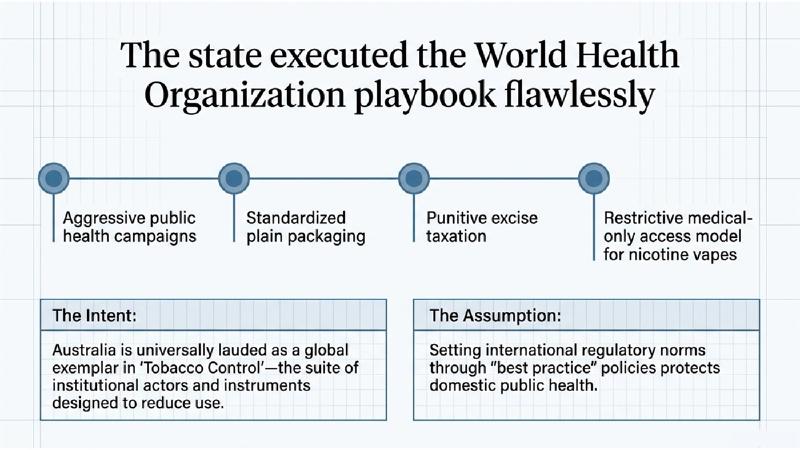
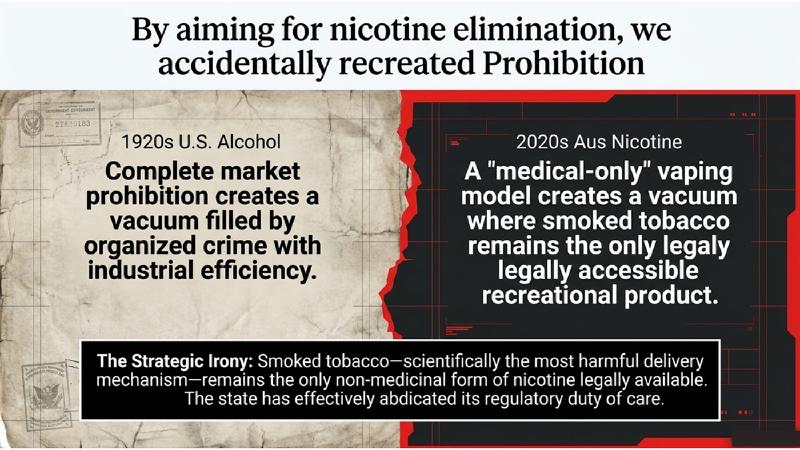
In today’s policy vocabulary, “Tobacco Control” refers to the collection of institutions and tools meant to curb consumption. Ironically, Australia’s current approach has produced a situation where combustible tobacco—the most harmful nicotine delivery method scientifically—remains the sole legal non‑medicinal nicotine source. This “nicotine‑free” strategy echoes the 1920s U.S. alcohol prohibition, creating a gap that organized crime fills with industrial efficiency.
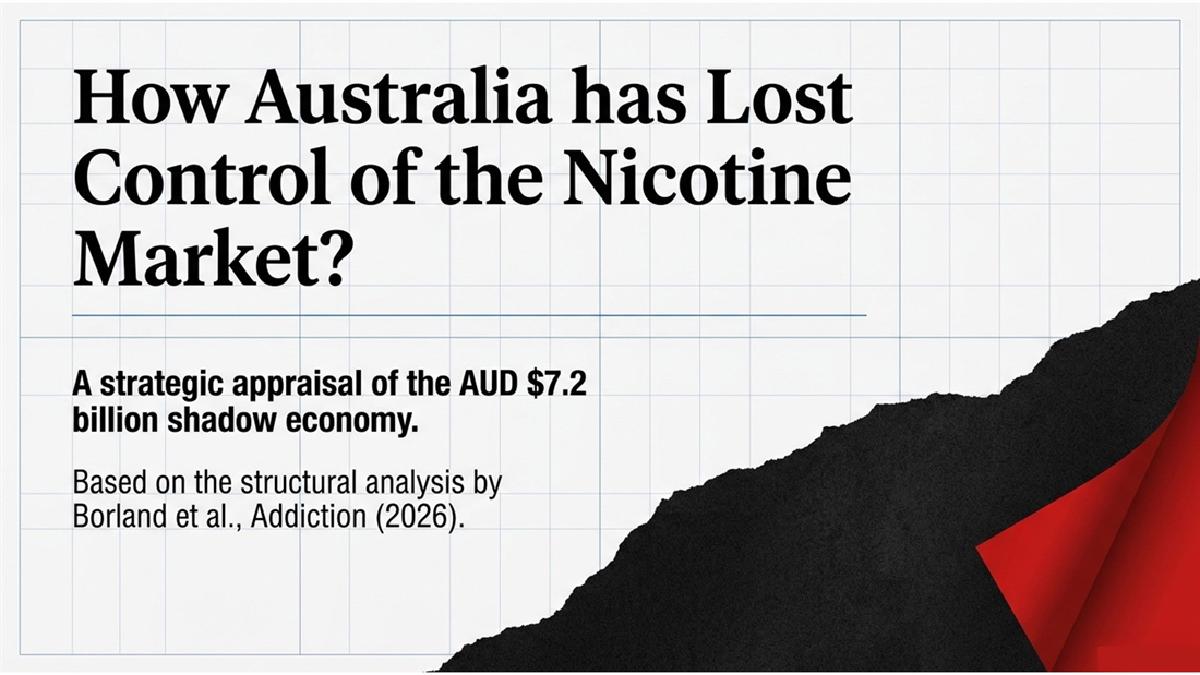
The issue has been examined thoroughly in a recent paper by Borland et al, published in Addiction, and the findings are summarised here.
As the authors state in their key assessment:
“Current policy has led exactly to this result—control of the nicotine market has shifted to criminal enterprises that determine which products are sold, at what price, and under what conditions. Tobacco control has indeed lost control.”
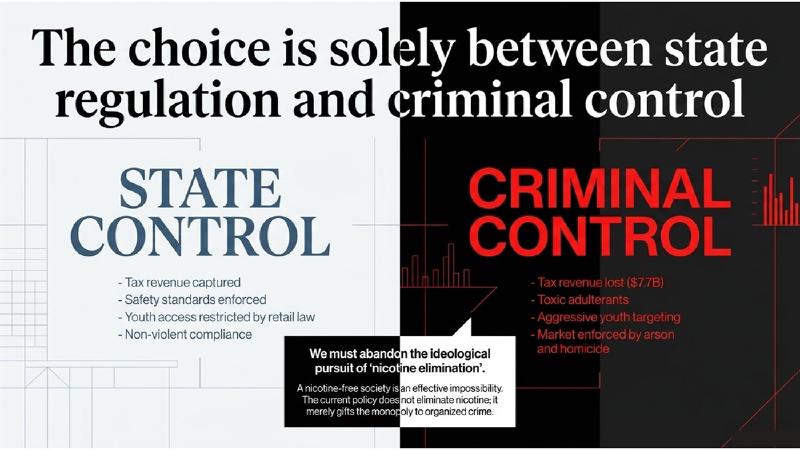
This shift goes beyond moving sales underground; it erodes the very public‑health aims the policy intended to serve. In a prohibition‑like setting, price signals disappear, product safety is ignored, and youth access falls into criminal hands rather than regulated retailers. This financial and social drain is not a side effect of policy. It is a direct effect of a strategy that has lost contact with market realities.
The AUD $7.2 Billion Shadow Economy#
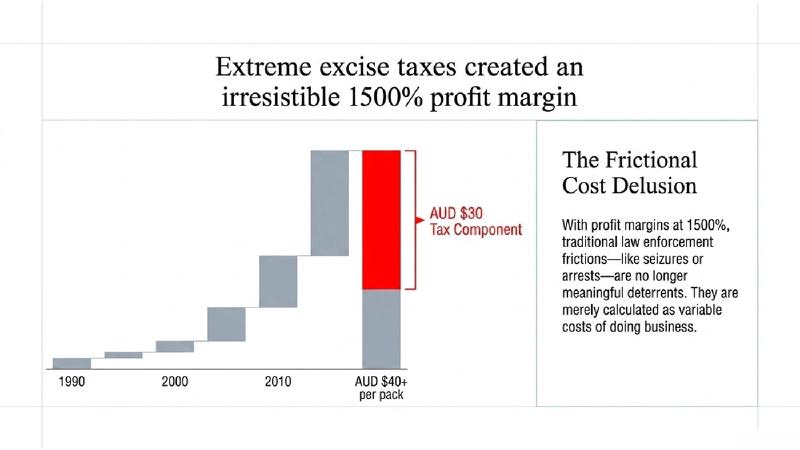
The illicit trade’s engine is the expanding price gap caused by steep excise taxes. From 1990 to 2024, the average price of a cigarette pack rose sevenfold, surpassing AUD $40. By 2025, the tax alone made up almost AUD $30 per pack. This fiscal climate has given organized crime a profit margin of about 1,500%, turning traditional law‑enforcement actions—such as seizures or arrests—into a mere business risk in a in a field of huge profit margins, rather than an effective deterrent.
Market Comparison: Legal vs. Illicit
| Regulatory Domain | Legal Market | Illicit Market (Black Market) | Advantage |
|---|---|---|---|
| —- | —- | —- | —- |
| Price & Taxation | High taxes (Excise + GST); AUD $40+ per pack. | Avoids taxes; roughly AUD $30 cheaper. | Illicit |
| Product Standards | Mandatory safety/quality compliance. | No standards; risk of dangerous adulterants. | Illicit (Cost) |
| Packaging | Standardized/Plain; large health warnings. | Unrestricted; branded; sold as “singles.” | Illicit |
| Flavors/Variety | Highly restricted. | No limits on flavours or product types. | Illicit |
| Market Control | Governed by law and state compliance. | Enforced through threats, coercion, and violence. | Legal (Where enforced) |
| Consumer Willingness | High legal/social barriers; high cost. | Attracts price‑sensitive users and youth. | Illicit (Demand) |
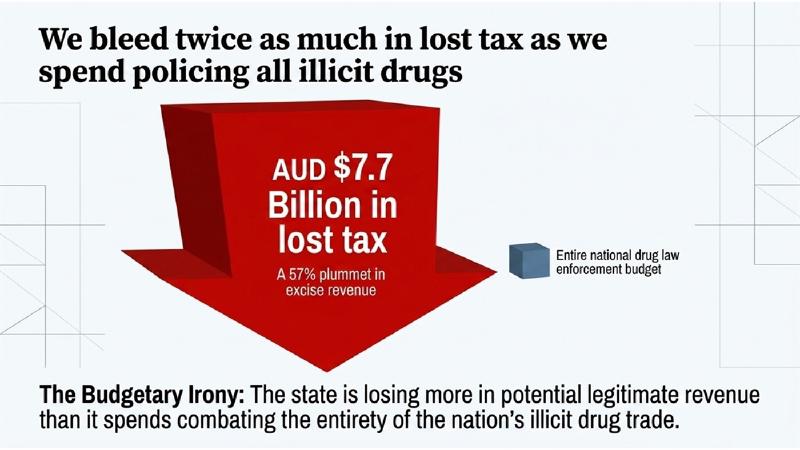
The scale of this failure is catastrophic. Tobacco excise revenue has fallen by 57%, amounting to a fiscal loss of over AUD $7.7 billion. Importantly, this shortfall exceeds twice the nation’s entire drug‑law‑enforcement budget.
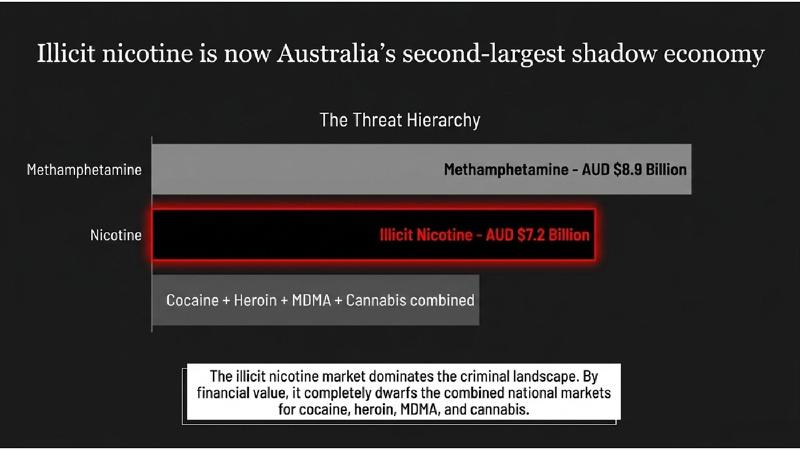
In monetary terms, the illicit nicotine market (valued at approximately AUD $7.2 billion) is financially larger than other criminal enterprises:
- Methamphetamine (AUD $8.9 billion)
- Illicit Nicotine (AUD $7.2 billion)
- Cocaine, Heroin, MDMA, and Cannabis (The nicotine market’s worth surpasses the combined value of these four markets).
The Criminal and Social Toll#
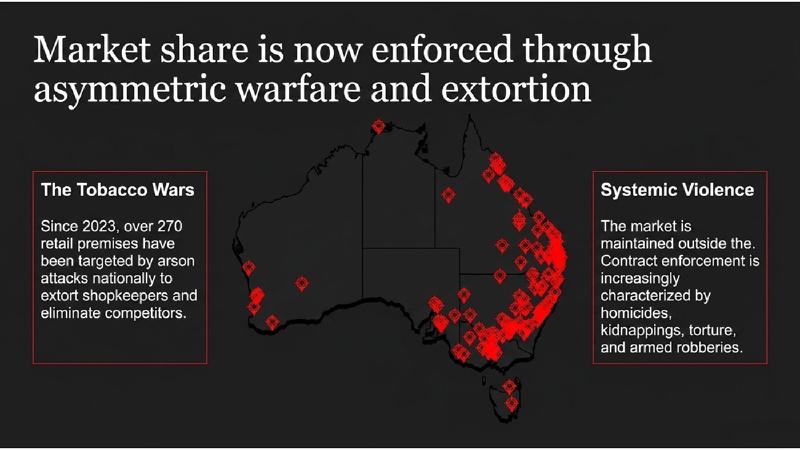
The illicit nicotine trade has morphed into an asymmetrical conflict, igniting “Tobacco Wars” that jeopardise both community safety and national infrastructure integrity. The revenue generated by this market is not static; it fuels a wider network of serious organised crime.
Systemic Violence and Criminal Consequences#
- Arson Attacks: Since 2023, more than 270 arson incidents have hit retail outlets across the country—tactics used to extort shopkeepers or remove rivals.
- Extreme Violence: The market increasingly involves homicides, kidnappings, torture, and robberies employed to enforce criminal agreements.
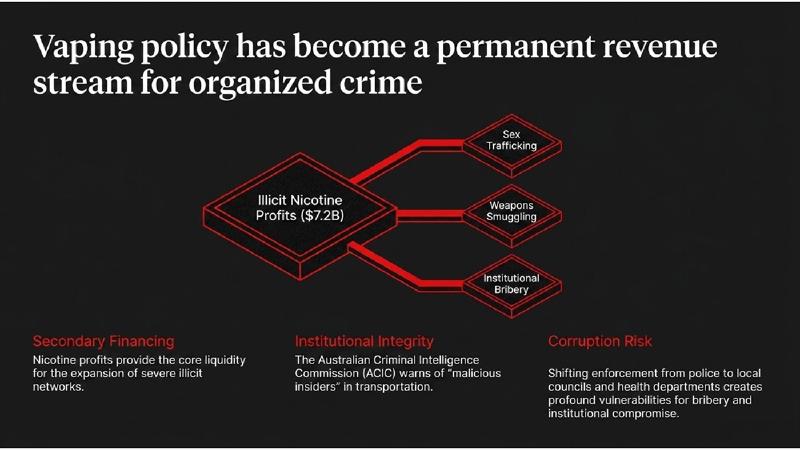
- Secondary Financing: Profits from nicotine provide cash flow for sex trafficking, weapons smuggling, and the growth of other illicit drug enterprises.
National Security and Institutional Integrity#
The immense profits invite systemic corruption. The Australian Criminal Intelligence Commission has warned of “malicious insiders” in the transport sector who facilitate large‑scale importation. Moreover, as oversight shifts to health departments and local councils—bodies lacking the strict integrity units found in police forces—the danger of bribery and institutional compromise rises. By insisting on a “medical‑only” vaping model, the government has effectively handed the recreational market to organised crime, converting a public‑health regulation into a lasting revenue stream for criminal bosses.
Why is the Supply Reduction Poliy Failing?#
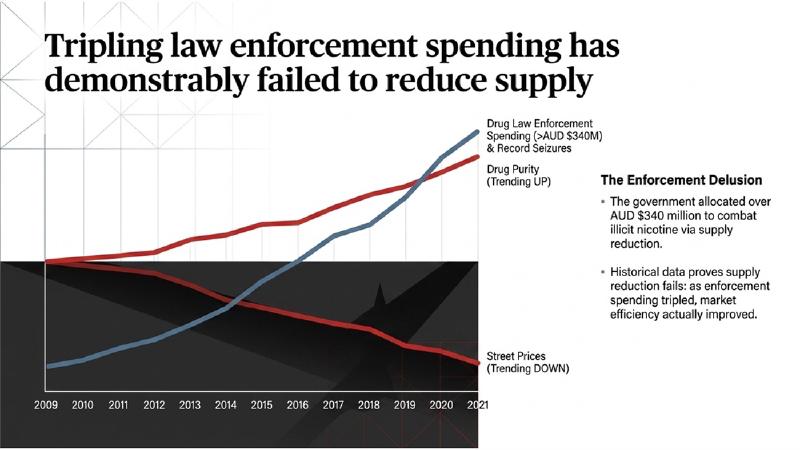
The Australian government has committed over AUD $340 million to combat illicit nicotine via supply reduction. Yet historical data indicates this is a strategic illusion. Between 2009 and 2021, spending on drug law enforcement tripled and seizure numbers peaked, while methamphetamine and cocaine purity rose and prices fell.
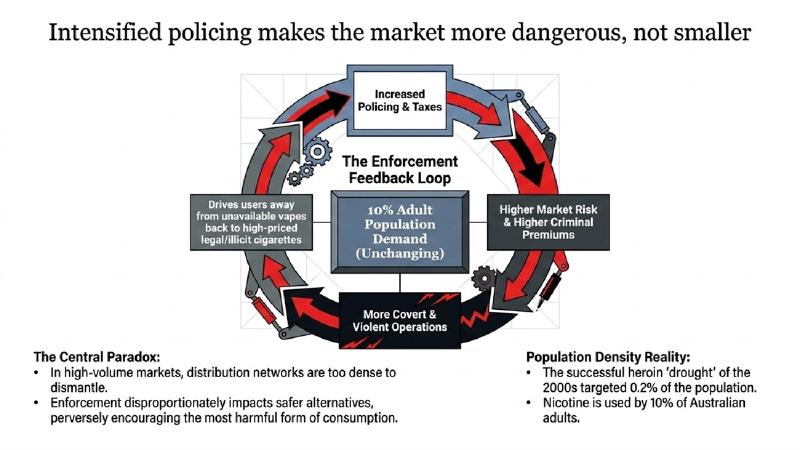
The failure of supply reduction here is driven by the Central Paradox: heightened policing makes the illicit market more covert and perilous but does not eliminate the underlying demand. In high‑volume markets, the distribution network is too dense to dismantle completely.
Use prevalence: The successful heroin “drought” of the early 2000s focused on a market representing only 0.2% of the population. Nicotine, by contrast, is used by roughly 10% of Australian adults.
Smoking Relapse: Because no legal recreational route exists for vapes, enforcement disproportionately affects the safer alternative. This pushes users back toward the expensive legal cigarette market or the hidden cigarette trade run by criminals, perversely encouraging the most harmful form of consumption.
The New Zealand Alternative#
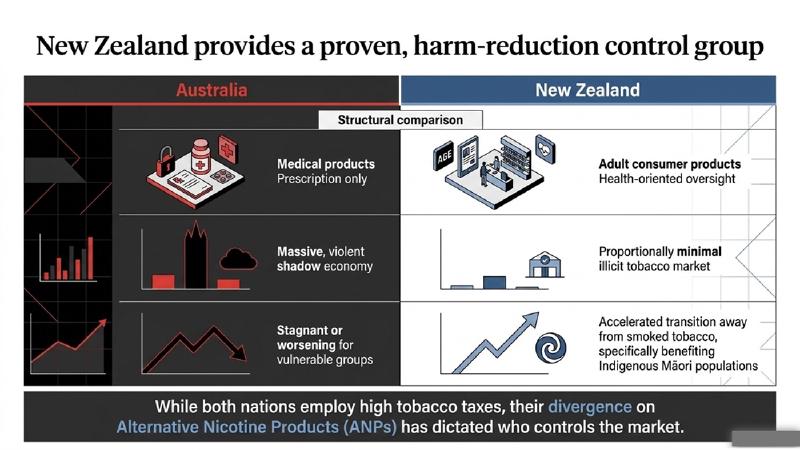
New Zealand is a great compaator case, demonstrating that market control is achievable through harm reduction rather than prohibition. Although both countries apply high tobacco taxes, their differing approaches to Alternative Nicotine Products (ANPs) produce contrasting outcomes.
Comparative Analysis (2016–2023):
Regulatory Model: Australia classifies vapes as medical products (prescription only); New Zealand treats them as adult consumer products with health‑focused supervision.
Illicit Market: New Zealand’s illicit tobacco market is proportionally far smaller because legal, regulated alternatives act as a “pressure‑release valve” for consumer demand.
Smoking Decline: New Zealand has recorded a quicker decline in adult smoking prevalence than Australia.
Health Inequalities: New Zealand’s model has particularly helped Indigenous (Māori) and disadvantaged groups, who use vapes to transition away from smoked tobacco at higher rates.
New Zealand’s experience shows that providing a legal, competitively priced avenue for adults to obtain lower‑risk nicotine products is the only effective way to weaken the black market’s dominance.
A Roadmap to Regaining Control#
Australia must shift from an ideological quest for “nicotine elimination” to a sober evaluation of market dynamics. The “practical impossibility” of a nicotine‑free society needs acknowledgment. The real decision for policymakers is not between nicotine use and total abstinence, but between a market governed by the state or one controlled by organised crime.
Policy Recommendations#
Immediate Tax Freeze: Stop all future tobacco excise increases to halt the widening price gap that fuels criminal profit margins.
Consumer Regulation of ANPs: Move vapes and other lower‑risk alternatives to an adult consumer product framework. This enables legal retailers to compete with the black market on price, variety, and safety.
Evidence Realignment: Conduct an authoritative reassessment of vaping risks to correct the public misconception that vapes are as harmful as cigarettes—a myth that currently locks smokers into the most lethal form of addiction.
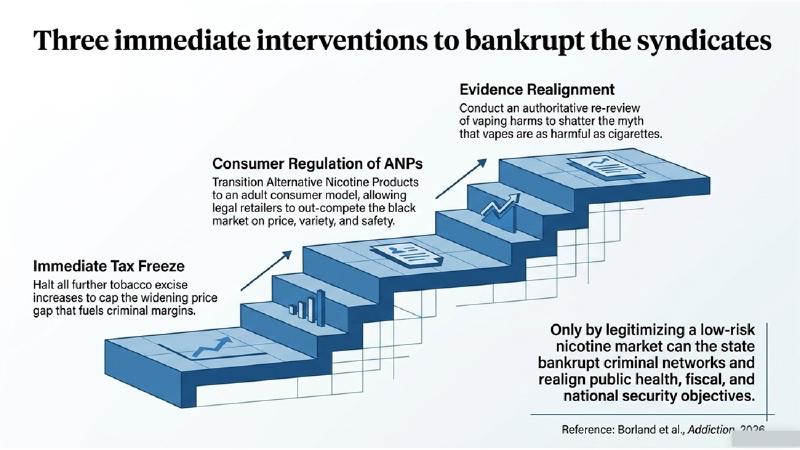
To regain control, Australia needs regulation that is proportionate to risk and feasible amid ongoing demand. Only by legitimising a low‑risk nicotine market can the state bankrupt criminal syndicates and realign its public‑health, fiscal, and national‑security objectives.
Source: Borland R, Martin J, Jegasothy E, Youdan B, Hall W. Has Australia lost control of its tobacco and nicotine markets? Addiction. 2026 Apr 21. doi: 10.1111/add.70428.