

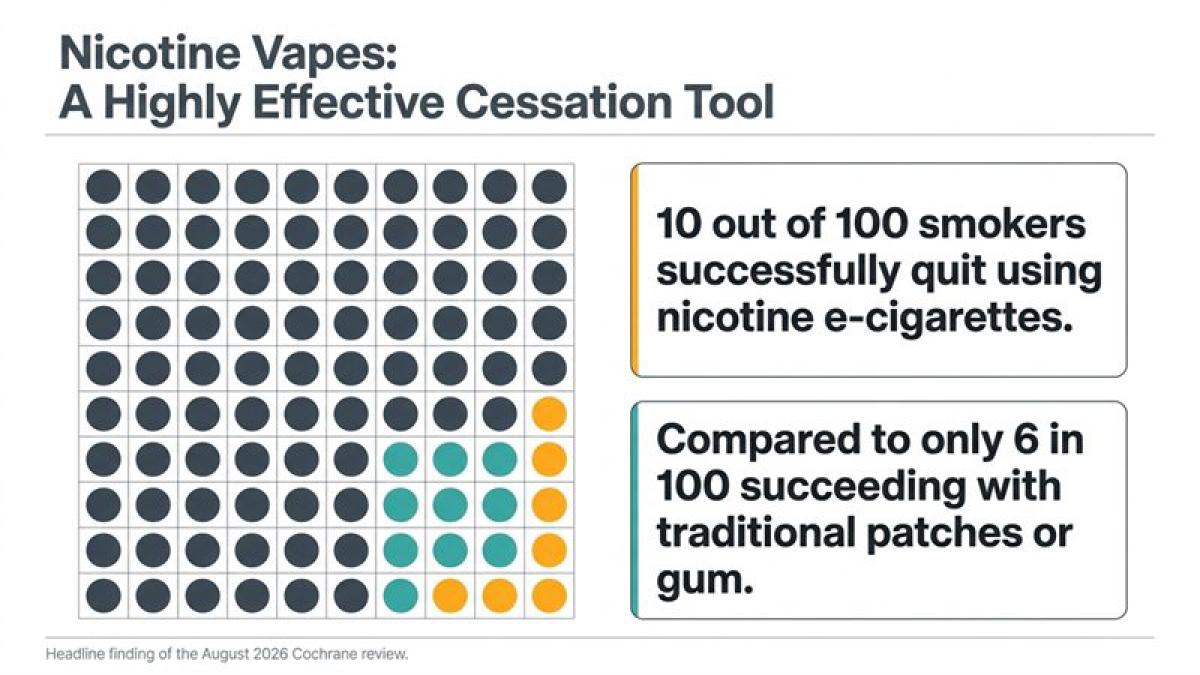

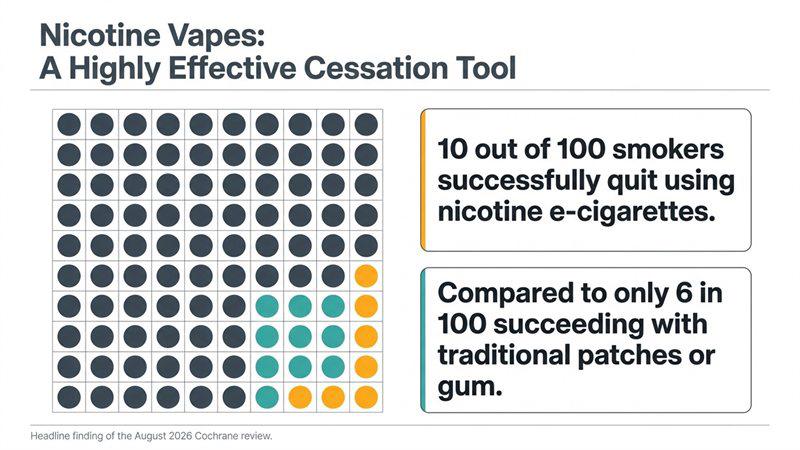
Ten out of 100 smokers quit with nicotine e-cigarettes. Only six in 100 succeed with patches or gum. That is the headline finding of the latest Cochrane review — the most rigorous form of evidence synthesis in medicine — updated in August 2026 with data current to January 2026.
What the review examined#
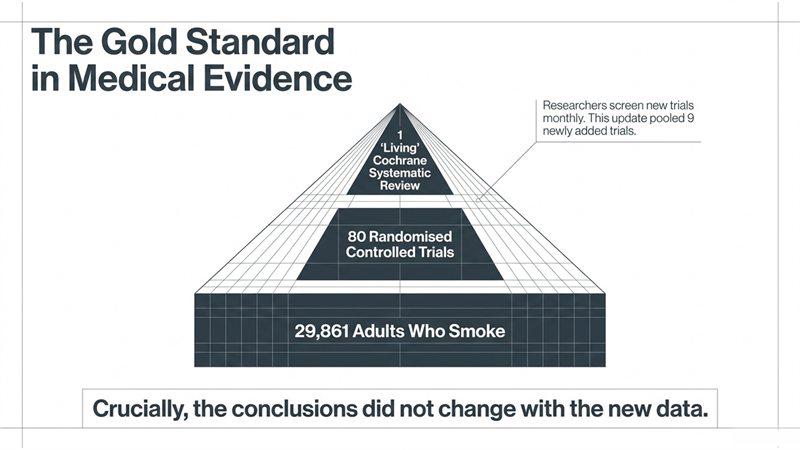
The Cochrane Collaboration maintains this as a ’living’ systematic review: researchers screen new trials monthly and update whenever relevant evidence appears. This update pooled 80 randomised controlled trials involving 29,861 adults who smoke — nine trials added since the previous version. The conclusions did not change. Randomised trials are the gold standard for answering whether a treatment works, and GRADE certainty ratings tell us how much to trust each result.
The effectiveness verdict#
Three comparisons stand out:
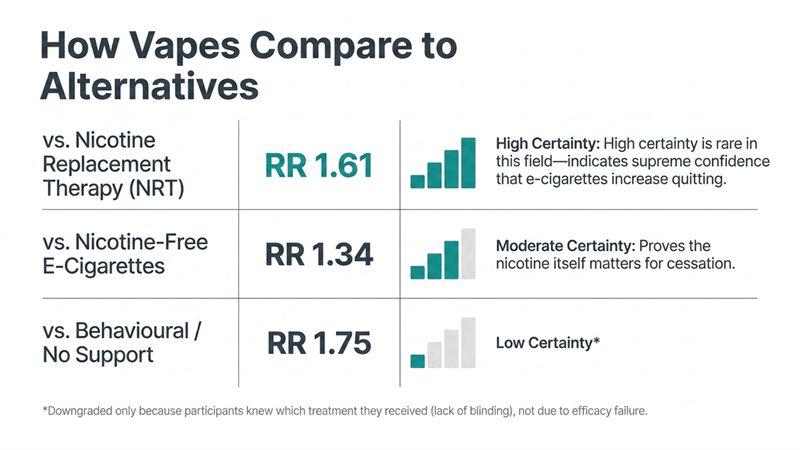
Against nicotine replacement therapy (NRT): high-certainty evidence that nicotine e-cigarettes increase quitting (RR 1.61).
Against nicotine-free e-cigarettes: moderate-certainty evidence they quit more people (RR 1.34), so the nicotine itself matters.
Against behavioural support alone or no support: low-certainty evidence still favours e-cigarettes (RR 1.75), downgraded only because participants knew which treatment they received.
What about e-cigarette safety?#
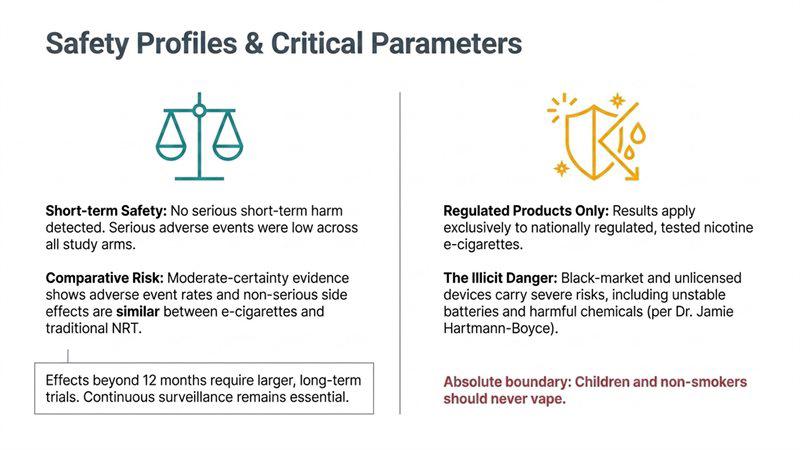
Serious adverse events were low across all study arms, with moderate-certainty evidence that rates are similar between e-cigarettes and NRT. Non-serious side effects were comparable too. No serious short-term harm was detected — but the authors are explicit that longer, larger trials are needed, because effects beyond 12 months remain unknown.
The caveats that matter#
These results apply to regulated, tested nicotine e-cigarettes — not black-market or illicit products. As co-author Dr Jamie Hartmann-Boyce warned in BBC coverage: unlicensed devices carry risks including unstable batteries and harmful chemicals. Anyone considering vaping to quit should use products approved by their national regulator. Long-term safety surveillance remains essential, and children and non-smokers should never vape.
Bottom line#
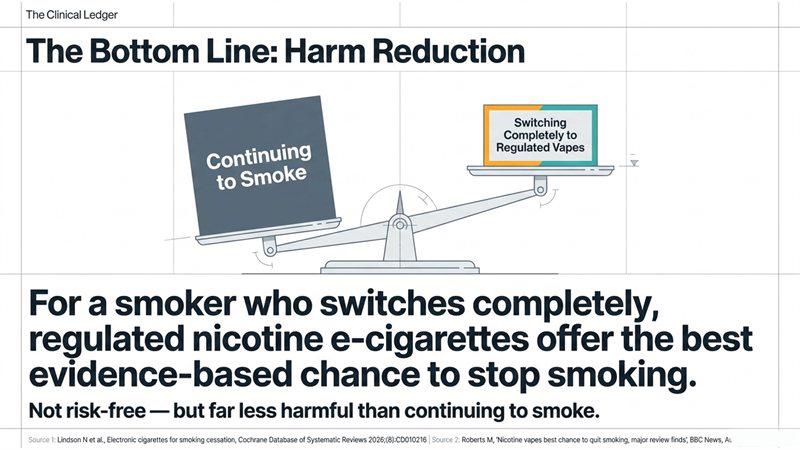
For a smoker who switches completely, the best available evidence keeps pointing the same way: regulated nicotine e-cigarettes help more people stop smoking than traditional aids, with no detected excess of serious harm in trials so far. Not risk-free — but far less harmful than continuing to smoke.
Sources: Lindson N et al., Electronic cigarettes for smoking cessation, Cochrane Database of Systematic Reviews 2026;(8):CD010216 | Roberts M, ‘Nicotine vapes best chance to quit smoking, major review finds’, BBC News, August 2026