


The Study at a Glance#
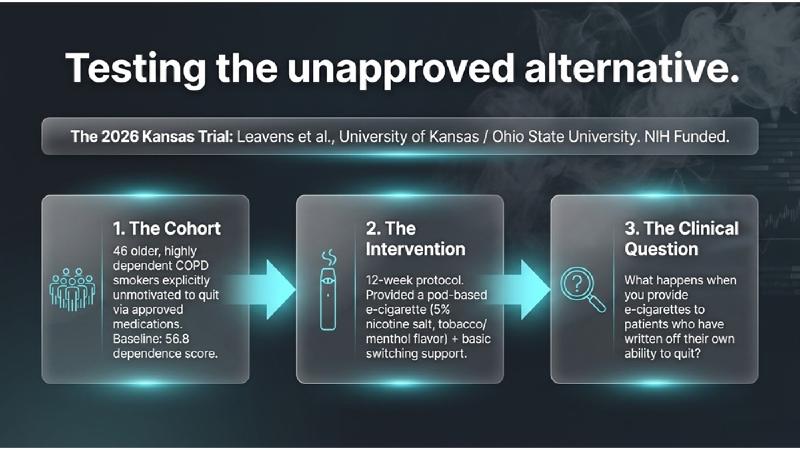
Researchers at the University of Kansas ran a 12-week pilot trial with 46 COPD patients who smoke and had no intention of quitting with approved methods. Everyone got a pod-based e-cigarette with 5% nicotine, in menthol or tobacco flavor, plus basic switching support. No control arm. No pharmacotherapy comparison. At week 12, there were two outcome groups:
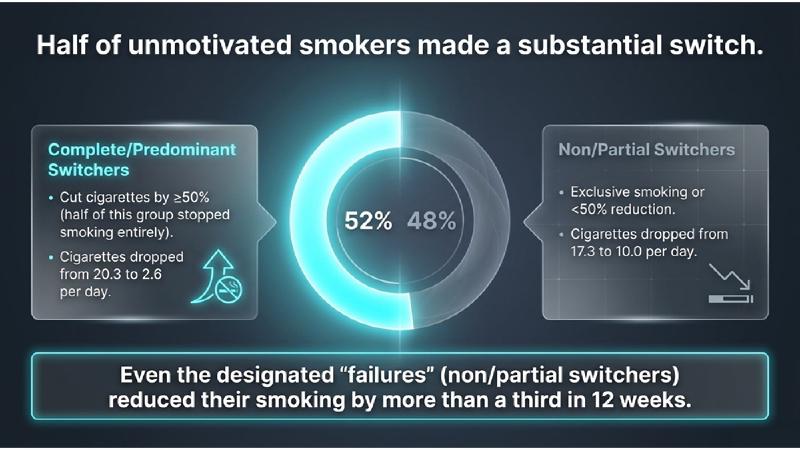
- Complete/predominant switchers (52%): used e-cigarettes in the past 7 days and cut cigarettes by ≥50%. Approximately one in four of the whole group (half of switchers) had stopped smoking cigarettes entirely.
- Non/partial switchers (48%): still smoking exclusively, or using e-cigarettes but cutting smoking consumption by <50%. Then they compared changes in exhaled CO, COPD symptoms (CAT score), respiratory symptoms, arterial stiffness, aerobic capacity (6-minute walk), and lung function (FEV1/FVC). Meaningful improvements were observed in exhaled CO and CAT score. Exhaled CO also fell in non/partial switchers.
Who were the study participants?#
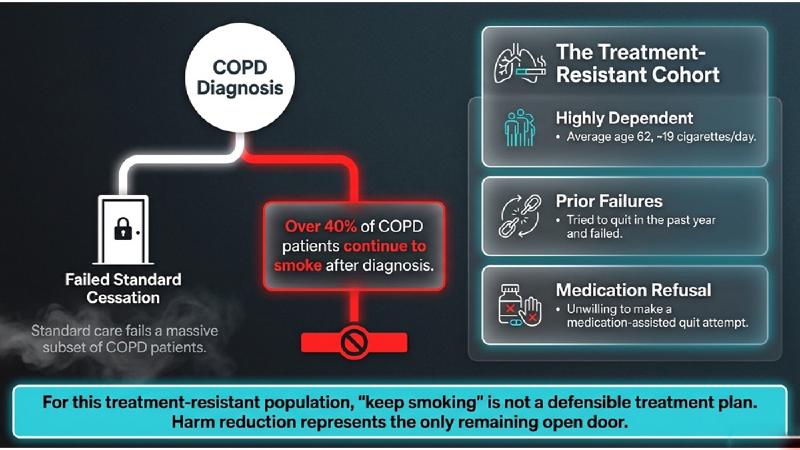
The study is E-cigarettes for harm reduction among COPD patients who smoke: A pilot investigation, published in Drug and Alcohol Dependence in September 2026 by Eleanor Leavens and colleagues at the University of Kansas and the Ohio State University. The trial was registered as NCT05510154 and funded by the US National Institutes of Health. Everyone enrolled had COPD and smoked. All of them had tried to quit in the past year and failed. None was willing to make a medication-assisted quit attempt in the next thirty days, so physicians could use non-approved tools for smoking cessation. They were 21 or older, smoked on more than 25 of the past 30 days, and had to be interested in trying an e-cigarette. People who already vaped, used other tobacco products regularly, were pregnant, or had a heart or lung event in the previous three months were excluded.
Eighty-three people were screened, 46 enrolled, and 36 completed every visit. The analysis used 45 participants who had at least one week-12 measurement, with missing values filled in statistically.
The average age was 62. They smoked about 19 cigarettes a day and scored 56.8 on a 15-to-76 cigarette dependence scale, which means high dependence, and one third of them were smoking menthol cigarettes. More than half had an annual household income under $25,000.
What happened to their smoking#
At week 12, they were two use categories, based on their past 7-day e-cigarette and change in cigarette smoking from baseline to week 12. Complete/predominant switchers had vaped in the past week and cut their daily cigarettes by at least 50% from baseline. Everyone else, exclusive smokers and people who cut down by less than half, was a non or partial switcher. The 50 per cent cut point was fixed before the study began, because earlier biomarker work showed that is roughly where toxicant exposure actually moves.
Twenty-four of the 45 analysed participants, 52 per cent, landed in the switcher group. Of those, 11 reported no cigarette use at all in the past week. The other 13 were still smoking, but had cut down by 79.1 per cent on average. The people classified as non or partial switchers still cut down their smoking consumption, by 37.0 per cent on average. Switchers went from 20.3 to 2.6 cigarettes per day. The rest went from 17.3 to 10.0 cigarettes per day. It is still noteworthy that even the people counted as failures cut their smoking by more than a third, and their exhaled carbon monoxide was also reduced at week 12.
What happened to their bodies?#
The study measured seven outcomes, and the pattern was consistent: the more the smoking reduction, the better.
| Outcome | Switchers | Non/partial switchers | Effect size |
|---|---|---|---|
| Cigarettes per day | −17.7 | −8.2 | — |
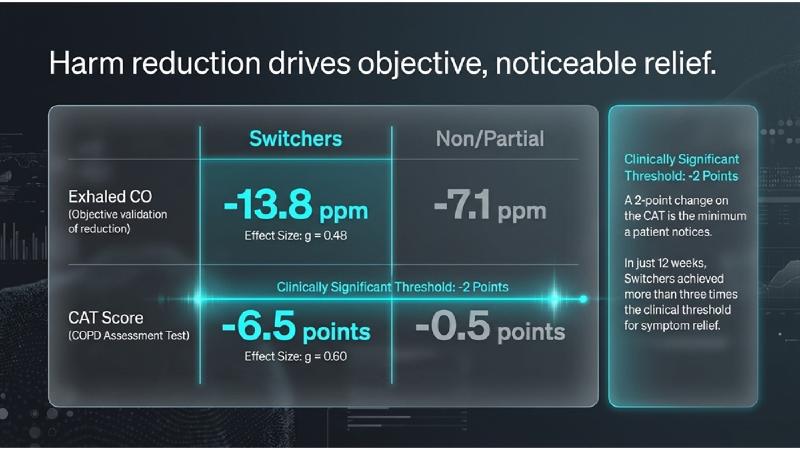
| Exhaled CO | −13.8 ppm | −7.1 ppm | g = 0.48 |
| CAT score | −6.5 | −0.5 | g = 0.60 |
| Respiratory symptoms | −5.2 | −3.7 | g = 0.20 |
| Arterial stiffness | −0.53 m/s | −0.40 m/s | g = 0.11 |
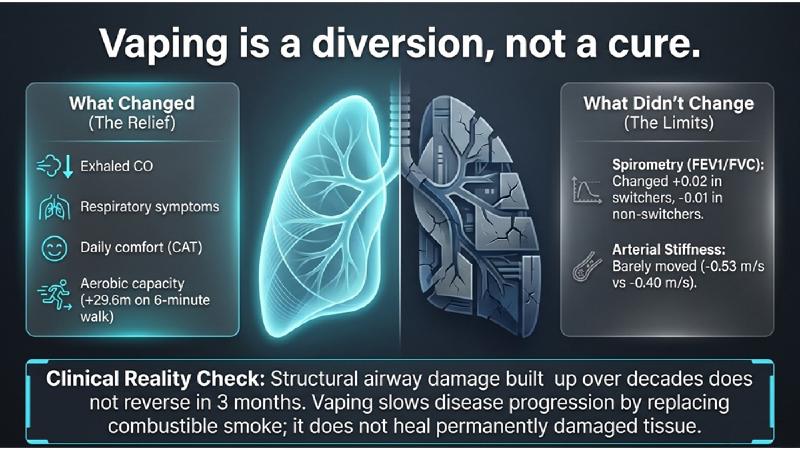
| 6-minute walk distance | +29.6 m | +18.5 m | g = 0.26 |
| FEV1/FVC | +0.02 | −0.01 | g = 0.20 |
Two of these matter clinically. The COPD Assessment Test, or CAT, is an eight-question scale on which a 2-point change is the minimum a patient actually notices. Switchers improved by 6.5 points. Non-switchers improved by 0.5. A swing of more than three times the clinical threshold, in twelve weeks, in people who had written off their own ability to quit, is a large change.
Exhaled carbon monoxide is an objective verification that the reported cigarette cuts were real. It fell by 13.8 ppm in switchers against 7.1 ppm in non-switchers.
Arterial stiffness, measured by pulse wave velocity, barely moved, despite other studies showing that complete switching is associated with benefits within 4 weeks. The six-minute walk distance improved more in switchers, but more than half of those measurements were missing and the authors could not perform a proper statistical assessment, so that number is suggestive only. Spirometry, the FEV1/FVC ratio, changed by 0.02 in switchers and −0.01 in everyone else. That is not a real change in airway obstruction, and twelve weeks is not long enough to expect one. Structural airway damage built up over decades does not reverse in 3 months.
Is the study conclusive?#
There are several limitations in this study.
No control group. Everyone got e-cigarettes. We can’t disentangle the device effect from regression to the mean, Hawthorne effect, seasonal variation, or the intensive study contact (4 in-person visits, $210 compensation). A proper RCT with pharmacotherapy or NRT comparison is the obvious next step — and Vojjala et al. already ran a pilot version of that, finding no difference between e-cigarettes and combination NRT at 3 or 6 months.
Differential attrition. More non/partial switchers dropped out. Multiple imputation helps, but if the missingness isn’t random (e.g., people struggling more are more likely to quit the study), bias remains. The sensitivity analyses adjusting for age and sex are reassuring but not definitive.
Short duration. 12 weeks tells us about acute switching. It says nothing about relapse, long-term dual use patterns, or whether initial switchers stay switched. Polosa’s 5-year follow-up is the only longer-term COPD data we have — and it’s observational, not experimental.
Device and flavor constraints. Two pod devices, two flavors, 5% nicotine salt only. Real-world users have infinite combinations. Whether these findings generalize to tank systems, lower nicotine, or different flavor preferences is unknown. But it is always preferable to provide freedom of choice to participants, based on self-preference.
How this fits with what we already knew?#
The 2026 Cochrane review of e-cigarettes for smoking cessation, covering 80 trials and nearly 30,000 people, found high-certainty evidence that nicotine e-cigarettes outperform nicotine replacement therapy, with a quit rate ratio of 1.61.
Two more studies exist in such patients:
| Study | Design | Population | Key Finding |
|---|---|---|---|
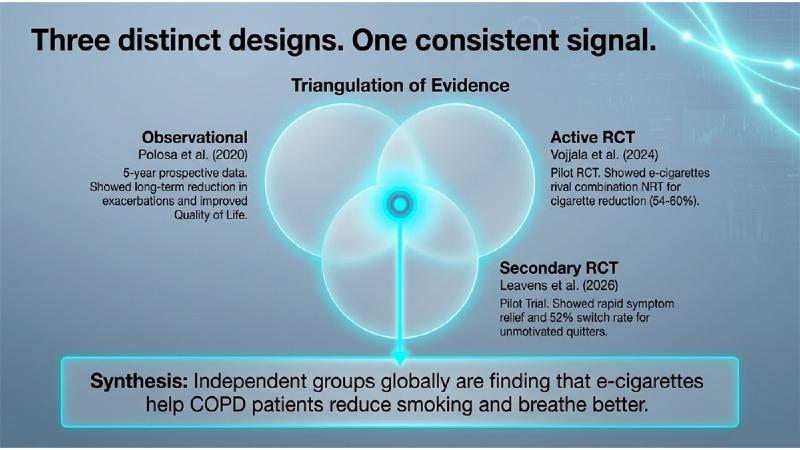
| Polosa et al. (2020) | 5-year prospective, non-randomized | COPD smokers who switched to e-cigs | Fewer exacerbations, better QoL, more physical activity |
| Vojjala et al. (2024) | Pilot RCT | Chronic pulmonary/cardiac/circulatory disease + smoking | E-cigs ≈ combination NRT for CPD reduction (54-60%); no between-group difference |
| Leavens et al. (2026) this study | Secondary analysis of pilot RCT | COPD smokers unmotivated to quit | 52% switched ≥50%; medium effects on CO & CAT |
Three independent groups, different designs, all pointing toward e-cigarettes helping COPD patients reduce smoking and improve symptoms. But all three have significant limitations and their findings are not conclusive.
Why many of the patients who need this will never try it?#
I’ve been researching tobacco harm reduction for years. This study won’t change guidelines tomorrow — it’s too small, too short, too uncontrolled. But it fills a specific, stubborn gap: what happens when you give e-cigarettes to COPD patients who explicitly don’t want to quit nicotine?
The answer: about half make a substantial switch, and those who do breathe better and show less smoke exposure. That’s not nothing. For a population with few options and terrible prognosis, “not nothing” is where progress starts.
What frustrates me is how long we’ve been stuck at the pilot stage. Polosa published 5-year data in 2020. Vojjala ran a pilot RCT in 2024. Leavens adds another pilot in 2026. Where is the definitive, adequately powered RCT comparing e-cigarettes to varenicline or combination NRT in COPD patients, powered for exacerbations and FEV1 decline? The FDA’s PMTA process, the EMA’s regulatory caution, and the “we need more evidence” loop keep delaying the trial that would actually answer the question in a convincing way.
Meanwhile, COPD patients keep smoking. Over 40% continue after diagnosis. Standard cessation fails them repeatedly. Harm reduction isn’t a theoretical debate for them — it’s the only door left open.
The Misperception Problem#
The Kansas trial had a screening requirement that quietly hides the bigger problem. Everyone who enrolled had to be interested in trying an e-cigarette. The people who would benefit most from a study like this are largely the ones who would never get that far, because they hold beliefs that stop them before they start.
The data on public and physician misperceptions is staggering. A 2024 study of over 1,000 US physicians found that 80.5% incorrectly believe nicotine causes cancer, 83.3% that it causes cardiovascular disease and 80.9% that causes COPD. Similar findings among healthcare professionals have been reported in Greece back in 2016, and they are probably worse now. Jackson et al. reported that between 2014 and 2023 the proportion of smokers who thought e-cigarettes were more harmful than smoking had more than doubled. How ironic, the more the evidence clearly demostrating the lower risk of e-cigarettes compated to combustible tobacco, the stronger the misperceptions.
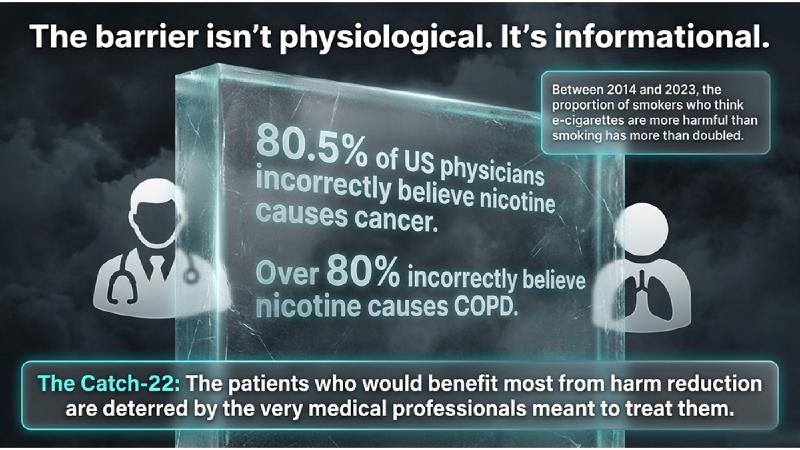
These aren’t minor misunderstandings. They’re systematic, widespread, and they directly deter switching. A COPD patient who thinks nicotine causes their disease has zero reason to try an e-cigarette. A physician who believes nicotine drives cancer won’t recommend it. The Leavens study shows what’s possible when patients do try: half substantially cut smoking, symptoms improve, toxicant exposure drops. But that door only opens if patients and providers have accurate information. Right now, they don’t. And the gap is widening.
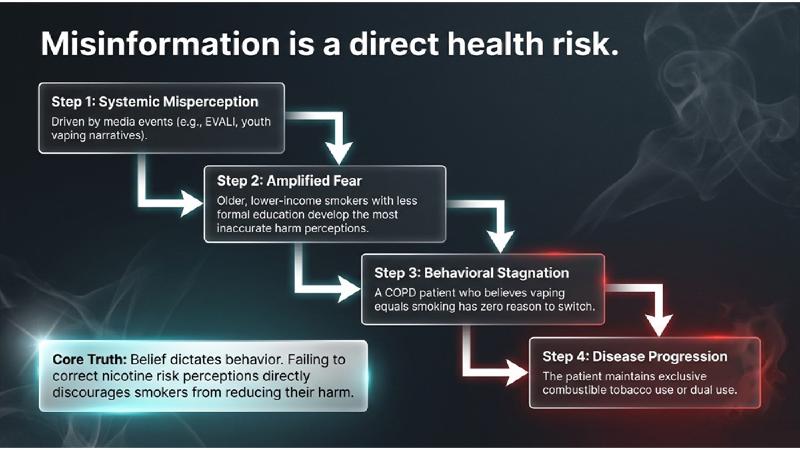
That deterioration was not necessarily gradual or random. Perceptions worsened sharply in late 2019 during the EVALI outbreak in the United States, which was widely attributed to nicotine e-cigarettes in the media before being traced to illicit cannabis vape cartridges containing vitamin E acetate. They also worsened as youth vaping became the dominant story.
The reason this matters is that the belief changes the behaviour. In the US Population Assessment of Tobacco and Health study, dual users who believed vaping was less harmful than smoking were more likely to move to exclusive vaping and less likely to relapse to cigarettes a year later. Back in 2015, I reported that higher risk perceptions about ECs was associated with dual use of ECs and tobacco cigarettes. This misperception is a health risk in itself, because it discourages smokers from substantially reducing their harm by switching.
The consequence lands hardest on exactly the population in this trial. Older smokers, lower-income smokers, and smokers with less formal education consistently show the most inaccurate harm perceptions, and those are the same groups where smoking prevalence remains high. A COPD patient who believes vaping is as dangerous as smoking, will just keep smoking, and is likely to be treated by a doctor who shares the belief. This is a problem that we are failing to address.
What needs to happen next#
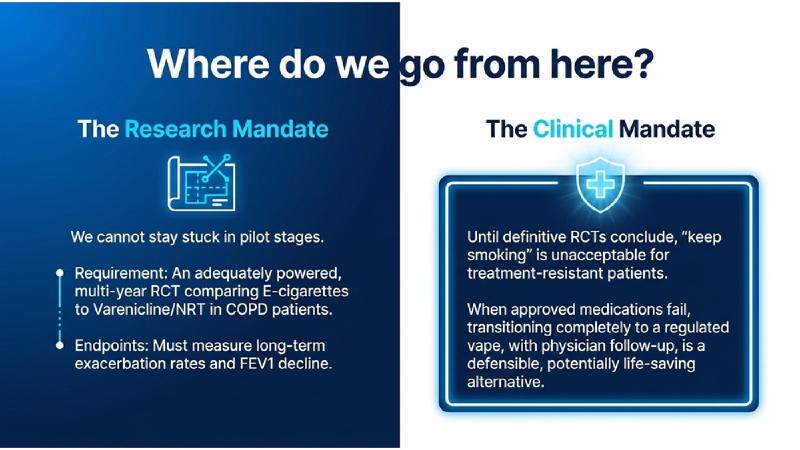
A properly powered randomised trial with an active comparator, e-cigarettes against varenicline or NRT, in COPD patients, running at least a year, and powered on exacerbation rates and FEV1 decline rather than cigarette counts. Secondary questions worth answering: whether complete switchers and predominant switchers actually differ over years, since this study merged them, and whether any improvements at 12 weeks persists, grows, or fades.
The clinical implication in the meantime is simpler. When a COPD patient who smokes has tried and failed the approved options and is not interested in another attempt, “keep smoking” is not a treatment plan. A regulated vape, with proper follow-up, is a defensible alternative to discuss.
Q&A#
Does vaping cure COPD? No. Nothing currently available does. What quitting smoking does is slow the disease progress and reduce exacerbations, which is where the real gains in life expectancy come from. Vaping is a route away from smoke for people who cannot reach abstinence, not a treatment for damaged airways.
Is vaping safe for someone with COPD? Nothing is safe and using nothing is the best option. But the question here is not to choose between vaping or using nothing. It is between vaping and continuous smoking. Vaping is by far less harmful than smoking.
I have COPD and I still smoke. Should I start vaping? Try the approved medications first, with real support, because they work for some people and they are the best-tested option. If you have already tried and failed, or you do not want to try them, switching completely to a regulated vape is far better than continuing to smoke. Do it with your doctor involved rather than alone. And I hope you will find an open-minded doctor.
What about dual use? The participants who only partially switched still did better than exclusive smokers, but the health gap favoured the people who got fully off cigarettes, and the gap was widest on the symptom measure. Partial is better than nothing and clearly worse than complete.
How long until I feel better? In this study the symptom improvement appeared within 12 weeks. The structural measures, lung function and arterial stiffness, did not move in that window and were not expected to.
Sources#
Leavens ELS, Wagener TL, Brown AR, Mayo MS, Lambart L, Ellerbeck EF, Billinger SA, Sanderson Cox L, Comfort B, Nollen NL. E-cigarettes for harm reduction among COPD patients who smoke: A pilot investigation. Drug and Alcohol Dependence 2026;288:113343. doi:10.1016/j.drugalcdep.2026.113343.