


We already knew that Japan has experienced a huge reduction in cigarette sales over the past several years. We now have more evidence, looking beyond sales, on the smoking cessation rates in the country. A government-run, household-sampled, nationally representative survey that has been tracking substance use since 1995, now shows exactly the substitution pattern that we were hoping for.
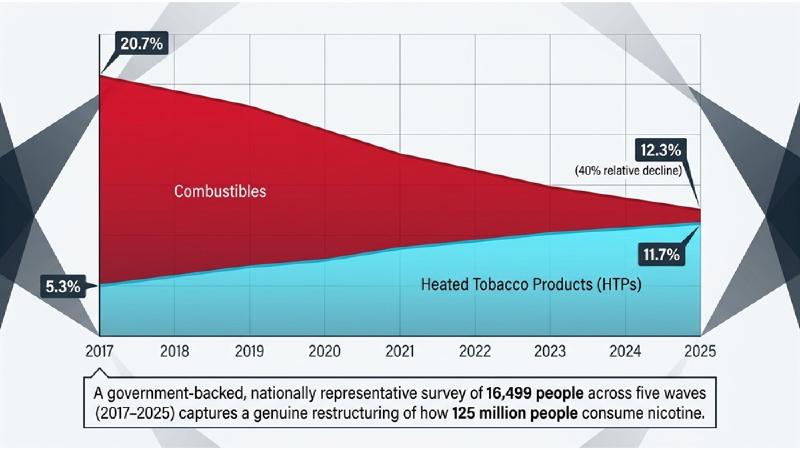
Mizuno S et al. published the analysis in Psychiatry and Clinical Neurosciences Reports (2026;5:e70409), using Japan’s Nationwide General Population Survey on Drug Use — 16,499 people, five survey waves between 2017 and 2025, stratified two-stage probability sampling. The headline: cigarette smoking fell from 20.7% to 12.3%, a 40% relative decline, while heated tobacco product (HTP) use rose from 5.3% to 11.7% over the same eight years. That’s a genuine restructuring of how a country of 125 million people consumes nicotine.
The independent evidence backs it up#
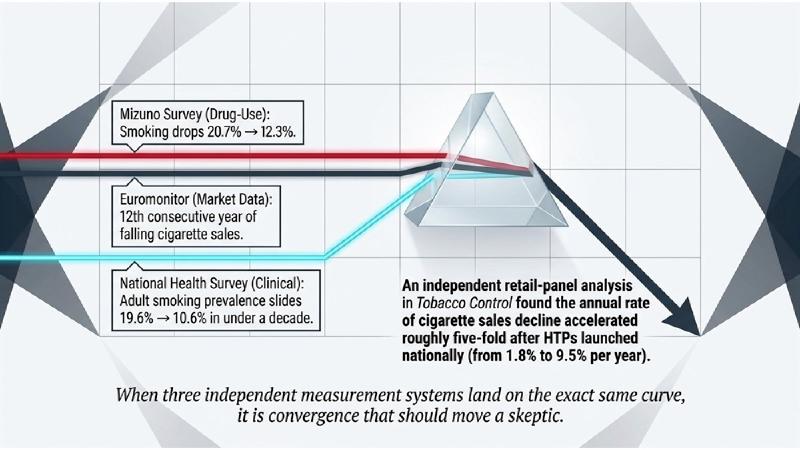
This finding was expected considering other sources of information showing a similar trend. Euromonitor’s Tobacco in Japan market report puts 2024 as the country’s twelfth consecutive year of falling cigarette sales. A retail-panel analysis published in Tobacco Control found the annual rate of cigarette sales decline accelerated roughly five-fold after HTPs launched nationally — from about 1.8% a year pre-2015 to about 9.5% a year afterward. The authors said they struggled to explain that acceleration without the HTP launch as the driver. And Japan’s own National Health and Nutrition Survey shows adult smoking prevalence sliding from about 19.6% to 10.6% in under a decade.
Is dual use a real issue?#
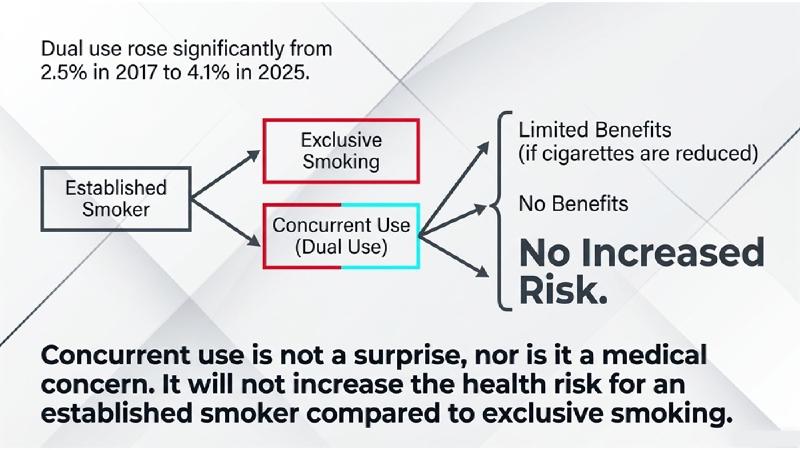
Concurrent cigarette and-HTP use (dual use) rose over the same period, from 2.5% in 2017 to 4.1% in 2025. That’s a statistically significant increase. I wouldn’t consider it a surprise, and I do not find it concerning. Since HTPs and cigarettes complement each other for overall nicotine intake, there is no increased risk expected from this combination compared to only smoking. It will either be associated with limited benefits (in case this “incomplete switching” is associated with a large reduction in number of cigarettes smoked) or with no benefits at all. But it will not increase the health risk for an established smoker.
Limitations#
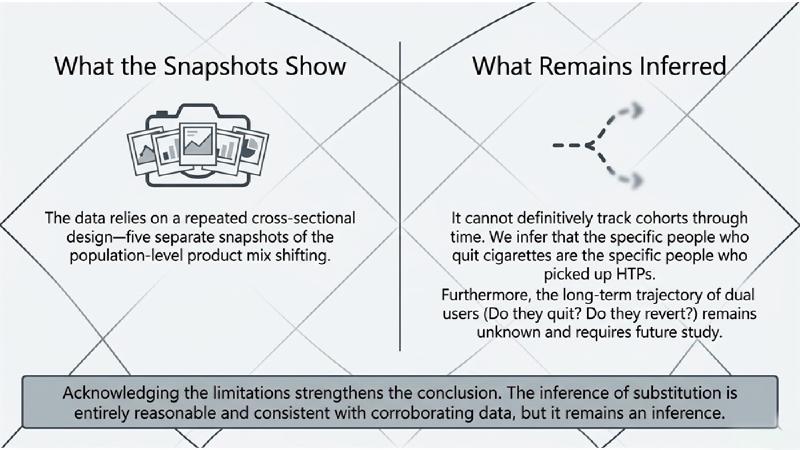
This is a repeated cross-sectional design. Five separate snapshots rather than a cohort followed through time. It can show the population-level mix of products shifting but it cannot show that the specific people who quit cigarettes are the same people who picked up HTPs. The inference of substitution is reasonable and consistent with everything else we know, but it is an inference. Another piece of information that cannot be examined with this design is the trajectory of dual users. Do they eventually quit smoking? Do they stick with dual use? Do they revert back to exclusive smoking? We have no idea about this, but it is worth examining in future studies.
Has overall tobacco use decreased in Japan?#
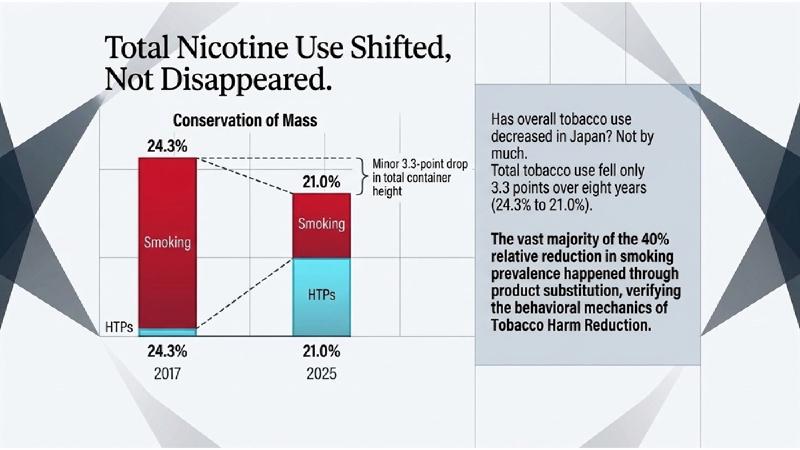
Not by much. Total tobacco use of any kind fell from 24.3% to 21.0%, a 3.3-point drop over eight years. This in fact verifies that the vast majority of the reduction in smoking prevalence in Japan has happened through substitution.
A word on biomarkers#
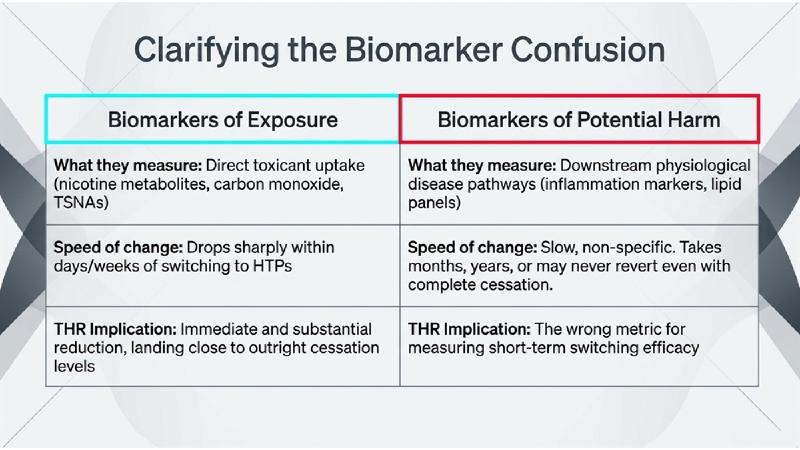
If we want to speak of harm reduction rather than merely a change in behavior, we currently lack sufficient data. There is, of course, literature on biomarkers, but it matters which “biomarkers” we cite. Biomarkers of exposure — direct measures of toxicant uptake, like polycyclic aromatic hydrocarbons, or tobacco-specific nitrosamines — drop sharply within days to weeks of switching to a heated tobacco product, often landing close to where they sit in people who’ve quit smoking outright. Biomarkers of potential harm are a different animal: slower, non-specific, downstream physiological signals tied to disease pathways — inflammation markers, lipid panels etc.
I needed to clarify the above because the authors of the Japanese study used the latter (biomarkers of potential harm) to support that no benefit comes from switching to HTPs. But even in those quitting smoking without any alternative, it may take a long time for these markers to revert to the levels of never smokers (if they ever revert to such levels). However, we have strong evidence that many biomarkers of exposure are substantially reduced shortly after switching from smoking to HTPs. This is why we expect benefits from such a switch.
How important are these results?#
The measure that matters most here isn’t if fewer people use nicotine. It is if fewer people smoke. On that specific, medically meaningful axis, Japan’s trajectory over the past eight years is genuinely one of the best natural experiments for the THR strategy: an 8.4-point absolute drop in cigarette smoking, a 6.4-point rise in a non-combustible alternative. That’s about as close as real-world evidence gets to confirming the core THR premise.
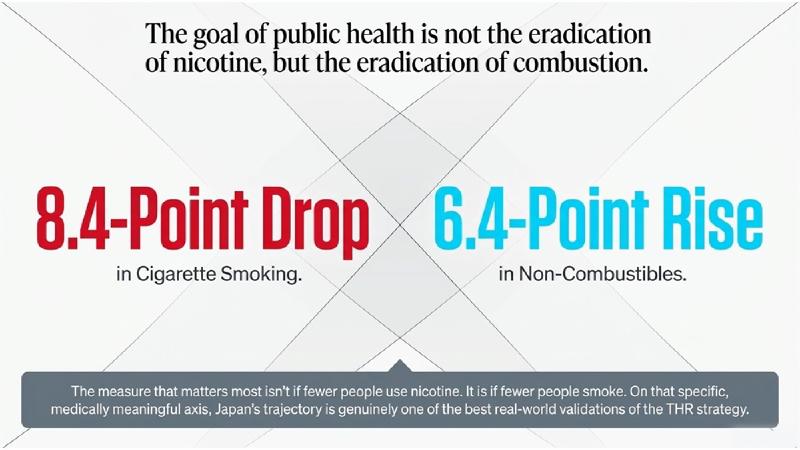
Japan is experiencing a historical transformation in public health. Had they not banned nicotine-containing e-cigarettes, I suspect the transformation would have been even more impressive.
Frequently Asked Questions#
** How much did cigarette smoking drop in Japan since heated tobacco products became available?** Cigarette smoking fell from 20.7% to 12.3% — a 40% relative decline — between 2017 and 2025, according to the Nationwide General Population Survey on Drug Use (Mizuno et al., 2026).
Did heated tobacco product use increase at the same time? Yes. HTP use rose from 5.3% to 11.7% over the same eight-year period, mirroring the cigarette decline.
Is dual use of cigarettes and HTPs a problem in Japan? Dual use increased from 2.5% to 4.1%, but this is expected and does not appear to be a major health concern. Since HTPs deliver nicotine without combustion, dual users aren’t adding risk compared to exclusive smoking — they’re either reducing harm (if they reduce their smoking consumption substantially) or staying neutral.
Has overall tobacco use decreased in Japan over the last 8 years? Only slightly. Total tobacco use dropped from 24.3% to 21.0%, a 3.3-point decrease. This confirms the cigarette decline was almost entirely substitution, not abstinence.
Can biomarkers prove that switching to HTPs reduces harm? Biomarkers only provide indirect proof and can be used to make reasonable assumptions. Biomarkers of exposure (like tobacco-specific nitrosamines) drop sharply within days of switching, but biomarkers of potential harm (inflammation, lipids) take much longer to change — and may never fully revert to never-smoker levels. We expect benefit, but population-level confirmation through epidemiological studies with clinical end-points is still pending.
Why doesn’t Japan allow nicotine e-cigarettes? Japan banned nicotine-containing e-cigarettes in 2016, classifying them as medicinal products requiring approval. This likely slowed the overall tobacco reduction, as vaping has established smoking cessation efficacy and could have served as an additional tool to help Japanese smokers quit.
*Sources: Mizuno S, Inoura S, Matsumoto T, Shimane T. “Nationwide trends in cigarette, heated tobacco product, e-cigarette, and multiple-product use in Japan 2017–2025.” Psychiatry Clin Neurosci Rep. 2026;5:e70409.