

Key Takeaways#
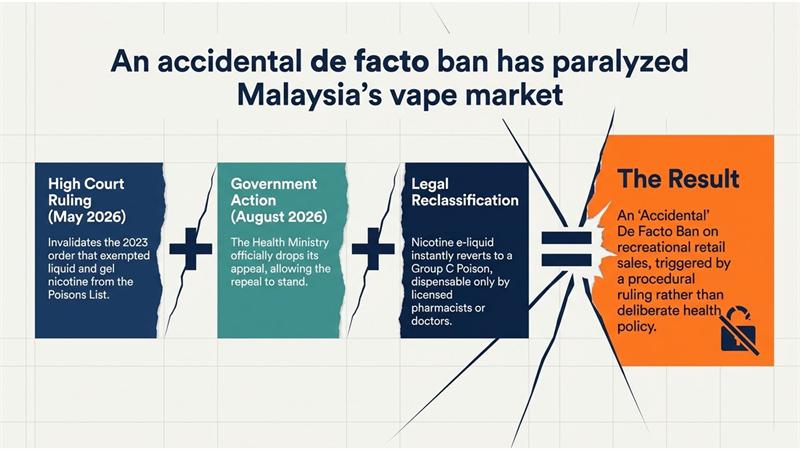
- Malaysia’s High Court ruled in May 2026 that a 2023 order exempting liquid and gel nicotine from the Poisons List was unlawful.
- The government dropped its appeal in August 2026, letting that ruling stand.
- Nicotine e-liquid is now a Group C poison — only pharmacists or doctors can dispense it. Analysts call this a de facto ban.
- A separate law, the Control of Smoking Products for Public Health Act 2024, still regulates vape sales. Two laws now pull in opposite directions.
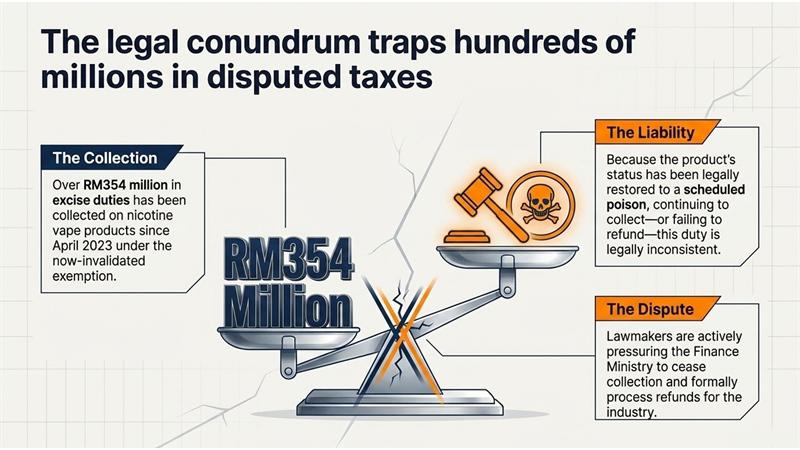
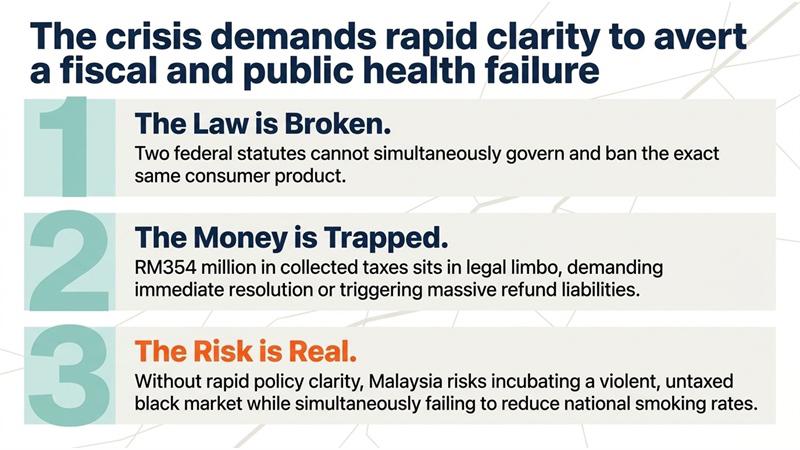
- Over RM354 million (roughly $88.5 million) in excise duties collected since 2023 sit at the center of a growing refund dispute.
- This environment creates serious misperceptions about the relative risk of nicotine vs. smoking, puts at risk the health of smokers and former smokers, and creates the ground for an uncontrolled illict market that will target vulnerable populations and youth.
What Is the Current Legal Status of Nicotine Vape in Malaysia?#
Right now, nicotine e-liquid is a Group C poison under the Poisons Act 1952. That means only a licensed pharmacist or registered doctor can legally dispense it — not a vape shop, not an online store. Only two nicotine products are exempt: tobacco itself, and registered nicotine patches or gum for smoking cessation.
Why Was Nicotine Exempted From the Poisons List in 2023?#
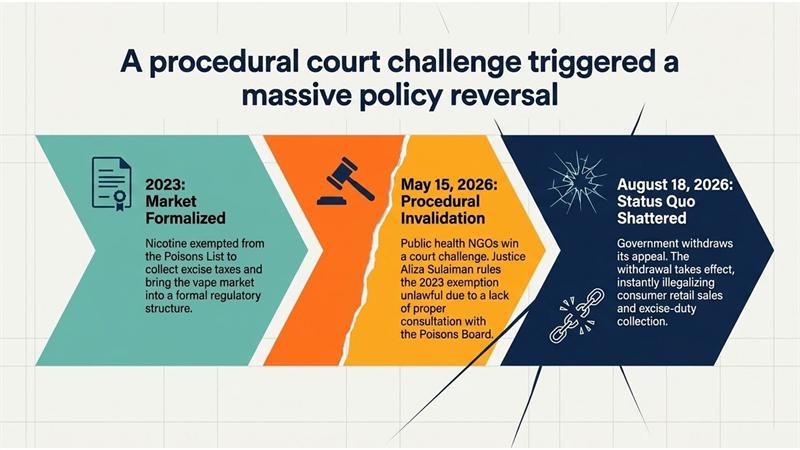
In 2023, then-Health Minister Dr. Zaliha Mustafa gazetted an order removing liquid and gel nicotine from the Poisons List. This move allowed the government to start collecting excise duty on vape products, treating them as taxable commodities rather than controlled substances.
What Did the High Court Rule in May 2026?#
However, three public-health groups – the Malaysian Council for Tobacco Control, the Malaysian Green Lung Association, and Voice of the Children – challenged this exemption in court. On May 15, 2026, Justice Aliza Sulaiman of the Kuala Lumpur High Court ruled that the government’s decision was irrational and unlawful because officials hadn’t properly consulted with the Poisons Board before making the change.
Why Did the Government Withdraw Its Appeal?#
The Health Minister, Dzulkefly Ahmad, withdrew the appeal on August 18, 2026. By doing so, he let the High Court judgment stand, putting liquid and gel nicotine back on the Poisons List. This decision reflects the legal relationship between the Poisons Act 1952 and the newer Control of Smoking Products for Public Health Act 2024.
Is Nicotine Vape Now Effectively Banned in Malaysia?#
Functionally, yes. Because the exemption was never lawful to begin with, nicotine’s status as a scheduled poison took effect instantly when the High Court ruled. Recreational sales and excise collection became illegal overnight. Some commentators have described this as an “accidental” ban – it came from a court ruling on procedure, not a deliberate new prohibition policy.
Why Are Two Laws Now in Conflict?#
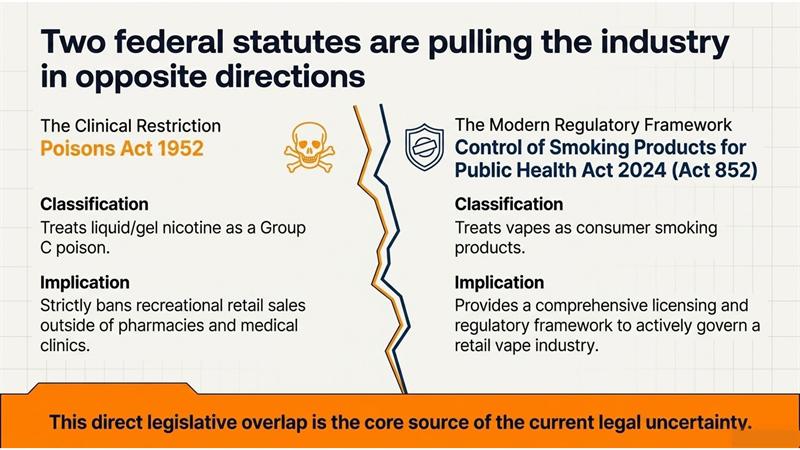
Malaysia has two statutes addressing nicotine vape: the Poisons Act 1952 and the Control of Smoking Products for Public Health Act 2024. These laws point in opposite directions:
| Law | What it does | Current implication |
|---|---|---|
| Poisons Act 1952 | Classifies liquid/gel nicotine as Group C poison | Bans recreational retail sale outside pharmacies |
| Control of Smoking Products for Public Health Act 2024 (Act 852) | Licenses and regulates vape sales | Still technically governs the retail vape industry |
This overlap is the core source of legal uncertainty, with industry groups pressing the government for a clear resolution.
What Are Lawmakers Saying?#
Parliament has split along the same fault line:
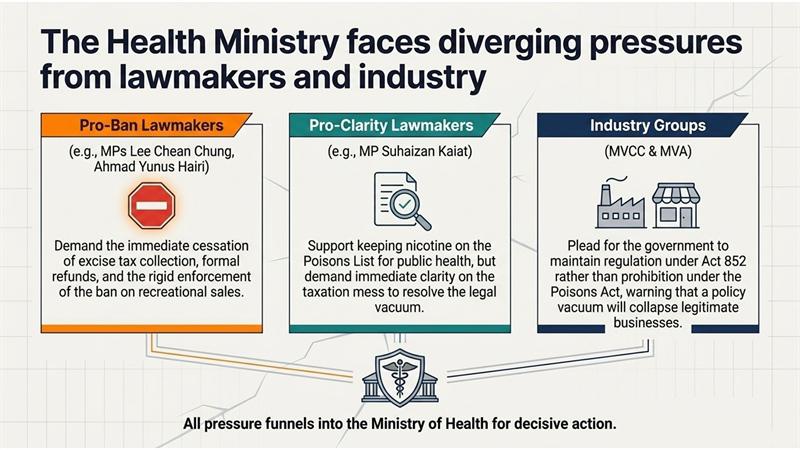
- Petaling Jaya MP Lee Chean Chung has called for a formal ban on recreational nicotine vape sales and for refunds of excise duties collected since April 2023.
- Pulai MP Suhaizan Kaiat wants clarity on taxation while supporting keeping nicotine on the Poisons List.
What Does the Industry Want?#
The Malaysian Vape Chamber of Commerce and the Malaysian Vapers Alliance are urging the government to keep regulating nicotine vape under Act 852, rather than treating it purely as a controlled poison. They fear that prolonged uncertainty will drive sales underground, risking an unregulated black market.
How Much Money Is at Stake?#
Over RM354 million (roughly $88.5 million) in excise duties has been collected since April 2023. With the exemption now invalidated, opposition MPs argue that continuing to collect — or failing to refund — this duty is legally inconsistent with nicotine’s restored status as a scheduled poison.
What Happens Next?#
As of early September 2026, the Health Ministry hasn’t issued a final resolution on this issue. The outcome will likely be influenced by ongoing debates in Parliament and discussions at Cabinet level about regulating nicotine vape products. Some commentators have noted a political dimension: the current ambiguity may give the vape industry a de facto grace period to sell off stock before the next general election. A new government could then move toward an outright ban.
What Are the Public Health Implications?#
Public health researchers who support tobacco harm reduction argue that reclassifying nicotine e-liquid as a poison undermines, rather than protects, public health. The core concerns:
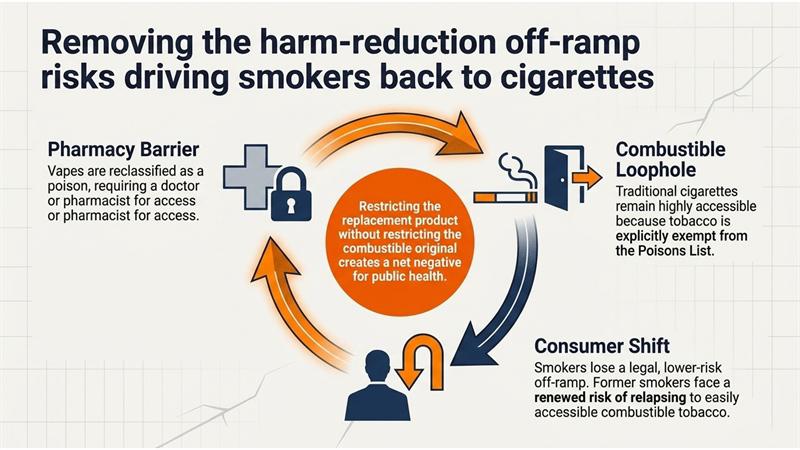
Tobacco harm reduction is undercut. Vaping is widely used internationally as a lower-risk alternative to smoking. Restoring nicotine e-liquid to Group C poison status removes legal access to that alternative for adult smokers, leaving cigarettes as the most accessible nicotine product — since tobacco itself remains exempt from the Poisons List.
Smokers lose a lower-risk off-ramp. Adult smokers who might switch to vaping to reduce their risk no longer have a clear, legal retail pathway. Getting nicotine e-liquid legally now requires a pharmacist or doctor — a barrier that doesn’t exist for buying cigarettes.
Former smokers risk relapse. People who quit smoking by switching to vaping face renewed risk of returning to cigarettes if vape products become harder to access, more expensive, or legally uncertain. Restricting the legal replacement without restricting the combustible product removes the substitute that helped them quit.
A black market is a predictable outcome. Restrictive vape policies elsewhere consistently push demand underground rather than eliminating it:
- India banned e-cigarette manufacture, sale, and import outright in 2019. Seven years on, illicit vapes remain widely available in urban markets; authorities seized e-cigarettes worth roughly INR 42 million between April and November 2024 alone, and researchers describe an illicit market now valued in the billions of dollars.
- Australia restricted vape sales to a pharmacy-only, prescription-style model. Government and independent estimates describe the illicit vape and tobacco trade as worth billions nationally, with the Australian Border Force seizing millions of illegal vapes annually. The enforcement gap has been linked to organized crime, including firebombings of retail stores and turf-war violence.
- Latin America, where several countries (Brazil, Argentina, Mexico) have imposed outright bans, has seen persistent informal and cross-border markets for nicotine vape products, mirroring the enforcement challenges in India and Australia.
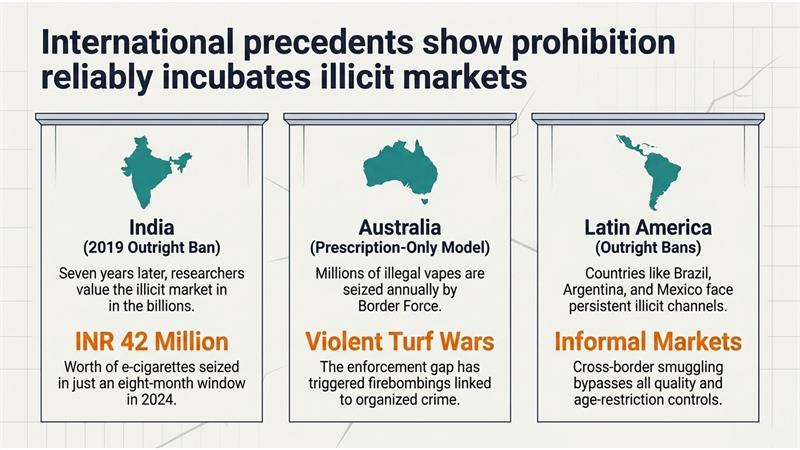
The pattern suggests prohibition-style restrictions shift consumption underground rather than end it, often with added costs: lost tax revenue, unregulated (and potentially more dangerous) product quality, and enforcement resources diverted toward organized illicit supply chains. Whether Malaysia’s current status — a de facto ban driven by a court ruling on procedural grounds — produces the same outcome is a key open question as the government decides its next move.
In detail, what are the implications for THR, smokers and former smokers?#
From a tobacco harm reduction standpoint, this ruling feels like a step backward in the worst possible way. Adult smokers who might have switched to vaping to lower their risk now face a legal pathway that requires a pharmacist or doctor, while buying a pack of cigarettes remains as easy as walking into a corner shop. The irony is hard to miss: tobacco, the product responsible for the overwhelming share of smoking-related harm, stays exempt from the Poisons List. Meanwhile, a lower-risk alternative is pushed out of reach. Former smokers who quit by switching aren’t safe either; if their replacement product is harder to access, moves undeground and becomes more expensive through back channels, or is wrapped in legal uncertainty, the risk of returning to cigarettes is real. Restricting the substitute without restricting the combustible product doesn’t protect anyone — it just tilts the playing field back toward the more dangerous option. There is an even bigger irony: it is public health groups that initiated and created these risks for people.
Υπάρχει επίσης η μαύρη αγορά — και δεν πρόκειται για υποθετικό σενάριο. Όταν χώρες όπως η Ινδία και η Αυστραλία περιόρισαν ή απαγόρευσαν το άτμισμα με νικοτίνη, η ζήτηση δεν εξαφανίστηκε· απλώς πέρασε στην παρανομία. Προϊόντα χωρίς ρυθμιστικό έλεγχο κάλυψαν το κενό, το κόστος επιβολής του νόμου εκτινάχθηκε και το οργανωμένο έγκλημα εισχώρησε στον χώρο. Η Μαλαισία δεν χρειάζεται να επαναλάβει αυτό το λάθος. Μια de facto απαγόρευση που επιβάλλεται δικαστικά ενέχει τον κίνδυνο να δημιουργήσει ακριβώς αυτό το κενό — ένα κενό που θα καλυφθεί από προϊόντα άγνωστης προέλευσης και ποιότητας, τα οποία πωλούνται χωρίς ελέγχους ηλικίας και βρίσκονται εκτός κυβερνητικού ελέγχου. Σε αυτά προστίθεται και το φαινόμενο της παραπληροφόρησης: όταν η νικοτίνη χαρακτηρίζεται ως δηλητήριο —χαρακτηρισμός που δεν αποδίδεται στα τσιγάρα— το κοινό λαμβάνει το λανθασμένο μήνυμα ότι το άτμισμα είναι πιο επικίνδυνο από το κάπνισμα και ότι η νικοτίνη αποτελεί την κύρια αιτία των ασθενειών που σχετίζονται με το κάπνισμα. Το κόστος για τη δημόσια υγεία προκύπτει τόσο από τη μαύρη αγορά όσο και από τις λανθασμένες αντιλήψεις: οι πολίτες λαμβάνουν το λάθος μήνυμα —ότι το άτμισμα είναι πιο επικίνδυνο από το κάπνισμα— γεγονός που απομακρύνει τους καπνιστές από μια επιλογή χαμηλότερου κινδύνου και τους ωθεί πίσω στο υφιστάμενο καθεστώς.
FAQ#
Is vaping illegal in Malaysia right now? Nicotine-containing e-liquid is a Group C poison, meaning it cannot legally be sold as a consumer retail product — only dispensed by a pharmacist or doctor. This is widely described as a de facto ban, though the government hasn’t issued a formal, explicit prohibition of vape devices themselves.
What was the court case about? Malaysian Council for Tobacco Control & 2 Others v Malaysia Health Minister & Another challenged a 2023 government order removing liquid and gel nicotine from the Poisons List. The High Court found the order unlawful for lack of proper consultation with the Poisons Board.
Will vape sales be regulated by a different law instead? That’s what the vape industry and some lawmakers want — continued regulation under the Control of Smoking Products for Public Health Act 2024 instead of prohibition under the Poisons Act. As of early September 2026, the Health Ministry hasn’t issued a final resolution.
What happens to the excise duty already collected? Refunds are legally due on excise duties paid since 2023, since the exemption that justified taxing nicotine vape has been invalidated. MPs have called for the Finance Ministry to formally process refunds exceeding RM354 million.
This is a fast-moving legal and regulatory situation. Details above reflect reporting available as of early September 2026 and may change as the Malaysian government issues further clarification.
Sources#
- CodeBlue — Malaysia’s Poisoned Chalice Of Nicotine Vape: First Lacuna, Now An Accidental ‘Ban’
- CodeBlue — Vape Businesses, Consumers Demand Clarity On Legality Of Nicotine Vape
- CodeBlue — Analysis: Court Decision Marks De Facto Ban On Nicotine Vape
- CodeBlue — Pulai MP Wants Clarity On Nicotine Vape Control, Taxation Status
- Tobacco Reporter — Malaysian MPs Want Vape Liquid Declared Controlled Poisons
- 2Firsts — Malaysia Liquid Nicotine Returns to Poisons List, Leaving Vape Retail and RM354 Million Tax Collection in Legal Uncertainty
- Nicotine Insider — Malaysia Vape Fight Grows After Court Ruling
- iGeekphone — Malaysia Withdraws Appeal in Liquid Nicotine Vape Case
- 2Firsts — India’s Vape Ban: A Case Study in Unintended Consequences
- Mediaindia.eu — Despite ban, e-cigarettes readily available in India
- Consumer Choice Center — Seven Years Later, India’s Vaping Ban Still Isn’t Working
- The Conversation — Australia’s restrictive vaping and tobacco policies are fuelling a lucrative and dangerous black market
- ABC News — Australian Border Force seize 20 million illegal vapes since January 2024 as crackdown continues
- World Vapers’ Alliance — Australia’s Vape Prohibition is Fueling a Violent Black Market