

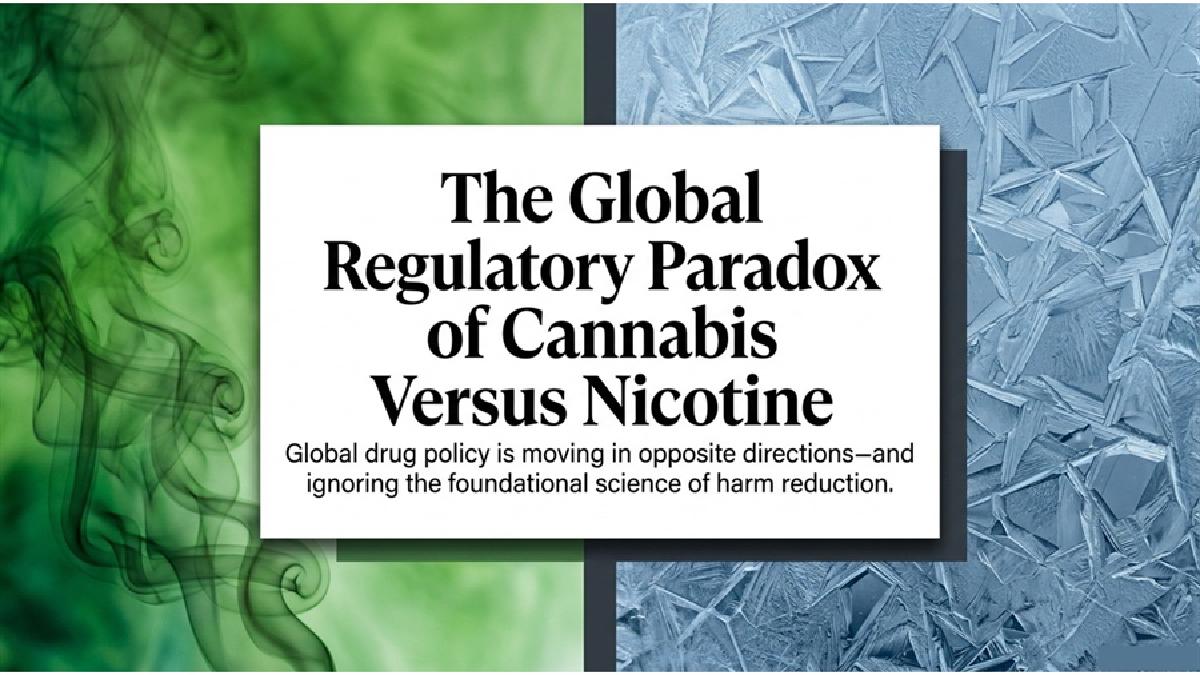

A new Harm Reduction Journal paper by Konstantinos Farsalinos argues that global drug policy has become internally inconsistent, and the application of double standards is becoming the new “norm”.
Key Takeaways#
- Cannabis, a psychoactive substance linked to real risks of psychosis and cognitive decline, is rolling out globally under the promise of personal freedom.
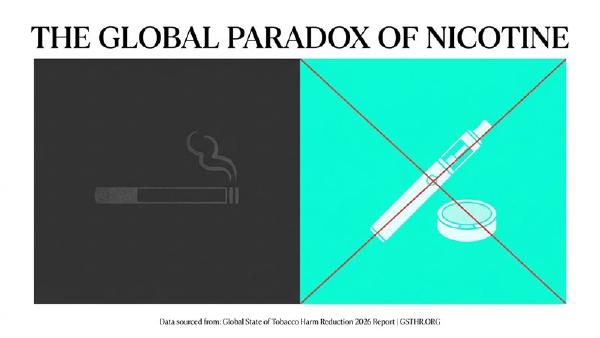
- At the same time, non-combustible nicotine products—like vapes, pouches, and snus, which don’t intoxicate and carry far lower toxicological risks than smoking—are getting banned or criminalized in dozens of countries.
- This contradiction has been labeled a “regulatory paradox.” In both cases, it’s the combustion, not the drug itself, that drives most of the harm, yet policy treats them as opposites.
- From a toxicological standpoint, smoke is smoke; cannabis smoke shares carcinogens and toxic pathways with tobacco smoke and may even deliver more tar per puff. Yet the restrictions focus on nicotine’s non-combustible forms while leaving cannabis smoking largely unchecked.
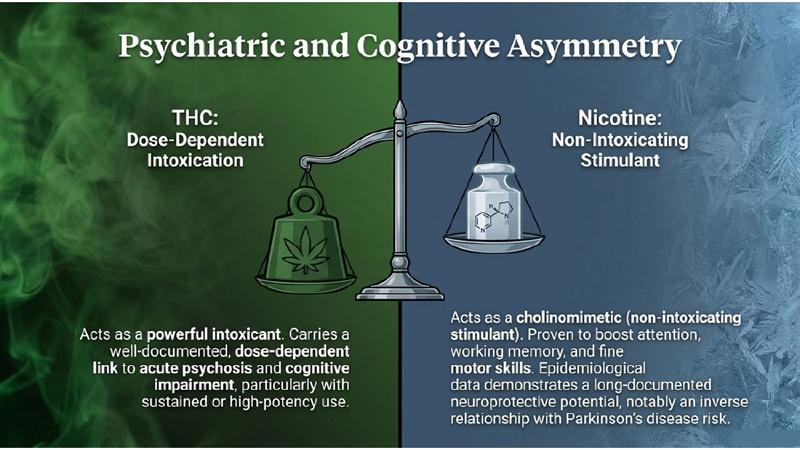
- Neurocognitively, nicotine acts as a non-intoxicating stimulant with proven cognitive benefits like sharpened attention and working memory, whereas THC carries a well-documented, dose-dependent link to acute psychosis and cognitive impairment.
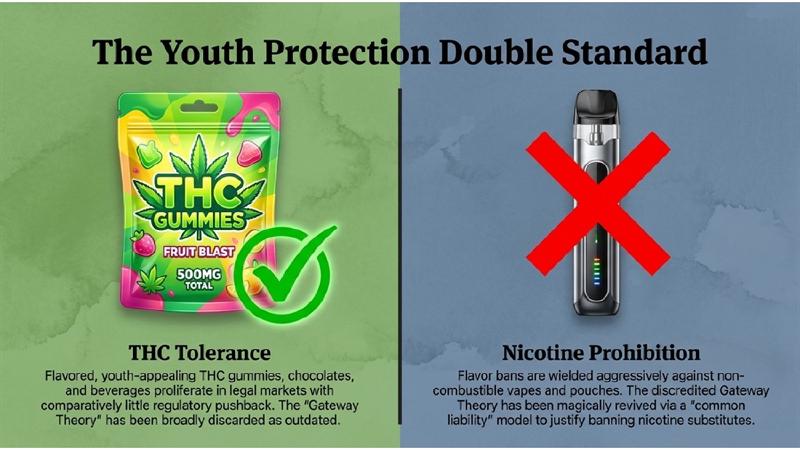
- A double standard protecting youth runs through both markets: flavor bans and “gateway theory” fears are weaponized against vapes and pouches, while flavored, youth-appealing THC edibles and vapes proliferate with little regulatory pushback.
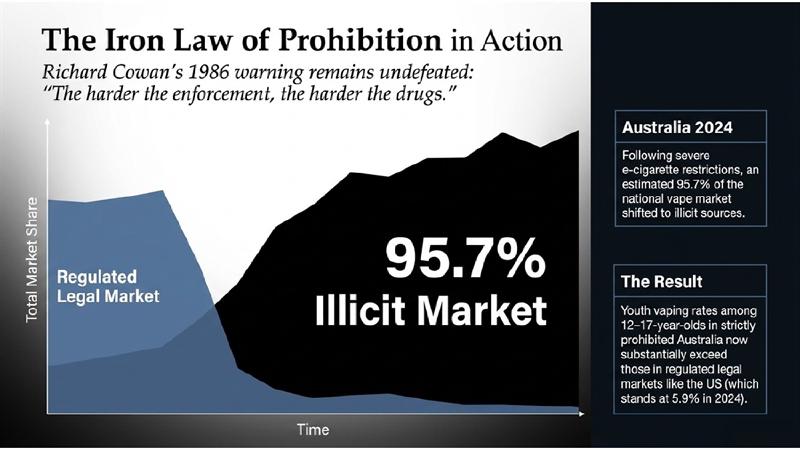
- Sociologically, the “Iron Law of Prohibition” is playing out again: Australia’s 2024 e-cigarette restrictions coincided with an estimated 95.7% of its vape market going illicit—the same black-market dynamic regulators previously accepted as a lesson from cannabis and alcohol prohibition.
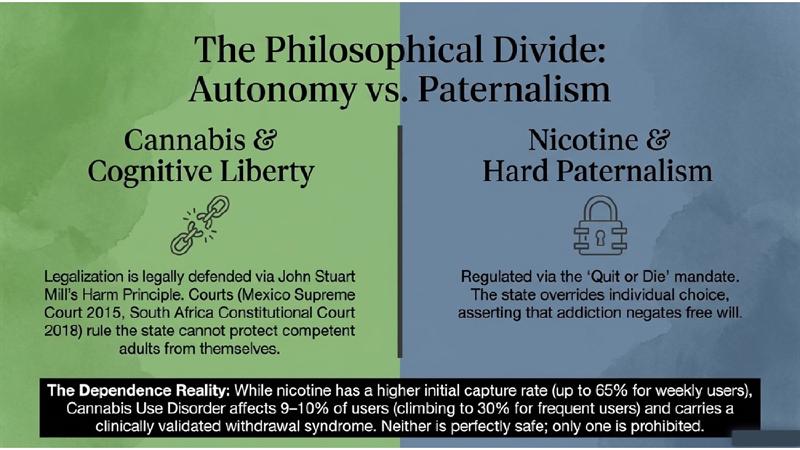
- Bioethically, cannabis legalization is defended through “cognitive liberty” and adult autonomy, while nicotine regulation has swung toward “hard paternalism,” treating addiction as negating free will and denying smokers access to lower-risk substitutes. The comparison of dependence also contradicts the policy trend.
- While nicotine has a higher capture rate among first-time users, cannabis use disorder is more prevalent at a population level and includes a clinically validated withdrawal syndrome, undercutting the idea that cannabis is simply the “safe” substance and nicotine the dangerous one.
- Economically and in criminal-justice terms, the paper argues nicotine bans reproduce the very costs cannabis liberalization was meant to avoid: lost tax revenue, destroyed legitimate businesses, and enforcement resources funneled into policing a black market instead of advancing public health.
The Core Claim, Up Front#
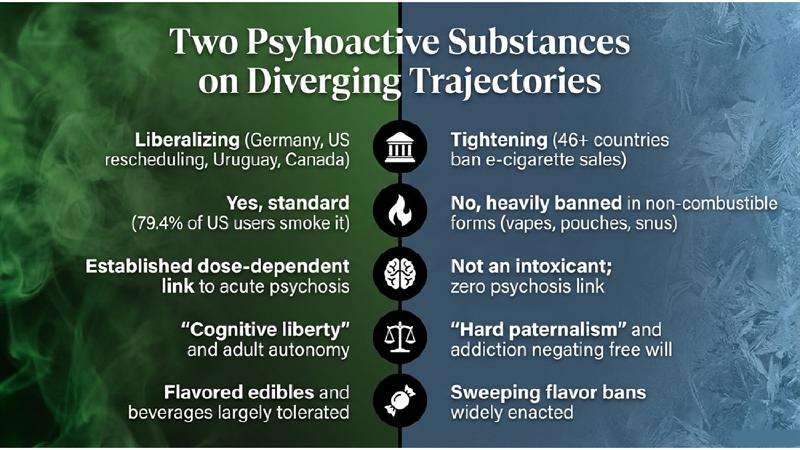
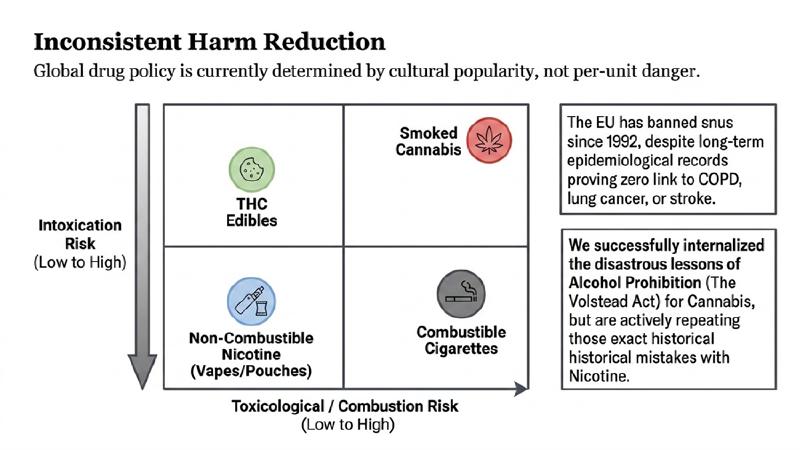
The argument is straightforward: if you separate THC and nicotine from their traditional delivery systems—smoked cannabis and combustible cigarettes—the toxicology simply doesn’t support current policy. Combustion, not the drug itself, is the primary driver of harm in both scenarios. Yet policy has moved in opposite directions: cannabis is heading toward liberalization, while nicotine is facing prohibition of exactly the products—e-cigarettes, snus, and pouches—that remove combustion from the equation.
What the Paper Actually Compares#
This manuscript pulls together toxicological, sociological, and bioethical literature to put these two substances side by side. Several contrasts stand out sharply:
Psychiatric risk is asymmetric. THC has a well-documented, dose-dependent link to psychosis and cognitive impairment, particularly with sustained or high-potency use. Nicotine, by contrast, is not an intoxicant; it does not cause psychosis and even shows documented cognitive-enhancing effects on attention and working memory.
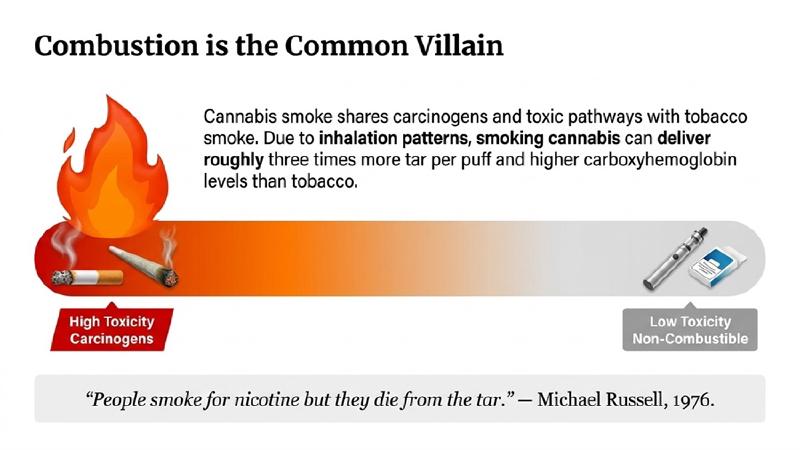
Combustion is the common villain. Cannabis smoke carries carcinogens and toxicological pathways similar to tobacco smoke, and per puff, it may deliver more tar than cigarette smoke. Yet regulators restrict non-combustible nicotine products while leaving combustible cannabis smoking largely unregulated for those reasons.
The “Iron Law of Prohibition” is being ignored — again. Australia tightened e-cigarette restrictions in 2024, coinciding with an estimated 95.7% of that nation’s vape market shifting to illicit sources. The lesson—that banning a product doesn’t eliminate demand, it just pushes supply underground—is one regulators readily accept for cannabis but not for nicotine.
Youth-protection arguments cut only one way. Flavor bans and “gateway theory” arguments are wielded aggressively against vapes and pouches, while flavored, youth-appealing THC gummies, chocolates, and beverages proliferate in legal cannabis markets with comparatively little pushback.
A Side-by-Side Snapshot#
| Dimension | Cannabis (“Green Wave”) | Nicotine (“Nicotine Freeze”) |
|---|---|---|
| Regulatory direction | Liberalizing (Germany, US rescheduling, Uruguay, Canada, etc.) | Tightening (46+ countries ban e-cigarette sales) |
| Combustion involved | Yes, in most use (79.4% of US cannabis users smoke it) | No, for vapes/pouches/snus specifically |
| Psychiatric risk | Established link to psychosis, especially high-potency use | Not an intoxicant; no psychosis link |
| Dependence framing | Framed as autonomy/cognitive liberty | Framed as “hard paternalism,” addiction negating free will |
| Youth flavor policy | Flavored edibles largely tolerated | Flavor bans widely enacted |
Where the Analysis Is Strongest#
The bioethical framing serves as the paper’s most compelling thread. It is genuinely difficult to justify, on principle, why the state defers to adult autonomy for a substance with documented psychiatric risk while overriding that same autonomy for a substance whose main behavioral hazard is dependence rather than intoxication. The “quit or die” framing—where the only sanctioned path off cigarettes is often complete abstinence, while safer substitutes get banned—represents a genuine policy tension, not merely a rhetorical flourish. The comparison to alcohol Prohibition (the Volstead Act) fits well: driving a market underground tends to increase potency and toxicity, not reduce use.
Bottom Line#
Regardless of your view on either substance, the paper’s central empirical point is one worth sitting with: harm-reduction logic is being applied inconsistently across two psychoactive substances, largely along the lines of “which one is currently unpopular in policy circles” rather than “which one is more dangerous per unit of exposure.” If regulators are willing to trust adults to weigh the risks of a smoked, sometimes psychosis-linked drug, the same logic arguably extends to a non-intoxicating stimulant, particularly when delivered without combustion.
FAQ#
What is the “Nicotine Freeze”? This is a term for a global pattern where governments ban or severely restrict non-combustible nicotine products like e-cigarettes, snus, and nicotine pouches, even while leaving combustible cigarettes legal in the same jurisdictions.
Does the paper claim nicotine is harmless? No. The author acknowledge that nicotine carries real dependence risks and some acute cardiovascular effects. Their point is that its overall danger is far lower than smoking, yet regulators treat it as if it poses the same level of risk as combustion.
Why does the primary source of tobacco harm matter for regulation? Because the paper’s core toxicological argument is that combustion—not the nicotine itself—is what drives smoking-related disease. This relies on Michael Russell’s 1976 observation that “people smoke for nicotine but they die from the tar.” Once you remove the combustion element, whether through vaping, heating, or oral pouches, the evidence shows the toxicological and exposure profiles shift sharply away from those of smoking.
Is smoking cannabis actually as risky as smoking tobacco? The paper suggests it may be riskier per exposure event in certain ways. Cannabis smoke shares carcinogens and toxicological pathways with tobacco; extract studies show it can be a more potent toxicant; and smoking cannabis delivers roughly three times more tar and higher carboxyhemoglobin levels than tobacco, partly because users tend to inhale deeper and hold their breath longer. However, the authors note that this evidence is often muddied by selection bias and the fact that users frequently smoke both substances together.
Why did the EU ban snus, and does the evidence support that ban? The EU has prohibited snus sales (with Sweden as the notable exception) since 1992. The paper argues the data doesn’t back up classifying it as high-risk. Long-term epidemiological records indicate snus use isn’t linked to chronic obstructive pulmonary disease, lung cancer, cancers in other organs, or acute myocardial infarction or stroke, despite the product containing tobacco-derived toxicants. Therefore, the ban is unjustified
Does the “gateway theory” still hold up as a reason to restrict nicotine vaping? The paper says no, noting the theory has undergone a “curious regulatory inversion.” Once the bedrock of cannabis prohibition, it has largely been dismissed by regulators as outdated and replaced by the “common liability” model, which focuses on shared psychosocial vulnerability rather than sequential causation. Yet, that same discredited logic has been revived specifically to justify restricting nicotine vapes and pouches.
What actually happened when Australia restricted e-cigarettes to prevent youth vaping? According to the paper’s cited data, the result was the opposite of the intended goal. By 2024, an estimated 95.7% of Australia’s e-cigarette market was illicit. Consequently, youth vaping rates among 12–17-year-olds ended up substantially higher than in countries with regulated legal markets, such as the US, where current use stood at 5.9% in 2024.
Was the 2019 EVALI outbreak caused by nicotine e-cigarettes? No. The paper flags this as a case study in health miscommunication. EVALI was driven by vitamin E acetate, a thickening agent found in illicit THC vaping products, not in nicotine e-cigarettes. Despite this, labeling the syndrome “e-cigarette… associated lung injury” led many smokers and the public to wrongly blame legal nicotine vapes.
Does nicotine have any cognitive or neuroprotective benefits? The paper argues yes, and claims these are systematically downplayed. Nicotine acts as a cholinomimetic that boosts attention, working memory, and fine motor skills in both smokers and non-smokers. Epidemiological data also show a long-documented inverse relationship between smoking and Parkinson’s disease risk, plausibly linked to nicotinic receptor stimulation.
How does cannabis dependence compare to nicotine dependence? Nicotine has a higher “capture rate”: roughly a third of people who try combustible tobacco progress to dependence, a figure that rises above 65% among weekly users, driven by nicotine’s rapid delivery to the brain. Cannabis use disorder is comparatively lower per exposure but remains substantial at a population level (around 9–10% of adult users, climbing toward 30% among frequent or high-potency users), and a clinically validated withdrawal syndrome exists as well.
What is Mill’s Harm Principle, and how does the paper use it? It is the philosophical concept from John Stuart Mill stating that state power can justly be used only to prevent harm to others, not to protect competent adults from themselves. The paper argues that courts—such as Mexico’s Supreme Court in 2015 and South Africa’s Constitutional Court in 2018—have invoked this principle to strike down cannabis prohibition. In contrast, nicotine policy has moved toward the opposite stance: “hard paternalism” that overrides individual choice in the user’s perceived best interest.
What is the “Iron Law of Prohibition,” and why does it matter for nicotine policy? Richard Cowan introduced the “Iron Law of Prohibition” in 1986 with a stark warning: “the harder the enforcement, the harder the drugs.” In an underground market, vendors aren’t pressured to be safe or consistent; they are driven to squeeze maximum potency out of every gram to slip past regulators and boost margins. That same playbook is now playing out with nicotine. By driving legitimate harm-reduction tools like vapes and pouches underground, we are stripping away the very safety nets that keep products controlled and age verification in place. This isn’t new; it is the same historical script seen during Alcohol Prohibition under the Volstead Act and during decades of cannabis crackdowns.
Where can I read the full paper? Farsalinos K. “Cannabis Green Wave” versus “Nicotine Freeze”: the regulatory paradox of cannabis liberalization and nicotine prohibition. Harm Reduction Journal (2026) 23:146. https://doi.org/10.1186/s12954-026-01517-8