
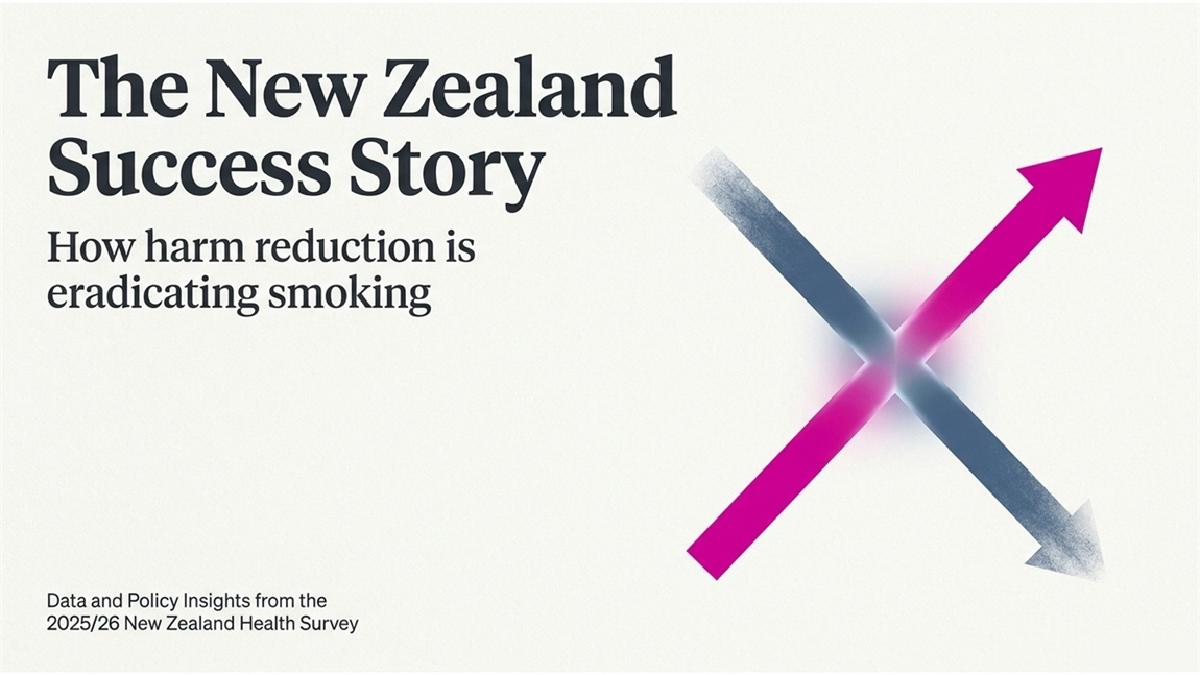

In short. Smoking in New Zealand has fallen by nearly two-thirds in fourteen years, from 16.4% of adults smoking daily in 2011/12 to 5.9% in 2025/26, while 11.2% now vape daily. Vaping was the most common aid people used in their last quit attempt (36.5%), ahead of nicotine replacement therapies such as patches (29.8%). Over half of daily vapers are former smokers, and the 6.3% of adults who are former smokers and vape daily outnumber the 5.9% who still smoke daily.
These figures come from the 2025/26 New Zealand Health Survey, published by the Ministry of Health (Manatū Hauora) on November 18, 2026. The survey covers people aged 15 years and over.
What do New Zealanders use to stop smoking?#
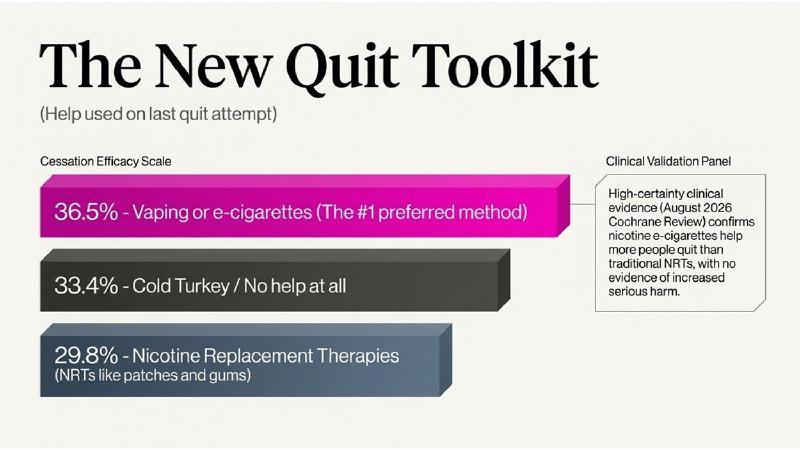
Vaping was the most common aid used in the last quit attempt, at 36.5%. The next most common response was no aid: 33.4% (one in three) used nothing in their last attempt. Nicotine replacement therapies followed at 29.8%.
| Help used on last quit attempt, 2025/26 | Share of people who tried to quit |
|---|---|
| Vaping or e-cigarettes | 36.5% |
| Nicotine replacement therapies (patches, gums) | 29.8% |
| No help at all | 33.4% |
The survey also asked about several other types of support: medication, support from friends and family, the national Quitline telephone service, face-to-face services, and traditional Māori healing (rongoā); less than 8.5% used any of these methods.
When daily vapers were asked why they vape, 46.1% answered to cut down on or quit smoking, the second most common reason after cost.
The survey records which types of aid people used in their last quit attempt, but it does not report successful attempts. It shows what people in New Zealand choose when trying to quit, and vaping is now the most popular smoking cessation aid in the country.
Is vaping replacing smoking in New Zealand?#
The numbers strongly indicate a substitution effect.
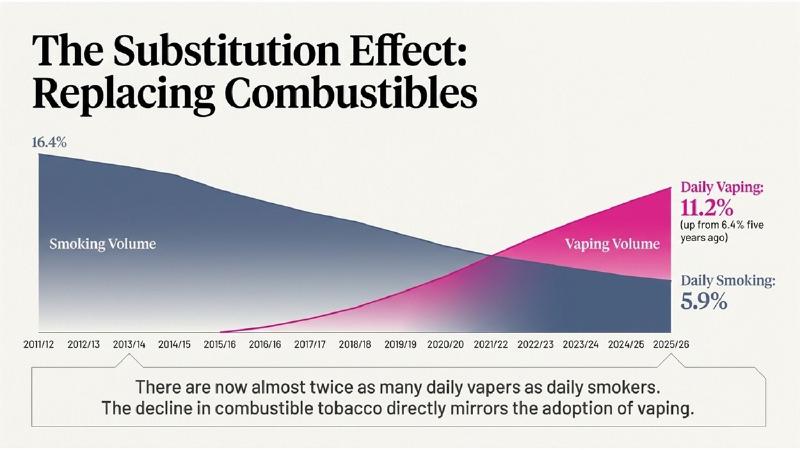
First, smoking fell dramatically while vaping rose. Daily smoking fell from 16.4% to 5.9%, and daily vaping, which was first measured in 2015/16, is now at 11.2%. In fact, a recent study showed that New Zealand’s policy shift, which adopted vaping as a tool for smoking cessation, led to a fivefold increase in the rate of smoking decline in the population. There are almost twice as many daily vapers as daily smokers. Vaping is now higher than smoking among young adults, and, most importantly, smoking among teenagers is close to zero.
Second, vaping is the most common aid reported in the last quit attempt, even more so than quitting without any help (which was traditionally the most popular way to quit among smokers).
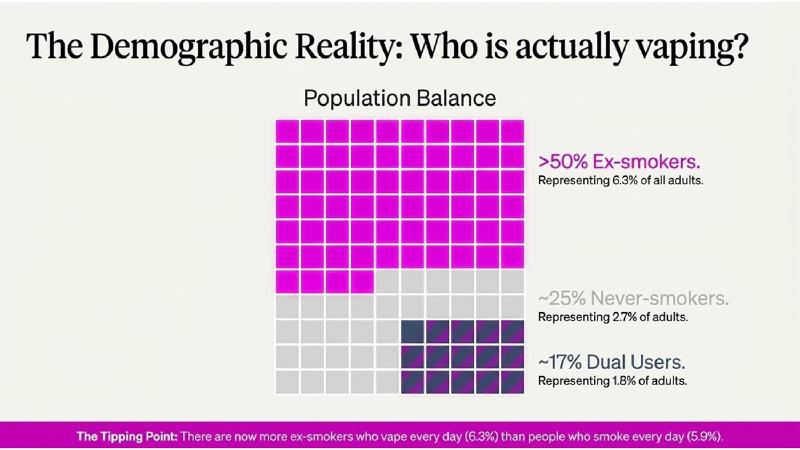
Third, just over half of all daily vapers used to smoke, and among daily vapers over 35 years old, the majority are former smokers. Adults who are former smokers and vape daily now make up a larger group than adults who smoke daily. Daily vaping has increased in every age group since it was first measured in 2015/16, which is not unexpected. About one in four adults aged 18 to 24 vapes daily, while less than 5% smoke daily. Among teenagers aged 15 to 17, smoking is now close to zero, and daily vaping is under 10%. This is lower than Australia’s 14.3% among teenagers, despite restrictive regulations and access bans.
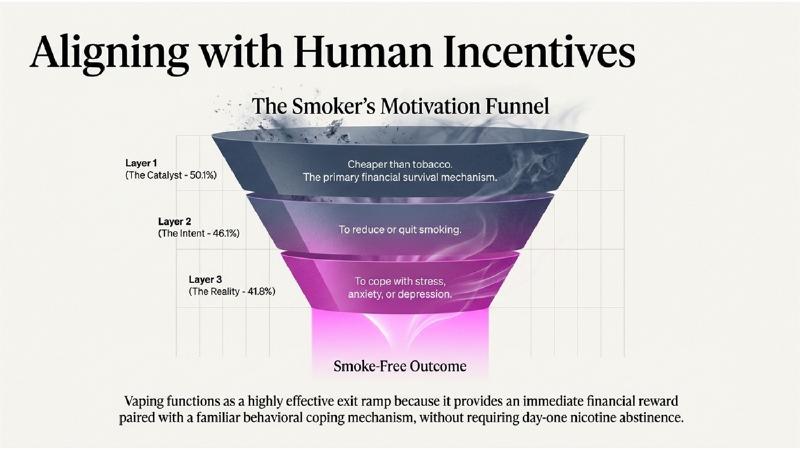
Fourth, almost half of daily vapers vape to cut down on or stop smoking, and half also say it is cheaper than conventional cigarettes, a major incentive for smokers. The survey also records other reasons, such as flavors (4th most popular answer, 33.9%), enjoyment of vaping, the belief that it is less harmful than smoking, and the feeling that it is more acceptable to others compared to smoking. At the other end of the list were “recommended by a health professional” (just 4.7%) and “easier to get than tobacco” (9%).
How much has smoking fallen in New Zealand?#
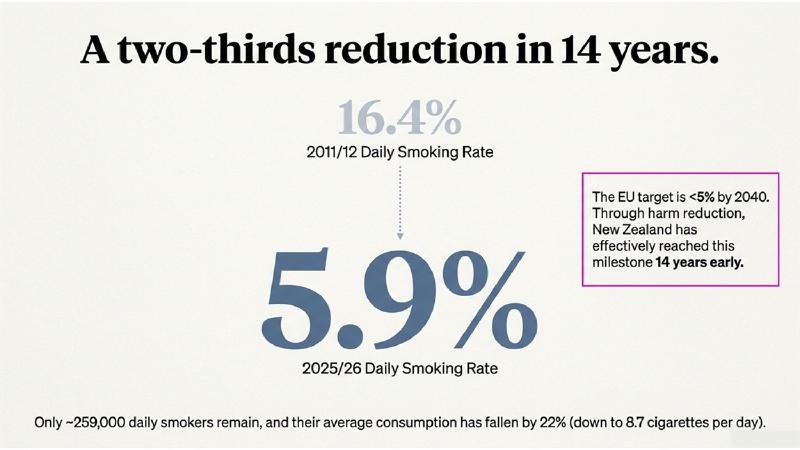
Daily smoking has fallen by nearly two-thirds since 2011/12. It was 16.4% of the population then, 6.7% in 2024/25, and 5.9% now. About 259,000 people smoke daily in New Zealand today.
The drop occurred in every age group, but it was largest among younger people.
| 2011/12 | 2024/25 | 2025/26 | |
|---|---|---|---|
| Adults who smoke daily | 16.4% | 6.7% | 5.9% |
Who still smokes in New Zealand?#
People who continue to smoke daily smoke less than before. In 2025/26, they smoked an average of 8.7 cigarettes per day, down from 11.2 in 2011/12 (a 22% decrease).
Smoking is now more common among middle-aged and older adults than among young adults. A decade earlier, the opposite was true. The highest rates are found in ages 45 to 54 (9.2%) and 55 to 64 (8.0%), and together these two groups make up 42% of all daily smokers.
Men are more likely to smoke than women: 7.0% of men smoke daily, compared to 4.9% of women. Men make up about 58% of all daily smokers, and after adjusting for age differences, men are 1.5 times more likely to smoke daily than women.
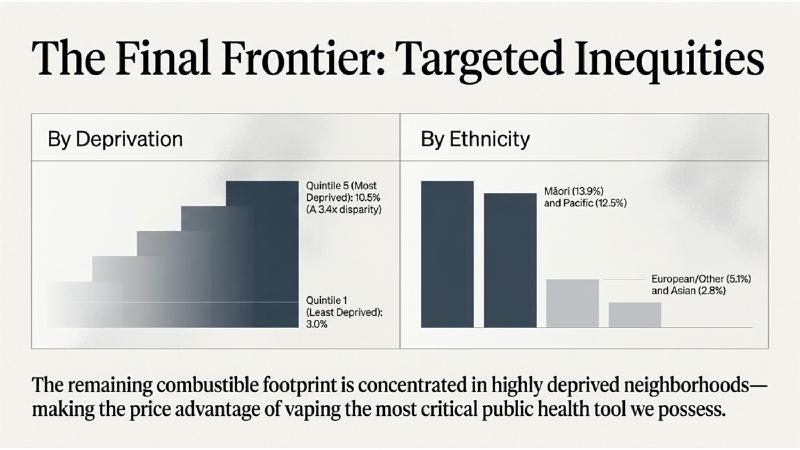
Socioeconomic factors also play a role in smoking rates. In the least deprived neighborhoods, 3.0% smoke daily, while in the most deprived, the rate is 10.5%. After accounting for differences in age, sex, and ethnicity, adults in the most deprived areas are 3.4 times more likely to smoke daily than those in the least deprived.
What New Zealand’s numbers mean#
The most logical reading of the survey is that vaping has replaced a large portion of smoking in New Zealand. Smoking fell by nearly two-thirds while vaping rose. Vaping is the most common tool people use to quit. Former smokers who vape daily now outnumber daily smokers. And among young adults, smoking has fallen to a very low level while vaping has become the most common habit.
This evidence aligns with clinical data. The Cochrane systematic review published in August 2026 found high-certainty evidence that nicotine e-cigarettes help more people quit than pharmaceutical replacements. There is no evidence of increased serious harm from using e-cigarettes for smoking cessation, though they naturally point out that further long-term studies are needed.
The New Zealand government played a major role in securing this positive outcome. In 2024, it stated in official documents that vaping played a significant role in reducing smoking rates and that it continues to support vaping as a tool for adults who smoke. Starting in January 2025, it began providing free vaping starter kits to smoking cessation services. At the same time, it tightened rules on youth vaping, with laws coming into effect in June 2025. They encouraged adult smokers to switch their habit with vaping, and sought to keep non-smoking youth away from e-cigarettes.
New Zealand is now very close to becoming a smoke-free country, as is already the case with Sweden.
Why this should be a model for other countries#
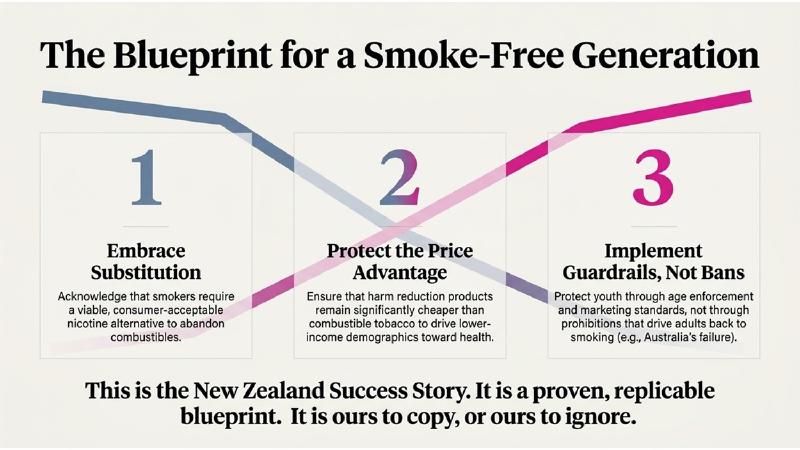
New Zealand shows what happens when a country actively offers smokers a realistic alternative. Most smokers want to quit, and many try repeatedly. Nicotine is the reason it is hard, but smoke is what kills. A product that delivers nicotine without burning tobacco helps people move away from cigarettes without having to give up nicotine from day one (which makes it particularly difficult for them). New Zealand’s data show that a large number of adults, mainly over 35, chose this option. Many used it because it was cheaper than tobacco, a financial incentive indicating that the pathway can also be open to lower-income people, who are more likely to smoke.
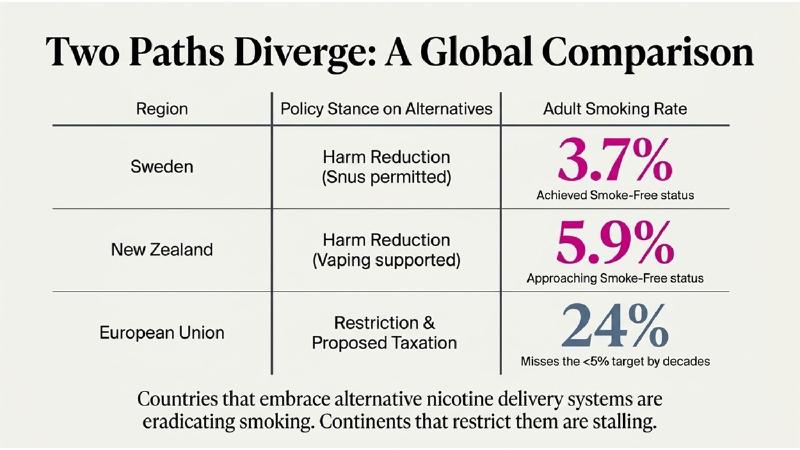
Sweden, which has allowed snus for years, has the lowest smoking rate in the EU at 3.7% (daily smoking). The United Kingdom has dramatically reduced smoking rates by supporting e-cigarettes as cessation tools. This is consistent with the idea that access to alternatives is linked to fewer smokers, and such a strategy can work in many other countries and regions.
How Europe compares#
Smoking is still much higher in the EU than in New Zealand. The latest Eurobarometer (2023) found that 24% of adults in the EU smoke. The EU has set a target for a “Tobacco-Free Generation” by 2040, meaning less than 5% smokers. New Zealand, at 5.9%, is almost there today.
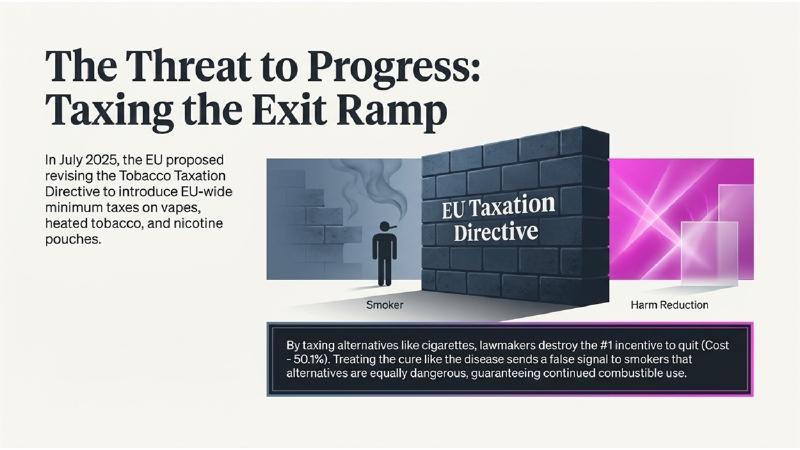
The European Commission is taking a different approach to novel nicotine products. Its July 2025 proposal to revise the Tobacco Taxation Directive will exponentially raise the minimum tax on cigarettes, but will also introduce high EU minimum taxes on e-cigarettes, heated tobacco products, and nicotine pouches for the first time. Treating products that help people quit smoking just like cigarettes removes the financial advantage that makes switching attractive, and sends smokers the message that e-cigarettes are just as dangerous as smoking. Europe has targeted smoking alternatives instead of using them in the fight against smoking, and New Zealand shows why this is a mistake. The tax proposal is still under negotiation. The European Parliament did not reach a final decision in June 2026, and the Council of the EU requires unanimity from all 27 member states. Sweden and other countries have resisted high minimum taxes on nicotine pouches in particular. Let’s hope they succeed.
Conclusions#
New Zealand is one of the strongest examples of what happens when a country lets vaping do part of the work of smoking cessation: daily smoking is down nearly two-thirds, vaping is the most common cessation aid, and there are now more former smokers who vape daily than people who smoke daily. The clinical evidence points in the same direction.
For Europe, where one in four still smokes, the lesson is that a policy targeted at smoking itself—supporting lower-risk alternatives for adults who smoke alongside strict rules for youth—deserves serious consideration before the EU decides how to treat these products.
Frequently Asked Questions#
What did people use to stop smoking in New Zealand?#
In their last quit attempt, 36.5% used vaping or e-cigarettes, 29.8% used nicotine replacement therapies such as patches or gum, and 33.4% used no aid. People could report more than one type of aid.
Is vaping the most common way people try to stop smoking?#
In the 2025/26 New Zealand Health Survey, yes: vaping (36.5%) was the most common aid used in the last quit attempt, ahead of nicotine replacement therapies (29.8%). The survey measures what people used, not how well it worked.
What percentage of New Zealanders smoke?#
In 2025/26, 5.9% of adults smoked daily, which is about 259,000 people. In 2011/12, it was 16.4%.
How many New Zealanders vape daily?#
About 11.2% of adults vape daily, according to the 2025/26 New Zealand Health Survey. This rate is similar to the previous two years.
Are most people who vape former smokers?#
Among daily vapers, yes: just over half (6.3% of all adults) are former smokers. About 1 in 6 daily vapers still smoke, and about 1 in 4 have never smoked.
Why do people vape in New Zealand?#
The top reasons given by daily vapers were that it is cheaper than tobacco (50.1%), to cut down on or stop smoking (46.1%), and to cope with stress, anxiety, or depression (41.8%).
Who is most likely to smoke in New Zealand?#
By age, people aged 45 to 54 (9.2%) and 55 to 64 (8.0%). Men (7.0%) are more likely to smoke daily than women (4.9%), and people in the most deprived neighborhoods (10.5%) are more likely than those in the least deprived (3.0%).
How many cigarettes do daily smokers smoke?#
An average of 8.7 cigarettes per day in 2025/26, down from 11.2 in 2011/12.
How does New Zealand compare with Europe?#
In the 2023 Eurobarometer, 24% of people in the EU smoked (daily or occasionally), and about 21% smoked daily according to the EU’s own estimate. The daily smoking rate in New Zealand is 5.9%.
Source#
The data come from the Ministry of Health, Manatū Hauora, Smoking and vaping: 2025/26 New Zealand Health Survey, published on November 18, 2026, covering adults aged 15 and over. More information is available on the New Zealand Health Survey page and in the Annual Update of Key Results 2025/26.