


The international Society for Research on Nicotine and Tobacco (SRNT) recently published in JAMA its recommendations for U.S. clinicians on e-cigarettes and smoking cessation. Here, I examine the scientific, clinical, and ethical foundations behind these guidelines. They mark a landmark shift toward active harm reduction for adult smokers in the United States, weighing robust clinical trial evidence against complex public health values.
Why were new recommendations for e-cigarettes & smoking cessation needed?#
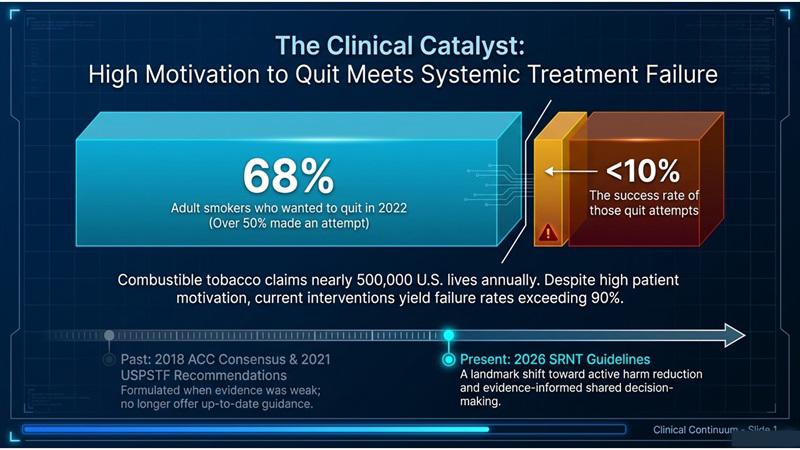
Combustible tobacco remains the leading cause of preventable death in the U.S., claiming nearly 500,000 lives each year. Although over 68% of adult smokers wanted to quit in 2022 and more than half attempted to do so, fewer than 10% succeeded. This high failure rate highlights the need to broaden the clinical toolkit with alternative strategies.
In response, the Society for Research on Nicotine and Tobacco (SRNT) Treatment Research Network (TRN) assembled a Harm Reduction Workgroup. Launched in July 2024 by TRN co-chairs Dr. Alana M. Rojewski and Dr. Adrienne L. Johnson, the 24-member group convened in February 2025 to address a critical gap in clinical guidance.
Current U.S. guidelines — such as the 2018 American College of Cardiology consensus and 2021 U.S. Preventive Services Task Force recommendations — were formulated when evidence on e-cigarettes was far weaker. These outdated frameworks no longer offer clinicians up-to-date guidance. With patients highly interested in e-cigarettes and already asking about them, the SRNT created these recommendations to provide structured, evidence-informed direction and standardize shared decision-making.
What is the scientific evidence supporting the efficacy of e-cigarettes for smoking cessation?#
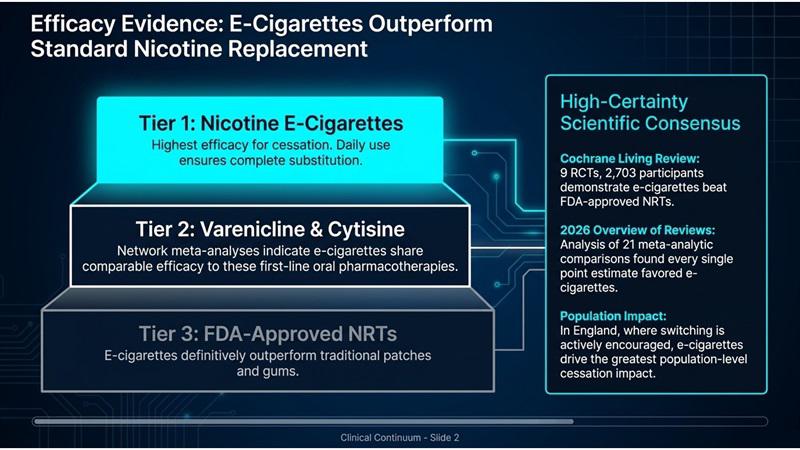
The main justification for the SRNT recommendations is strong scientific evidence showing that nicotine e-cigarettes are highly effective for smoking cessation. The Cochrane living systematic review, updated monthly, provides high-certainty evidence from nine randomized clinical trials (2,703 participants) demonstrating that nicotine e-cigarettes outperform FDA-approved nicotine replacement therapies (NRTs) for quitting smoking.
This evidence is remarkably consistent. A 2026 overview of reviews analyzing 21 meta-analytic comparisons found that every point estimate favored e-cigarettes. Moreover, a network meta-analysis indicates that e-cigarettes have comparable efficacy to other first-line pharmacotherapies, such as varenicline and cytisine. In observational cohorts, daily e-cigarette use is consistently linked to higher smoking cessation rates, underscoring the importance of regular use for complete substitution. In England, where health campaigns actively encourage adult smokers to switch, e-cigarettes have had the greatest population-level impact on smoking cessation in recent years.
How does the safety profile of e-cigarettes compare to combustible tobacco?#
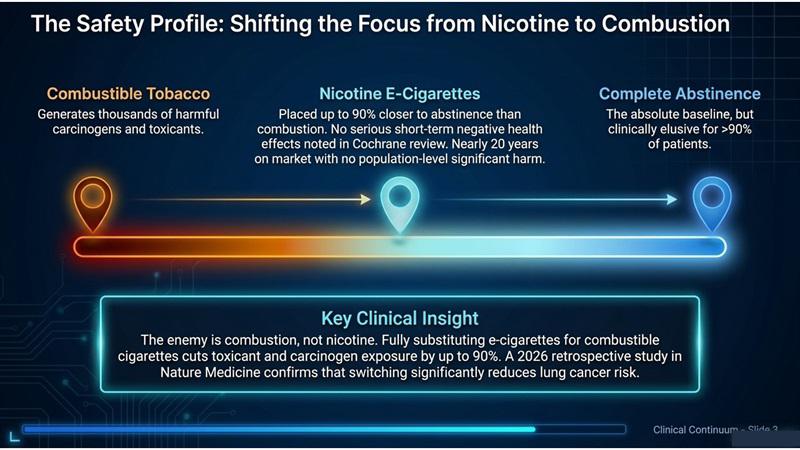
Safety is a top concern for clinicians. The SRNT addresses this by positioning e-cigarettes on a “continuum of risk.” The scientific consensus is clear: while no nicotine product is entirely harmless, the primary driver of tobacco-related disease is combustion, not nicotine. Burning tobacco produces thousands of harmful carcinogens and toxicants.
Fully substituting e-cigarettes for combustible cigarettes dramatically cuts exposure to these harmful substances. Biomarker studies show that toxicant and carcinogen exposure in exclusive vapers is substantially lower than in traditional smokers — in some cases up to 90% lower. The Cochrane living review found that nicotine e-cigarettes do not appear linked to serious short-term negative health effects. While long-term safety data (beyond 2 years) are not yet available, e-cigarettes have been on the market for nearly 20 years without population-level evidence of significant harm. A 2026 retrospective study in Nature Medicine found that switching to vaping significantly reduced lung cancer risk. For adult smokers, transitioning completely to e-cigarettes represents a profound reduction in physiological harm.
Why are public & clinician misperceptions about e-cigarettes so widespread?#
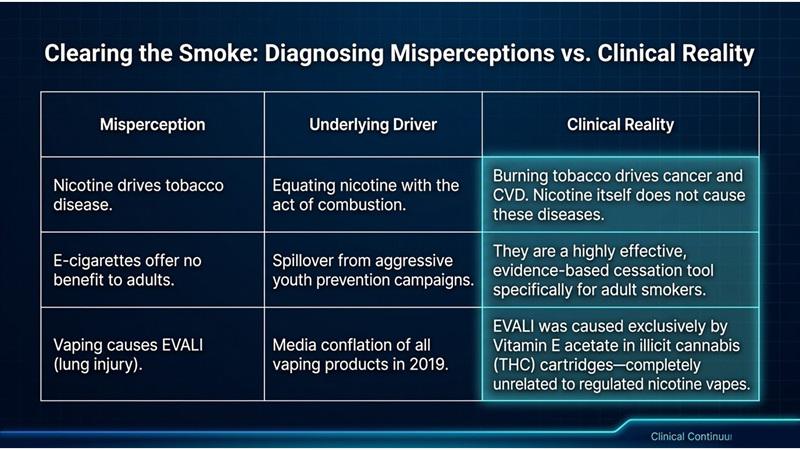
Despite scientific evidence of reduced harm, public and clinician perceptions of e-cigarettes have grown increasingly negative, deterring adult smokers from switching. The SRNT identified three main factors driving these widespread misperceptions.
First, there is fundamental confusion about nicotine, with many wrongly attributing smoking-related cancers and cardiovascular diseases to nicotine rather than tobacco combustion. Second, public health messages aimed at discouraging youth e-cigarette use have had the unintended consequence of confusing adult smokers, who misinterpret these warnings as meaning e-cigarettes offer no benefit for adults. Third, misunderstandings persist about the 2019 vaping-associated lung injury (EVALI) outbreak. While the public often associates EVALI with standard nicotine e-cigarettes, scientific investigations proved the outbreak was caused by vitamin E acetate, a harmful thickening agent used in illicit, adulterated cannabis (THC) vaping cartridges — completely unrelated to regulated nicotine vapes.
How are e-cigarettes regulated in the U.S.?#
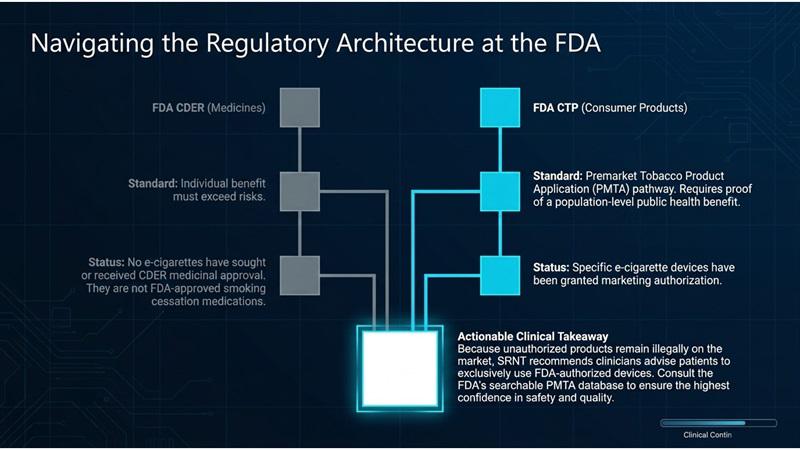
The regulatory landscape in the United States poses a unique challenge for clinicians, which the SRNT guidelines carefully clarify. Unlike traditional NRTs, regulated as medicinal products by the FDA’s CDER under a strict standard requiring individual benefits to exceed risks, e-cigarettes are not
FDA-approved smoking cessation medications. No manufacturer has sought CDER approval.
Instead, e-cigarettes are regulated as consumer tobacco products by the FDA’s Center for Tobacco Products (CTP). Through the PMTA pathway, the CTP grants marketing authorization (not medicinal approval) to specific devices based on a population-level public health standard, determining that the product’s overall benefit to the population outweighs its potential harms. Because unauthorized products remain on the U.S. market illegally, the SRNT recommends that clinicians advise patients to use only FDA-authorized devices. Consulting the FDA’s searchable database gives clinicians and patients the highest possible confidence in product safety and quality.
What is the ethical and philosophical rationale for tobacco harm reduction?#
The e-cigarette debate is fundamentally a values issue about treatment priorities: is the primary goal complete nicotine abstinence, or is it reducing the risks of smoking-related disease? If complete abstinence is the sole priority, reluctance to recommend e-cigarettes is understandable. However, the SRNT adopts a pragmatic harm reduction framework, acknowledging that quitting smoking is exceptionally difficult and most attempts fail.
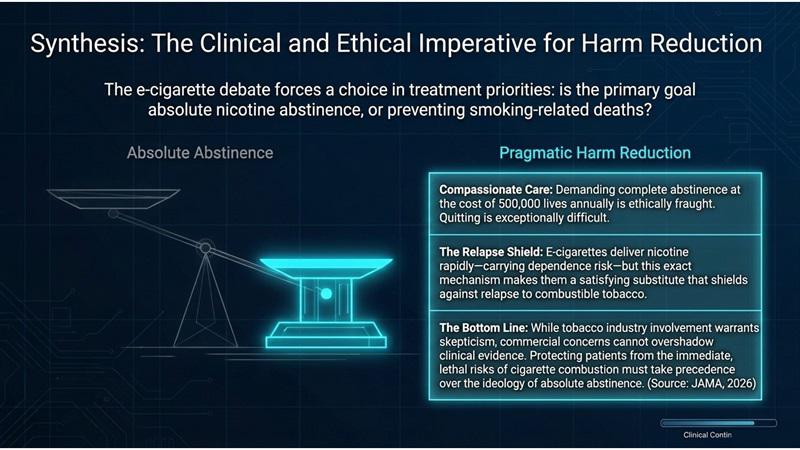
Encouraging adult smokers to switch to e-cigarettes represents a compassionate, evidence-based approach, akin to public health harm reduction strategies used for illicit drug use. While e-cigarettes deliver nicotine rapidly — carrying a risk of greater dependence than NRTs — this rapid delivery is precisely what makes them a satisfying and effective substitute, protecting against relapse. Finally, the SRNT addresses the ethical complexity of tobacco industry involvement. The industry owns many authorized e-cigarette brands, and its history of deception warrants skepticism. Yet the workgroup concludes that commercial concerns must not overshadow the clear evidence that e-cigarettes save lives. Clinical pragmatism dictates that protecting patients from the immediate, lethal risks of cigarette combustion must take precedence.
Sources:
Leavens ELS, Pebley K, Smith TT, et al. Nicotine E-Cigarettes for Cigarette Smoking Cessation: Recommendations to US-Based Clinicians. JAMA, 2026.
Hartmann-Boyce J. Physician Advice on E-Cigarettes for Smoking Cessation: Differentiating Evidence From Values. JAMA, 2026.