


"Popcorn lung"—bronchiolitis obliterans—is a rare, serious, irreversible lung disease that destroyed the airways of popcorn-factory workers. That’s how the disease got its name; it’s not because lungs look like popcorn on an X-ray (a claim that circulates occasionally). The cause was traced to a natural flavoring agent used in factories at the time: diacetyl.
The popcorn-lung story became a favorite horror tale on social media and beyond. Between the fairy tale and reality lies a gap few have tried to bridge.
The Diacetyl Comparison Everyone Ignores#
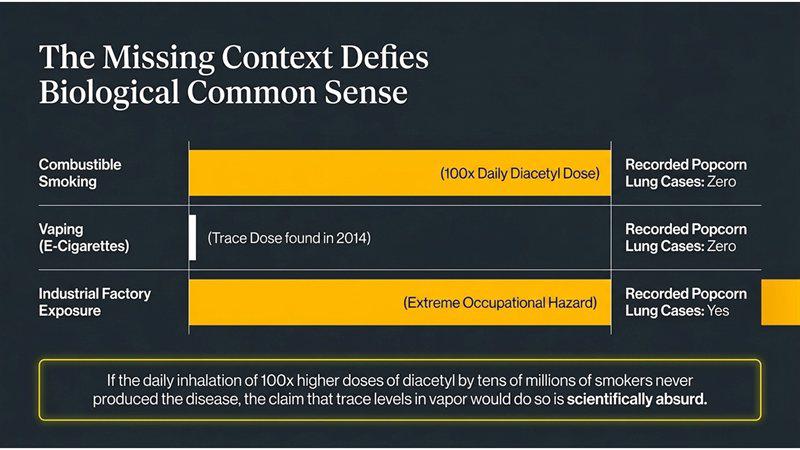
My study was the first to flag the issue and detect diacetyl in e-cigarette liquids. Comparing vaping to smoking in 2014, I found that a smoker inhales, on average, about 100 times more diacetyl daily than a vaper using liquid with the diacetyl levels I measured. Yet despite decades of research on millions of smokers, popcorn lung has never been identified as a smoking-related disease. If daily inhalation of far higher diacetyl doses by tens of millions of smokers never produced the disease, claiming the much lower levels I found in vapor would do so defies common sense.
The Market’s Response That Regulation Never Provided#
Diacetyl was never banned through EU regulatory measures. A complete ban would likely be unworkable. First, diacetyl is a natural substance present in many foods (dairy, alcoholic beverages, butter, cocoa, coffee, etc.). Trace residues—negligible amounts—may exist in preparations that don’t use diacetyl as an ingredient.
However, after our study identified diacetyl in e-cigarette liquids for the first time, major manufacturers removed it from their products voluntarily. No such move happened with cigarettes—which still deliver far more diacetyl to smokers than any e-liquid. Even that can’t change, since diacetyl appears to be both a natural tobacco-plant component and a combustion byproduct.
Anatomy of a Scary Story#
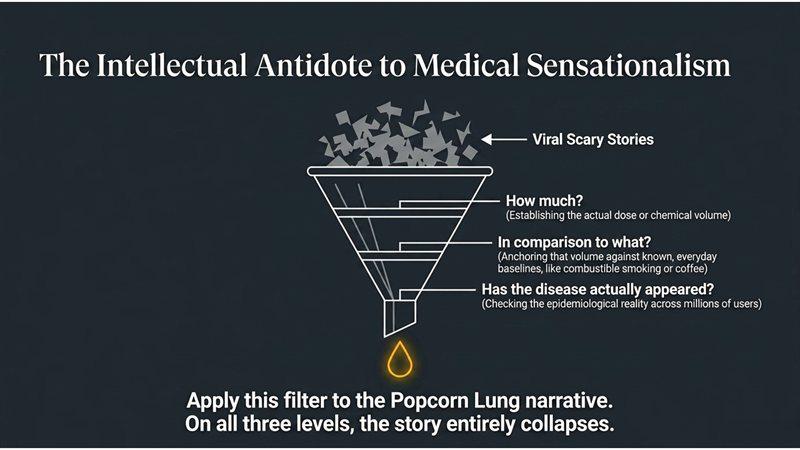
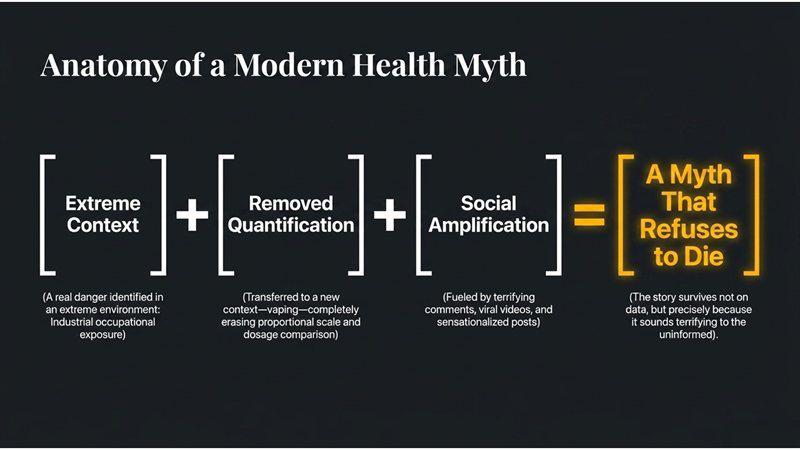
The popcorn-lung narrative illustrates a pattern we see repeatedly: a real danger identified in an extreme context (industrial occupational exposure) gets transferred without quantified comparison to another context (vaping), amplified by terrifying comments, videos, and posts, and becomes a story that lacks common sense. The result is a myth that refuses to die precisely because it sounds terrifying. Next time, ask three simple questions: how much? Compared to what? Has the disease actually appeared? In all three, the popcorn-lung story collapses.