


Nicotine Replacement Therapy (NRT) represents one of the most significant pharmacological advances in public health and tobacco control. For smokers seeking a medically supervised path to a smoke-free life, NRT provides a way to manage withdrawal symptoms without the thousands of toxic chemicals in tobacco smoke. By delivering nicotine in controlled doses, NRT helps individuals break the physiological addiction to cigarettes. Here are five key points on the nature, history, and function of NRT.
1. From Swedish Submarines to the Global Market#
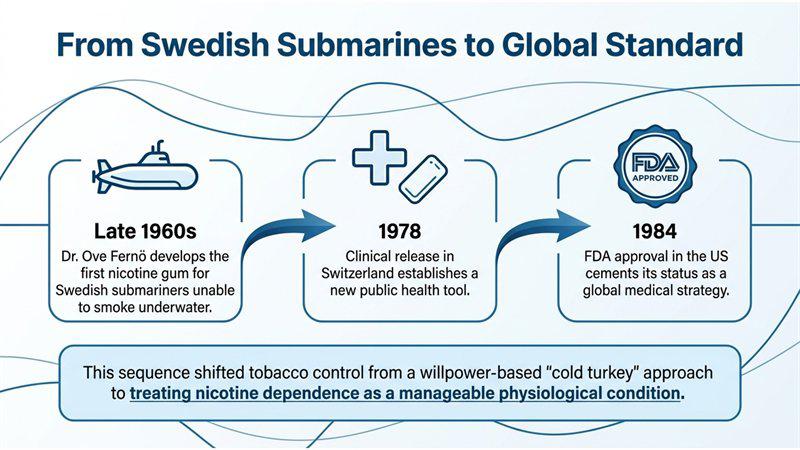
NRT’s history began in the late 1960s in Sweden. Dr. Ove Fernö, a researcher at Leo AB, was approached by the Swedish Navy to help submariners who couldn’t smoke while submerged. In response, Fernö developed the first nicotine-infused chewing gum (Nicorette), designed to deliver nicotine through the mouth lining.
After extensive clinical trials, the gum launched in Switzerland in 1978 and received FDA approval in the United States in 1984. This marked a shift in tobacco control, moving from a “cold turkey” approach to a “medicalized” strategy treating nicotine dependence as a manageable physiological condition.
2. The Diversity of Delivery: Forms of NRT#
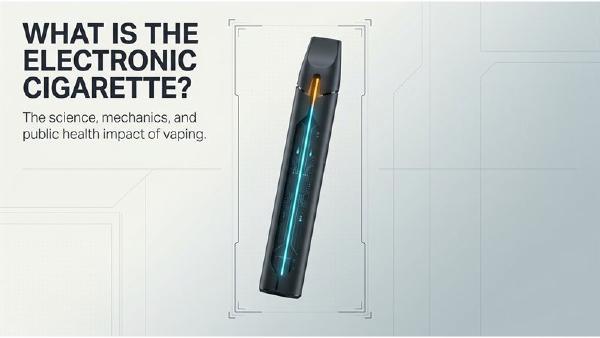
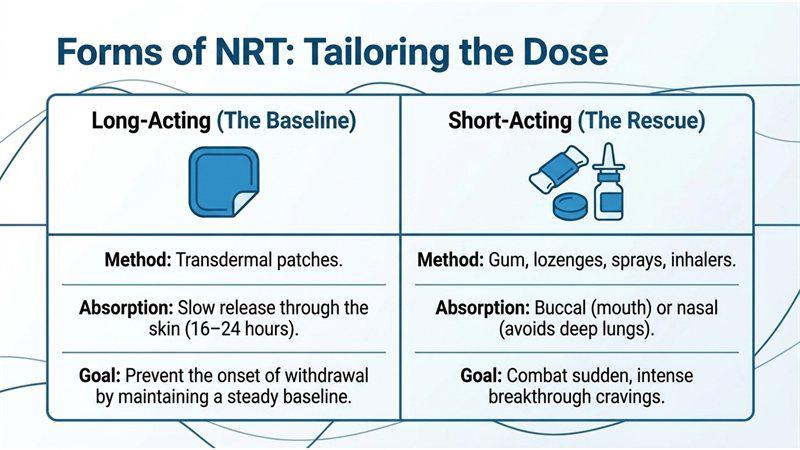
Unlike electronic cigarettes, which rely on vaporization, NRT comes in several pharmaceutical forms suited to different dependence levels. These fall into two categories:
- Long-Acting: Transdermal patches provide a steady, slow nicotine release through the skin over 16 to 24 hours, creating a “baseline” level to prevent withdrawal.
- Short-Acting: Used for sudden “breakthrough” cravings. These include nicotine gum, lozenges, nasal sprays, and oral inhalers. They rely on buccal (mouth) or nasal absorption rather than deep-lung inhalation.
3. How Does It Work?#
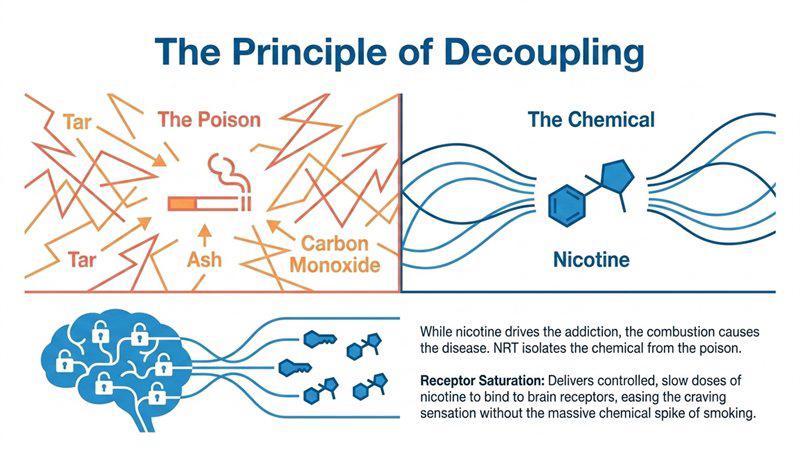
The basic principle of NRT is decoupling nicotine from the toxic substances produced by combustion. While nicotine is the addictive component, it’s the tar, ash, and carbon monoxide in cigarette smoke that cause the vast majority of smoking-related diseases.
- Receptor Saturation: NRT provides just enough nicotine to bind to nicotinic receptors in the brain, easing the “craving” sensation.
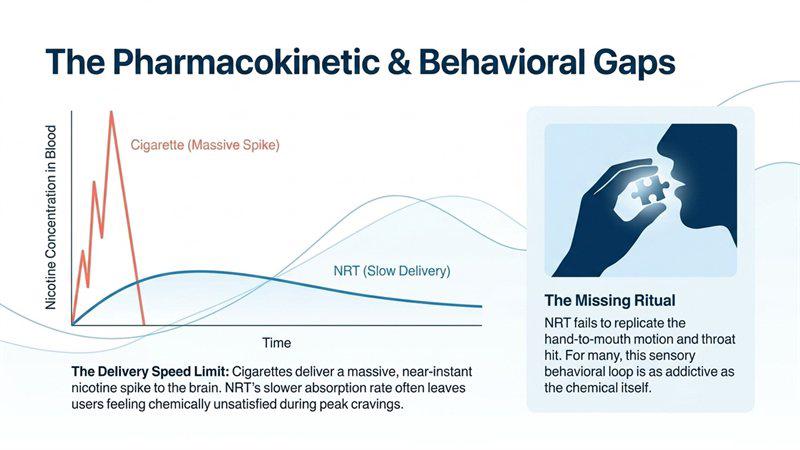
- Controlled Absorption: Unlike a cigarette, which delivers a massive nicotine spike to the brain within seconds, NRT delivers nicotine much more slowly. This makes the therapy itself significantly less addictive than smoking.
4. Disadvantages: The Behavioral and Physiological Gap#
Unfortunately, NRT has notable limitations compared to other alternatives that substantially reduce its efficacy.
- Lack of Ritual: NRT fails to replicate the “hand-to-mouth” motion and “throat hit” many smokers find essential. For many, the ritualistic and sensory aspects of smoking are just as addictive as the nicotine itself.
- Pharmacokinetics: The most significant disadvantage is delivery speed. A cigarette provides a rapid, high-peak nicotine concentration in the blood almost instantly. NRT delivers much lower levels at a significantly slower rate. This often leaves the user feeling “unsatisfied” during the most intense craving moments.
5. The Verdict: Efficacy and Harm Reduction#
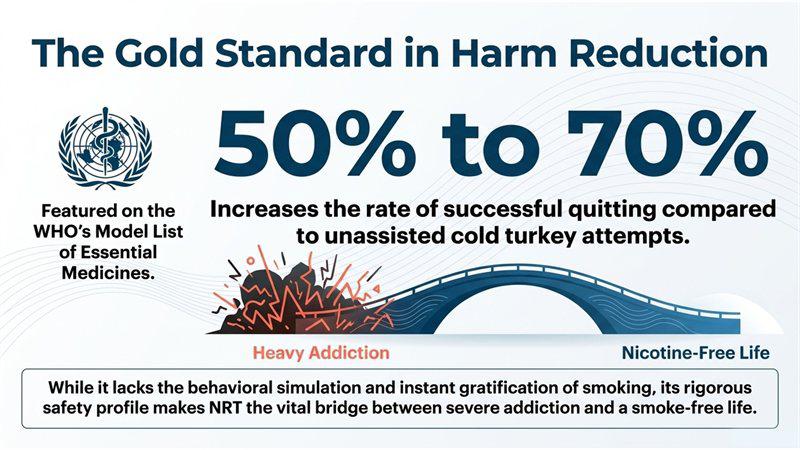
NRT appears on the World Health Organization’s (WHO) Model List of Essential Medicines. Clinical research confirms that using NRT increases successful quitting rates by 50% to 70% compared to unassisted attempts.
While NRT may lack the immediate satisfaction or behavioral simulation of a cigarette, it remains the gold standard for clinical cessation due to its rigorous regulation and safety profile. It is a vital tool for Tobacco Harm Reduction, bridging the gap between heavy addiction and a nicotine-free life.